

Within the framework of the Ocean Future 2025 Conference in Khanh Hoa, organized recently by the University of Economics Ho Chi Minh City in collaboration with the People's Committee of Khanh Hoa province, the discussion session "Co-innovation for a Sustainable Ocean Economy" focused on innovative, interdisciplinary, and multi-stakeholder collaborative approaches to promote the sustainable development of the Ocean Economy. The session emphasized the role of stakeholder participation, comprehensive governance, and the integration of modern economic models – such as the circular economy, socio-economics, green finance, and community economy – into the strategy for developing the sea and coastal areas.
Europe and the lag in maritime policy priorities: Causes and cumulative consequences.
Opening the session, Professor Giovanni Quaranta and Professor Rosanna Salvia – two experts from the Department of Mathematics, Computer Science and Economics, University of Basilicata (Italy) – shared exemplary models in Europe for promoting a sustainable ocean economy with the aim of "leaving no one behind".
Although the European Union (EU) has been in existence for nearly 80 years, issues related to the sea and coastal areas have only truly received priority in the last two decades. This stems from the fact that coastal areas were previously not considered a policy priority, even though more than 40% of Europe's population lives along the 136,000km coastline. As a result, imbalances in territorial governance have accumulated over time, manifested in increased environmental pressure, a monolithic economic structure based on resource exploitation, and social challenges for small-scale fishing communities.
Starting from the community: How the EU is recreating a sustainable future for coastal regions.
Recognizing the persistent policy gaps and the accumulating negative consequences in coastal regions, the EU has embarked on a journey to reinvent the future of development starting from the local communities. This new strategy is shaped by three core pillars:
(1) enhance the sustainability of the local economy;
(2) Restoration and conservation of marine ecosystems;
(3) improve the quality of life of the indigenous people.
In this approach, "innovation" is no longer understood purely as technology, but is expanded to encompass social innovation, emphasizing the participation and central role of the community – consistent with the complexity of the maritime economic space, where people, livelihoods, and ecosystems are closely intertwined.
According to the two professors, endogenous development – that is, development based on indigenous resources, values, and knowledge – is key to long-term sustainable transformation. This requires restoring confidence in the capacity of communities, placing them in a position to co-create solutions rather than merely being beneficiaries of policies. The EU's new step is towards a neo-endogenous model, in which coastal communities are connected into networks to share experiences, support each other, and enhance their resilience to global challenges.
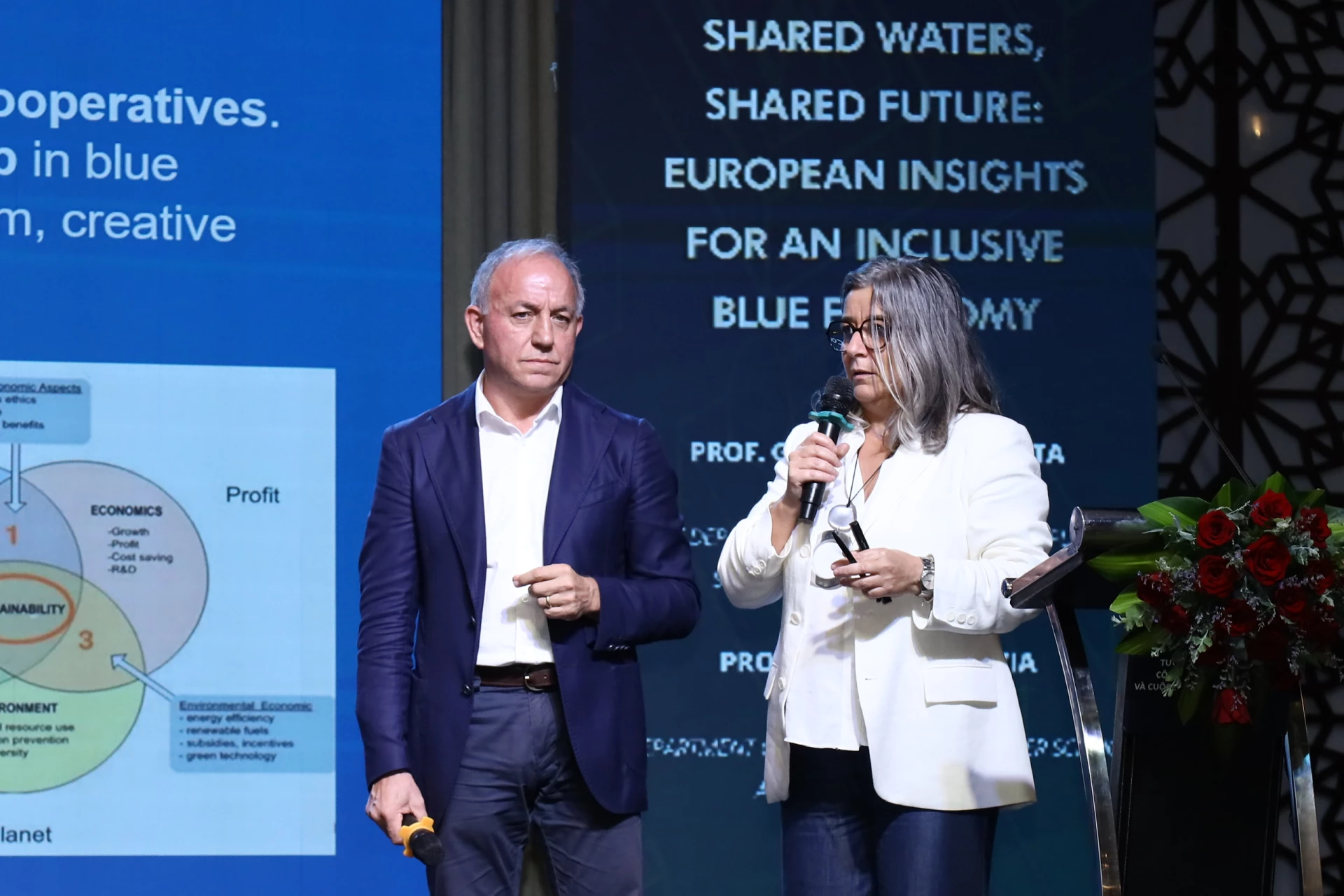 |
| Professor Giovanni Quaranta and Professor Rosanna Salvia presented at the panel discussion. Source: UEH (ISCM, October 2025) |
From Mediterranean practices to new thinking directions for sustainable marine development.
The above analysis has been vividly demonstrated through practical implementation in Southern Italy, with a project supporting the formation of a social cooperative for local fishermen. This area had previously faced a severe decline in fish stocks, with average nightly catches falling from around 200 kg to less than 10 kg. The application of a co-management model for resources and sustainable livelihood transformation created a significant turning point: catches recovered to approximately 60 kg per night. This result shows that when communities are empowered, participate in decision-making, and co-create solutions, the resilience of the ecosystem can be powerfully activated.
The experiences of Mediterranean coastal communities simultaneously demonstrate that social innovation and enhanced community cohesion only truly produce long-term impact when placed in an organic link with urban and inland systems. Multi-stakeholder cooperation mechanisms – between communities, governments, research institutions, and the private sector – are helping the EU gradually overcome previously existing policy gaps, forming a modern model of coastal governance where the sea is seen not only as a source of livelihood, but also as a space for culture, history, and environmental security.
Overall, the presentation emphasized a new way of thinking: Coastal development can only be sustainable when local communities play a central role in the entire process of policy planning, implementation, and monitoring. When this principle is ensured, new solutions have the potential to create lasting, widespread, and harmonious value for both coastal communities and the entire marine economic space.
Marine Spatial Planning (MSP) – a multidisciplinary tool for optimizing resources and reducing conflicts.
In his presentation, Dr. Ho Quoc Thong, Coordinator of the Blue Resources for Development (BlueRforD) Program, provided an overview of Marine Spatial Planning (MSP), a multidisciplinary governance tool being implemented globally. BlueRforD is an international research network bringing together scholars from 9 countries across 3 continents to study issues related to fisheries and aquaculture, marine spatial structure, as well as their impact on poverty reduction, gender equality, and sustainable coastal resource management.
Dr. Thong emphasized that MSP is a key tool for efficient resource utilization, reducing conflicts of interest, promoting green economic development, and shaping the future structure of marine spatial development. This work involves not only resource management but also addressing complex issues such as cross-border cooperation, maritime security, and the "shared resource tragedy."
Through the analysis of nearly 180 international scientific works and reports from the World Bank and the United Nations, the research team found many prominent themes similar to those discussed at the workshop, including: marine governance, co-creation, policy frameworks, resource management, and technology application. Marine Special Policies (MSPs) are currently being strongly implemented in Europe, the United States, Australia, and South Africa, while many Asian and African countries still face limitations in data, research capacity, and institutions, highlighting the importance of evidence-based and locally tailored policies.
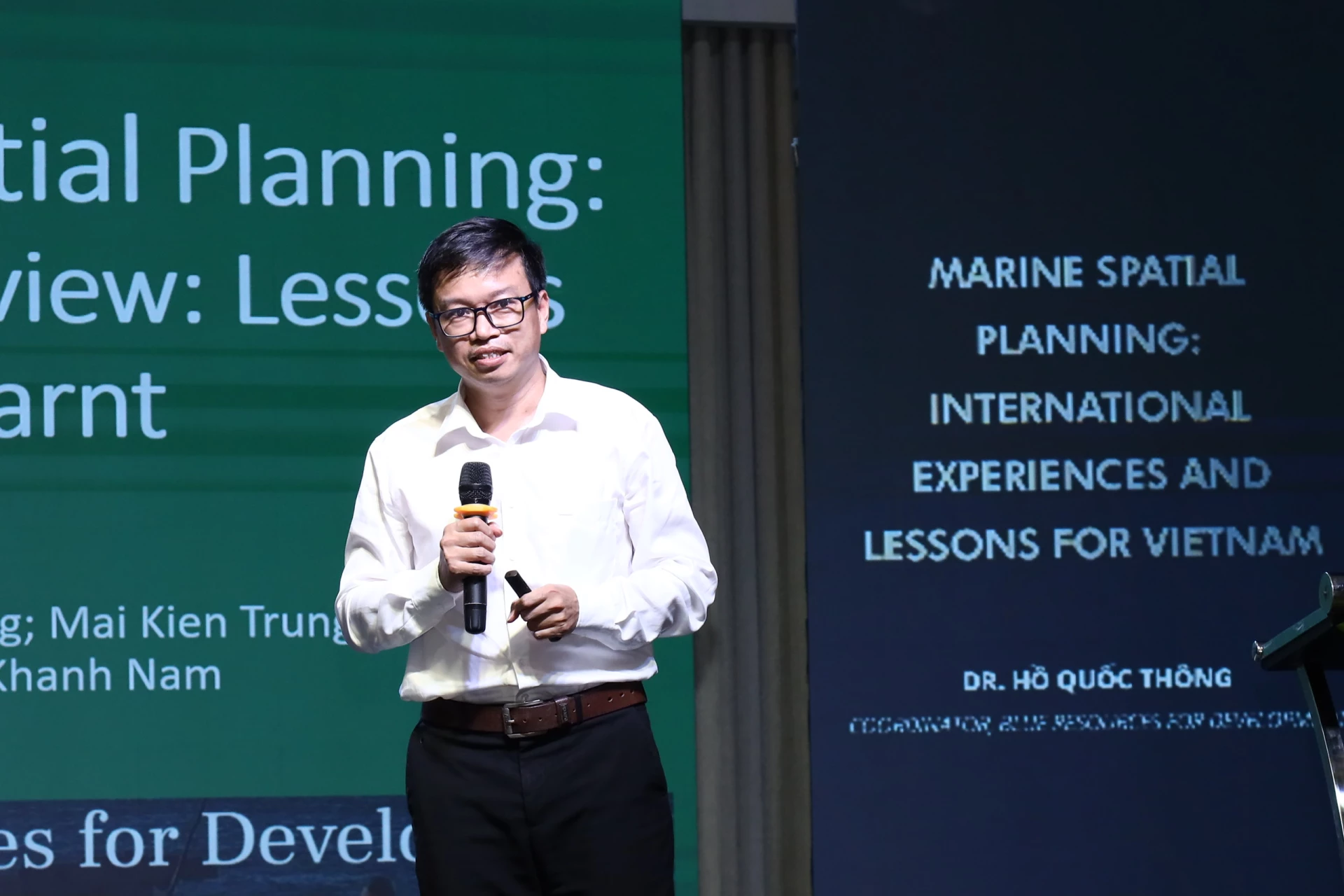 |
| Dr. Ho Quoc Thong, Coordinator of the BlueRforD Program, shared research on MSP. Source: UEH (ISCM, October 2025) |
Unlocking Vietnam's maritime economic potential through strategy and MSP.
Regarding Vietnam, Dr. Ho Quoc Thong noted significant progress in perfecting the policy framework, most notably Resolution No. 36/2018 of the 12th Central Committee of the Communist Party of Vietnam on the Strategy for Sustainable Development of the Marine Economy. The goals for 2030 include: the purely marine economy contributing approximately 10% of GDP, coastal provinces contributing 65-70% of GDP, expanding the area of marine protected areas, reducing conflicts in the use of marine space, protecting ecosystems and cultural-historical values, while strengthening security and sovereignty.
Based on international experience, the group proposes several priority directions for Vietnam and coastal localities: Strengthening early participation and cooperation of stakeholders, valuing indigenous knowledge, developing a unified marine spatial data infrastructure, implementing adaptive planning models, enhancing transparency in governance, and training multidisciplinary human resources in ecology, economics, law, and spatial analysis.
In conclusion, the MSP is seen as a dynamic and sustainable governance cycle, operating based on scientific evidence and the co-creation of the community. This is an important foundation for Vietnam to effectively exploit its marine economic potential, aiming for harmonious and sustainable ocean governance in the long term.
From marine waste to green materials: The potential applications of seashells.
Dr. Riley Pham Xuan Quyet, lecturer at Sunway University (Malaysia) and PhD in Sustainable Hotel and Tourism Management at UEH, presented his research on the application of seashells in coastal urban construction and development, particularly for hotels and tourism. Approximately 40% of the world's population lives within 100km of the coast, creating a high demand for coastal infrastructure, but many "green" constructions still rely on cement and steel – the construction industry accounts for 27% of global CO₂ emissions, with cement alone accounting for about 8% (UNEP, 2023).
In this context, seashells – waste from over 10 million tons of seafood annually – emerge as a potential green material. In Vietnam, abundant seafood resources provide a plentiful supply of raw materials for research and applications. Seashells are rich in calcium carbonate, mechanically durable, capable of self-healing cracks, improve thermal insulation, and reduce the need for paint. Several models in Japan, the Netherlands, and the Philippines have demonstrated feasibility in construction and interior decoration, opening up opportunities to transform marine waste into sustainable materials for coastal development.
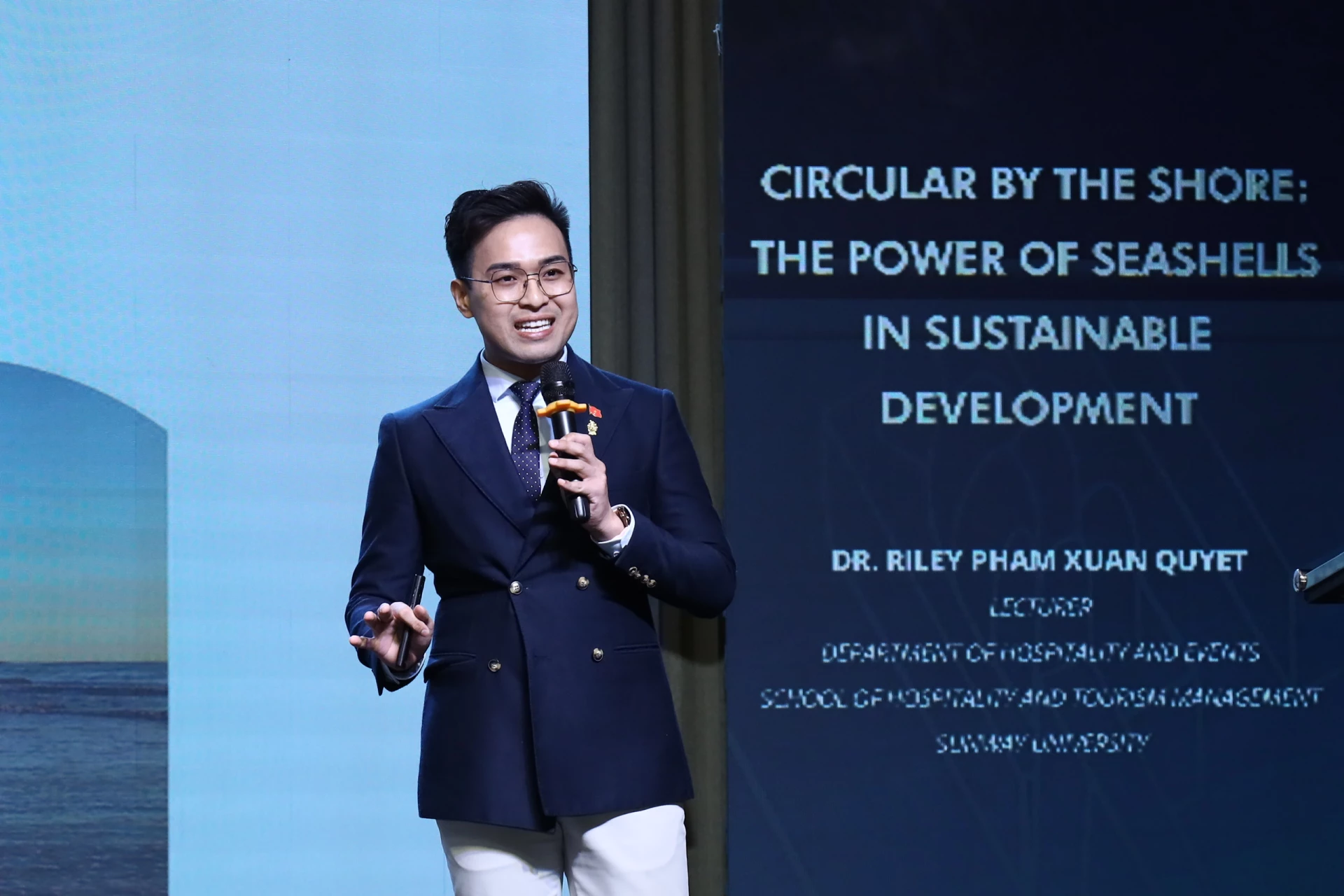 |
| Dr. Riley shared insights on potential green materials during the panel discussion. Source: UEH (ISCM, October 2025) |
Seashell materials in Vietnam: Pilot projects, challenges, and a sustainable vision.
In Vietnam, research proposals focus on developing a set of standards for eco-hotels using materials derived from seashells, along with pilot programs at pioneering coastal hotels and resorts based on the "smart materials from the ocean" approach. This approach supports the implementation of the United Nations Sustainable Development Goals (SDGs): SDG 11 (sustainable cities and communities), SDG 12 (responsible consumption and production), and SDG 14 (marine resources and environment).
However, Dr. Riley also pointed out the challenges Vietnam needs to overcome: issuing technical standards, developing a raw material collection and processing chain, and improving the readiness to apply new materials in the construction industry. Multi-stakeholder collaboration projects and interdisciplinary research are key conditions for promoting the application process.
In conclusion, Dr. Riley expressed his hope that Vietnam would become a pioneering country in recycling seashells for sustainable construction, reducing carbon emissions, and developing environmentally friendly and innovative coastal tourism models.
Text and photos:
Institute of Smart Cities and Management (ISCM) - University of Economics Ho Chi Minh City
This article is part of a series spreading research and applied knowledge with the message "Research Contribution For All," a collaboration between UEH and Khanh Hoa Newspaper, Radio, and Television, aiming to support the sustainable development of Khanh Hoa province. UEH cordially invites readers to watch the next Scientific Knowledge Newsletter.
Source: https://baokhanhhoa.vn/ueh-nexus-nha-trang/202512/dong-doi-moi-sang-tao-cho-nen-kinh-te-dai-duong-ben-vung-eff61e0/













![[Photo] Prime Minister Pham Minh Chinh holds a phone call with the CEO of Russia's Rosatom Corporation.](/_next/image?url=https%3A%2F%2Fvphoto.vietnam.vn%2Fthumb%2F1200x675%2Fvietnam%2Fresource%2FIMAGE%2F2025%2F12%2F11%2F1765464552365_dsc-5295-jpg.webp&w=3840&q=75)













































Comment (0)