

 |
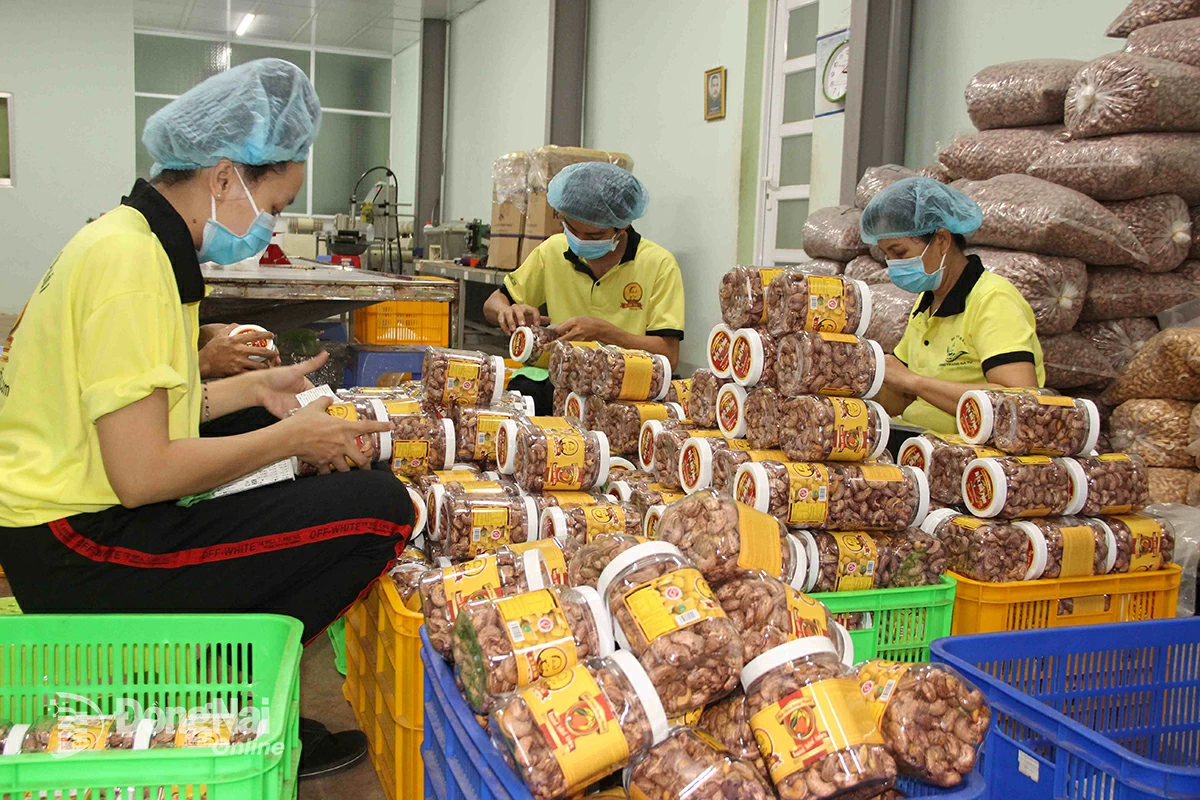
| Cashew processing at Gia Bao Group Joint Stock Company ( Binh Phuoc ward). Photo: DONG KIEM |
Thanks to the advantage of having a large raw material area, Dong Nai has attracted many corporations and enterprises to invest in the fields of preservation, preliminary processing, and processing associated with the raw material area. Thanks to that, the export turnover of the above key industrial products is among the top in the country.
Largest area in the country
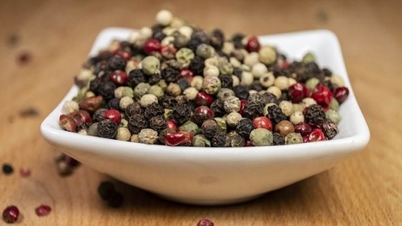
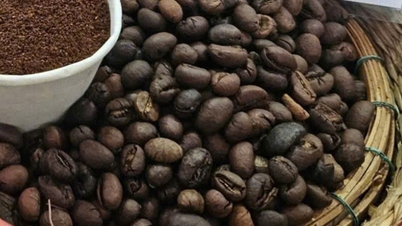
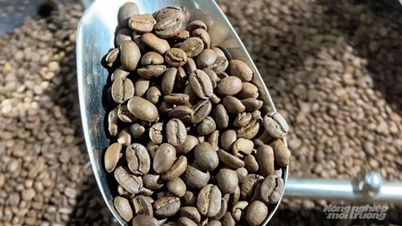
With an area of over 438,000 hectares, the former Binh Phuoc province had one of the largest areas of industrial clusters in the country. Among these, some crops had the largest cultivated areas nationwide, such as rubber trees (nearly 245,000 hectares) and cashew trees (nearly 150,000 hectares). In addition, other large industrial clusters included coffee (nearly 14,300 hectares) and pepper (nearly 11,000 hectares).
According to the Project for the Development of Key Industrial Clusters in Binh Phuoc Province (formerly) until 2030, the province will maintain and develop the area of four key industrial clusters: coffee, rubber, cashew, and pepper, with a total area of over 356,000 hectares. Although the area of these crops has decreased significantly compared to the present, their value has increased considerably. The goal is to strive for a total export value of products from the province's four key industrial clusters reaching 450 million USD by 2030.
Dong Nai province is expanding intercropping models of perennial industrial crops such as coffee and cashew, cocoa and cashew… In these models, the crops complement each other, helping to reduce investment costs while increasing productivity and profits many times compared to monoculture cashew farming.
Dong Nai province (old) also has many advantages in developing long-term industrial parks with an area among the top in the country with nearly 93,200 hectares. Of which, rubber area reaches 40,000 hectares, cashew trees reach nearly 28,000 hectares, pepper is about 10,000 hectares, coffee is more than 6,000 hectares...
Looking ahead to 2030, Dong Nai will continue to develop its key industrial clusters, including rubber, cashew, coffee, and pepper. The specific target is to reduce these clusters to approximately 77,100 hectares by 2030, a decrease of tens of thousands of hectares compared to the present, while maintaining high production levels thanks to the comprehensive application of scientific and technological advancements in production.
In order to enhance the added value of key industrial clusters in the coming time, Dong Nai province is orienting itself to promote linkages in production areas along the value chain on a large scale, associated with the development of processing industries, deep processing, product diversification, and consumer markets.
Increase your competitive advantage in the export market.
In 2024, Vietnam will have 7 agricultural products/groups with export turnover of more than 3 billion USD, of which the industrial cluster sector has 3 products including: coffee 5.4 billion USD; cashew nuts nearly 4.4 billion USD; rubber nearly 3.5 billion USD. In addition, pepper products have officially returned to the "billion-dollar club" after many years of absence when reaching a turnover of 1.3 billion USD. The above industrial clusters will continue to be Vietnam's key export commodity groups in the coming time.
As an industrial province, Dong Nai (formerly) has the advantage of attracting many corporations and businesses to invest in deep processing and exporting key industrial products. In 2024, the export turnover of agricultural, forestry, and aquatic products in the province reached 3.7 billion USD, an increase of 17% compared to the same period in 2023. Of which, coffee exports reached nearly 912.7 million USD; cashew nuts over 510.9 million USD; rubber over 79.2 million USD; and pepper nearly 72.9 million USD.
Accordingly, the rubber, coffee, cashew, and pepper groups remain strong agricultural products included in the list of 15 key national agricultural products. These are also the key crops that Dong Nai province will focus on developing in the direction of safe production, increasing export advantages to demanding markets.
According to a representative of Olam Vietnam Co., Ltd. (Bien Hoa 2 Industrial Park), the company is currently exporting approximately 40,000 tons of cashews annually, including to demanding markets such as Europe and the United States. The export market potential for this product remains very large, so the company is very interested in connecting with large-scale cashew production areas. The company has many policies to support farmers in establishing specialized cashew growing areas that meet safety standards and organic production zones, as export market standards are becoming increasingly stringent.
Binh Phuoc Province (old) has attracted 10 cashew processing and exporting enterprises to join in association with 38 cooperatives (HTX), with an area of about 4,500 hectares, and an organic cashew chain of about 3,500 hectares. With pepper, the province has also formed a chain of nearly 2,500 hectares.
The Trang Co Bu Lach Organic Cashew Cooperative (Tho Son commune) has 160 members, mainly ethnic minorities, cultivating over 1,700 hectares of cashew trees. The entire cashew growing area follows organic farming practices, and the produce is purchased at a price 500-1,000 VND/kg higher than the market average. Therefore, for each hectare of cashew trees, members receive 700,000 VND in support for fuel and grass cutting. Thanks to this profit-sharing system, the area of organic cashew cultivation by cooperative members is continuously expanding.
Ms. Thi Khoi, Director of the Trang Co Bu Lach Organic Cashew Cooperative, shared: “Our cashews are available in 34 countries worldwide through direct cooperation with foreign partners. They come to our orchards to collect water, soil, fruit, and leaf samples. Thanks to the application of organic farming methods, all indicators after analysis meet European standards. The merger of Binh Phuoc and Dong Nai into the new Dong Nai province opens up even greater export opportunities, increasing the value of cashews for our ethnic minority people and improving their economic lives.”
Sharing the same view, Hoang Hong Tien, Director of Bazan One-Member Limited Company (Phuoc Son commune), commented that after the merger into the new Dong Nai province, a vast space for cashew processing and export will open up thanks to the large number of businesses in Dong Nai. He hopes that the cashew export market, as well as the cashew brand from the red basalt soil region of Dong Nai, will strongly expand globally, bringing prosperity and happiness to farmers.
Binh Nguyen - Dong Kiem
Source: https://baodongnai.com.vn/kinh-te/202507/dong-nai-thu-phu-cay-cong-nghiep-2b712c0/

![[Photo] Prime Minister Pham Minh Chinh holds a phone call with the CEO of Russia's Rosatom Corporation.](/_next/image?url=https%3A%2F%2Fvphoto.vietnam.vn%2Fthumb%2F1200x675%2Fvietnam%2Fresource%2FIMAGE%2F2025%2F12%2F11%2F1765464552365_dsc-5295-jpg.webp&w=3840&q=75)
![[Photo] Closing Ceremony of the 10th Session of the 15th National Assembly](/_next/image?url=https%3A%2F%2Fvphoto.vietnam.vn%2Fthumb%2F1200x675%2Fvietnam%2Fresource%2FIMAGE%2F2025%2F12%2F11%2F1765448959967_image-1437-jpg.webp&w=3840&q=75)









![[Infographic] Preventing students from making their own firecrackers: 7 things parents need to know](https://vphoto.vietnam.vn/thumb/402x226/vietnam/resource/IMAGE/2025/12/11/1765466656703_img_0320_20251211183542.jpeg)







![[Photo gallery] Long Thanh Airport 'lights up' ready to welcome its first flight](https://vphoto.vietnam.vn/thumb/402x226/vietnam/resource/IMAGE/2025/12/11/1765467251707_bia_20251211222704.jpeg)

![[Infographic] Personal Income Tax Law 2025: How much tax will employees pay?](https://vphoto.vietnam.vn/thumb/402x226/vietnam/resource/IMAGE/2025/12/11/1765445652282_9abd1bf33581badfe390_20251211152612.jpeg)






















![[OFFICIAL] MISA GROUP ANNOUNCES ITS PIONEERING BRAND POSITIONING IN BUILDING AGENTIC AI FOR BUSINESSES, HOUSEHOLDS, AND THE GOVERNMENT](https://vphoto.vietnam.vn/thumb/402x226/vietnam/resource/IMAGE/2025/12/11/1765444754256_agentic-ai_postfb-scaled.png)












































Comment (0)