

Actively contribute to socio-economic development and new rural construction
According to Chairman of the Dong Thap Province Cooperative Union Le Quang Cuong, after the merger, Dong Thap province has a total of 533 cooperatives operating in many fields. Of which, the agricultural and aquatic sector accounts for a large proportion with 411 cooperatives, playing an important role in the production, processing and consumption of the province's key agricultural products.
Regarding cooperatives, the whole province currently has 1,192 units, continuing to promote the role of linking and cooperating between production households, supporting each other in production, product consumption and increasing income, especially in rural areas.
The activities of cooperatives and cooperative groups have been actively contributing to the socio-economic development of the province, not only increasing income and creating jobs for people, but also promoting economic restructuring, building new rural areas and strengthening community solidarity. In the first 6 months of 2025, the total revenue of the entire cooperative sector reached over 1,921 billion VND, an average of 4.1 billion VND/operating cooperative.
Estimated revenue for the whole year is about 3,836 billion VND, an average of 8,377 billion VND/cooperative, exceeding the plan by 2.4%. Profit for the whole region is estimated at 157.99 billion VND, an average of 344 million VND/cooperative, exceeding the plan by 2.4%. The rate of effectively operating cooperatives is 68.6%, equivalent to 361 units.
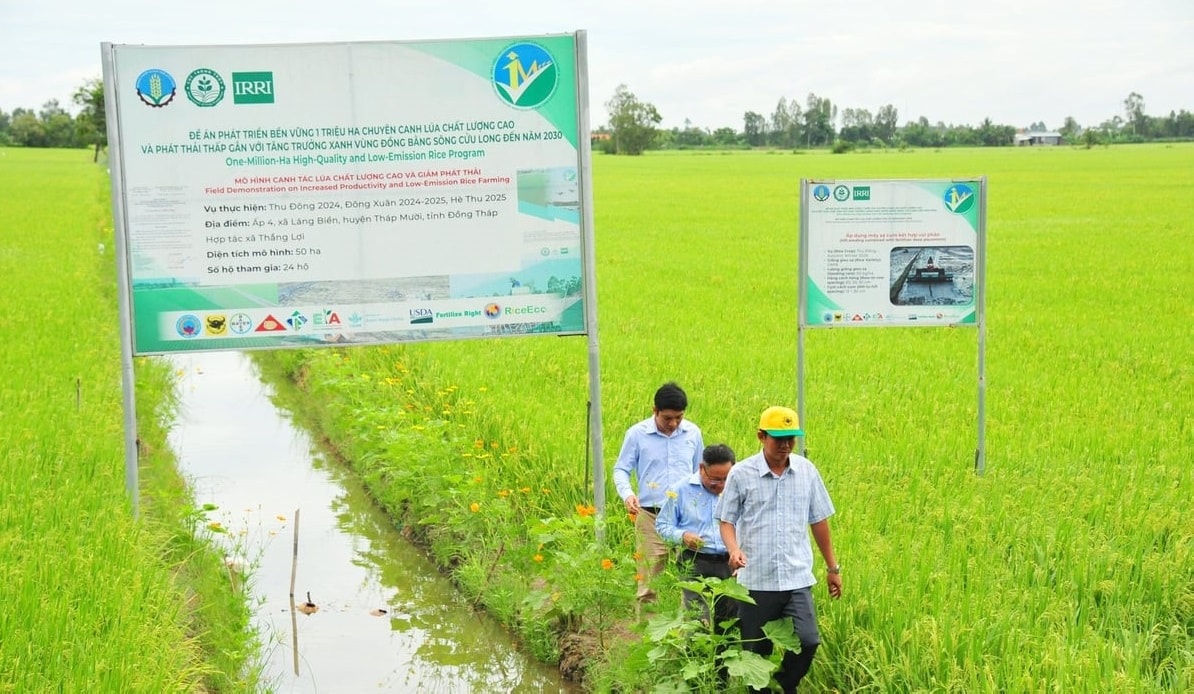
Farmers are the direct beneficiaries.
Chairman of the Dong Thap Province Cooperative Union Le Quang Cuong said that the highlight in the province's collective economic development in recent times is the shift from a single service cooperative model to a value chain model. In which, cooperatives take charge of production organization, enterprises ensure product consumption, and farmers are the direct beneficiaries. Many cooperatives have applied VietGAP and GlobalGAP standards, participated in the OCOP Program and built growing area codes, meeting the requirements of traceability and quality of domestic and foreign markets.
Director of the Department of Agriculture and Environment of the province Le Ha Luan affirmed that the collective economy and cooperatives are showing a core role in agricultural development. The current strengths are digital transformation and value chain linkage, gradually solving the fundamental problem of "good harvest, low price". In the coming time, the province will continue to consider the collective economy as a key task, associated with sustainable development and climate change adaptation.
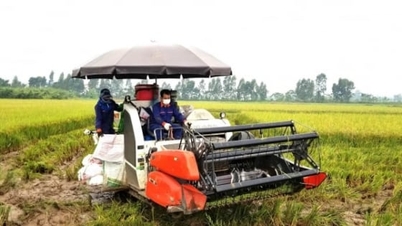
In fact, many cooperatives have demonstrated clear effectiveness. Thang Loi Agricultural Service Cooperative (Lang Bien commune) applies a water-saving irrigation system and smart pest monitoring, helping rice productivity increase by 10-15% and member profits improve significantly.
Mr. Nguyen Van Hung, Director of Thang Loi Cooperative, said that previously, farmers produced on a small scale, with unstable output. Now, the Cooperative has linked up with businesses, bringing products to supermarkets and exporting, helping farmers feel secure in production and increasing income. In particular, in the past 2 years, the Cooperative has been cultivating high-quality rice as part of the 1 million hectare low-emission rice project, which is showing high efficiency as expected.
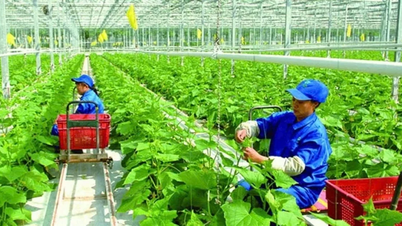
At the household level, the effectiveness is also recognized. Ms. Nguyen Thi Hong (Hong Ngu commune) is excited, since joining the safe vegetable cooperative, my family's vegetables are sold at a price 10-15% higher than the market price. Thang Loi Cooperative provides technical support and connects consumers, so we no longer have to worry about not knowing who to sell to after producing.
Although it was established just over a year ago, Kim Phat High-Tech Agricultural Cooperative (Binh Tho Trung, An Thanh Thuy Commune) has its own creative direction and achieved remarkable initial results. The Cooperative produces tree varieties using tissue culture techniques, nurseries and builds fruit growing area codes, linking domestic consumption and export. The "first" product and the highest result of the Cooperative is the production of MD2 pineapple seedlings, orchids, bananas... using tissue culture and has been favored by farmers.
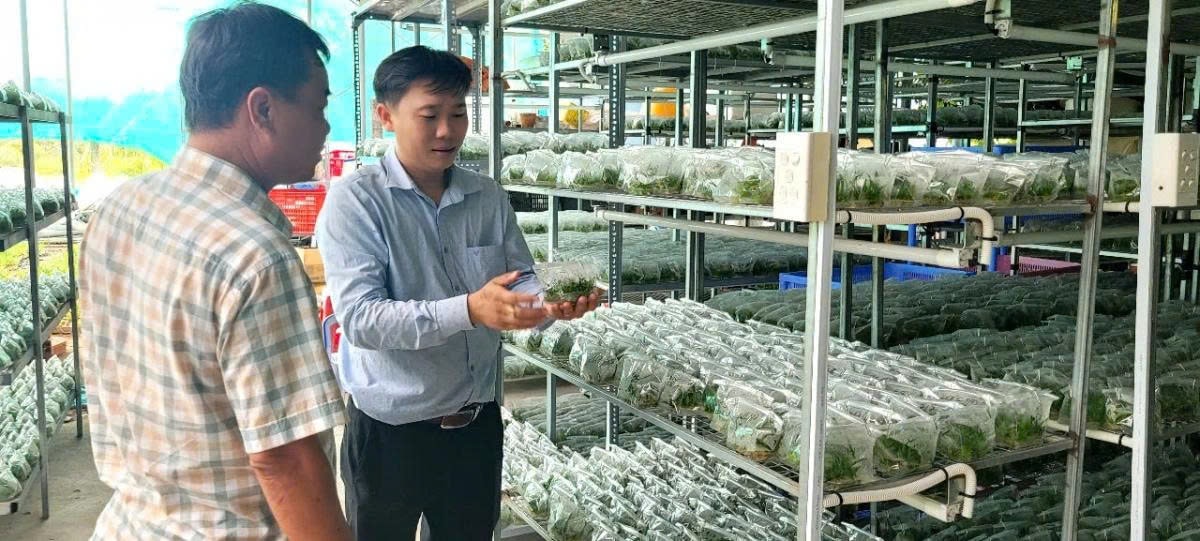
Tissue culture at Kim Phat Cooperative is the application of cell technology to propagate new plants in an artificial environment, helping to quickly and uniformly produce plant varieties while still fully preserving the characteristics of the original plant, while overcoming the disadvantages of other asexual propagation methods such as layering, grafting or cuttings. Over the past year, members of the Cooperative have devoted themselves to researching the process of propagating many types of plants using tissue culture.
The tissue culture seedling production model of Kim Phat Cooperative not only provides farmers with quality seedlings at affordable prices, contributing to promoting production, reducing costs, and increasing profits for farmers, but also helps farmers change their awareness in developing agriculture in a modern, high-tech direction.
In addition to tissue culture seed production, Kim Phat Cooperative also cooperates with businesses and gardeners to build production models and manage fruit tree production areas that meet export standards, including 100 hectares of coconut trees and 50 hectares of green-skinned grapefruit. The Cooperative has sent staff to strengthen the transfer of science and technology into production, organize propaganda to raise awareness of production in a concentrated direction, and unify production standards from seed selection to care, preliminary processing, processing, and export, in order to create a raw material area with high quality and food safety, providing quality goods for domestic consumption and export units.
Mr. Ngo Hung Vu, Deputy Director of Kim Phat Cooperative, informed that currently, the Cooperative operates production and business on an area of 3.5 hectares with a tissue room area of 400 m², a nursery area of 1,500 m², and a nursery area associated with members of 3,000 m².
Kim Phat High-Tech Agricultural Cooperative also built a socio-economic project to participate in the program "Cooperatives linking with farmers to develop the economy and escape poverty sustainably" with the goal of creating jobs and increasing income for poor and near-poor households to escape poverty from 2025 - 2030. Accordingly, the Cooperative will support farmers with seedlings to develop production, buy back products; strengthen links with agricultural cooperatives and enterprises to export agricultural products.
In practice, in addition to production efficiency, the collective economy also creates regular jobs for about 2,670 workers in Dong Thap province, with an average income of 85 million VND/year in 2024. Currently, the province has also developed more than 26,000 new members, bringing the total number of members in the collective economic sector to nearly 75,000 people - an important resource for local agriculture.
On the other hand, the province has also implemented many support policies such as granting up to 30 million VND to newly established cooperatives; more than 3,000 training sessions to improve capacity; supporting 32 cooperatives to build websites and apply management software; and putting over 400 products on e-commerce platforms. In particular, the province has granted growing area codes to 126 cooperatives and built 10 consumption chains with businesses, contributing to affirming the brand of local agricultural products.
Source: https://daibieunhandan.vn/dong-thap-hop-tac-xa-nang-cao-hieu-qua-san-xuat-tai-co-cau-nganh-nong-nghiep-10397903.html

![[Photo] Parade to celebrate the 50th anniversary of Laos' National Day](/_next/image?url=https%3A%2F%2Fvphoto.vietnam.vn%2Fthumb%2F1200x675%2Fvietnam%2Fresource%2FIMAGE%2F2025%2F12%2F02%2F1764691918289_ndo_br_0-jpg.webp&w=3840&q=75)

























![[Photo] Worshiping the Tuyet Son statue - a nearly 400-year-old treasure at Keo Pagoda](/_next/image?url=https%3A%2F%2Fvphoto.vietnam.vn%2Fthumb%2F1200x675%2Fvietnam%2Fresource%2FIMAGE%2F2025%2F12%2F02%2F1764679323086_ndo_br_tempimageomw0hi-4884-jpg.webp&w=3840&q=75)





























































Comment (0)