

CII, the investor, will guarantee a loan of up to nearly 2,400 billion VND over 7 years for the Hanoi Highway expansion BOT project.
The Board of Directors of Ho Chi Minh City Infrastructure Investment Joint Stock Company (CII) has approved the company's guarantee of a medium- and long-term loan for the BOT project to expand Hanoi Highway and National Highway 1, from the old Station 2 Junction to the Tan Van intersection. The maximum loan amount is approximately VND 2,398 billion over a period of 7 years. The company has not disclosed any further information about the loan.
The Hanoi Highway expansion BOT project is one of Ho Chi Minh City's key infrastructure projects, with CII as the investor. The project is divided into three phases, with the entire main section from Saigon Bridge to the Ho Chi Minh City National University intersection now completed, and the entire Di An ( Binh Duong ) section upgraded and paved with asphalt.
The project, which includes two parallel roads to Hanoi Highway, remains unfinished due to land acquisition issues and overlapping infrastructure with other projects such as the Ben Thanh - Suoi Tien metro line and environmental sanitation projects.
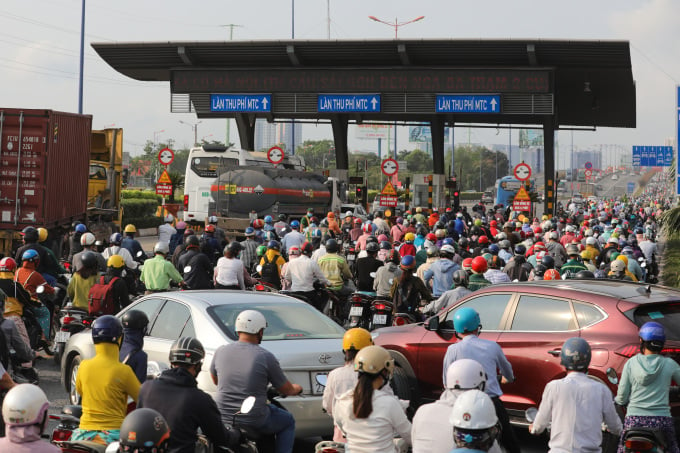
Traffic congestion on Hanoi Highway when BOT toll collection resumed on April 1, 2021. Photo: Quynh Tran
For CII specifically, this project is of immense importance to the company's business operations. The Hanoi Highway expansion BOT project accounts for 25% of the company's asset contribution, second only to the Trung Luong - My Thuan expressway. With a payback period in 2035, according to management calculations, the project could account for 30% of annual revenue during the 2023-2032 period. Meanwhile, CII estimates revenue during this period will increase from nearly 2,400 billion VND to 5,000 billion VND.
The expansion of Hanoi Highway, as well as other BOT projects that CII is investing in, while bringing in large and stable revenue in the future, still leaves the company with risks from financial leverage. The company's debt at the end of 2016 was nearly 3,600 billion VND, and by 2021 it had risen to over 17,000 billion VND. Last year alone, the company had to spend more than 3 billion VND per day to pay interest on its loans.
Nevertheless, CII's leadership declared that, with two major revenue sources from BOT projects and real estate, the company is fully capable of fulfilling all its financial obligations. After a long period of being "burdened with debt," the company is also beginning to focus on a roadmap for increasing capital and reducing borrowings.
At the annual meeting on May 24th, General Director Le Quoc Binh announced that a major financial institution, among the top 3 in Vietnam, had approved a financing decision of VND 2,400 billion for CII. This amount is part of a long-term loan package (12 years) worth nearly VND 9,400 billion.
Also at this meeting, the company approved a plan to issue 4,500 billion VND in convertible bonds to existing shareholders. A portion of the proceeds will be used to repay bank loans for the Hanoi Highway expansion BOT project, up to a maximum of 2,400 billion VND.
The company's plan to increase capital and reduce debt is also aimed at preparing for participation in new large-scale projects in the period after 2024. According to the plan, CII will allocate 60,000 billion VND to research new transportation infrastructure projects such as elevated roads combined with real estate in Ho Chi Minh City, the Trung Luong - My Thuan expressway phase 2, interchanges within Ho Chi Minh City, and the Thu Thiem 4 bridge.
Tat Dat
Source link






































































Comment (0)