The Android operating system is renowned for its exceptional versatility. Beyond smartphones, Android officially runs on tablets, watches, TVs, cars, and augmented reality (XR) glasses. However, Android is almost entirely absent from traditional personal computers, where Google has instead placed its bet on ChromeOS.
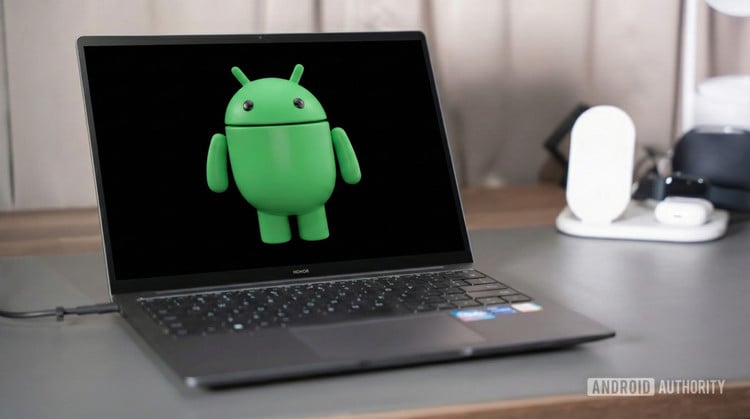
The green Android will be coming to personal computers under the name Aluminium OS.
Despite its efforts to compete with Windows and macOS, ChromeOS still ranks only a considerable third. To close this gap, Google is merging ChromeOS and Android into a single desktop platform, codenamed 'Aluminium OS'. Here's the latest information we've gathered.
Android on PC: The journey to the present.
A year ago, Android Authority revealed Google's plans to focus on developing Android into a unified desktop operating system. Our sources indicate that this shift aims to create products that better compete with the iPad, while also making more efficient use of development resources.
By July, a Google executive partially confirmed this information, revealing that the company planned to merge ChromeOS and Android into a single platform. Finally, at Qualcomm's Snapdragon Conference in September, Google officially announced it would bring Android to the PC market.
Google says it is partnering with Qualcomm to build a new platform that combines the power of mobile and desktop computing, leveraging the latest advances in artificial intelligence (AI).
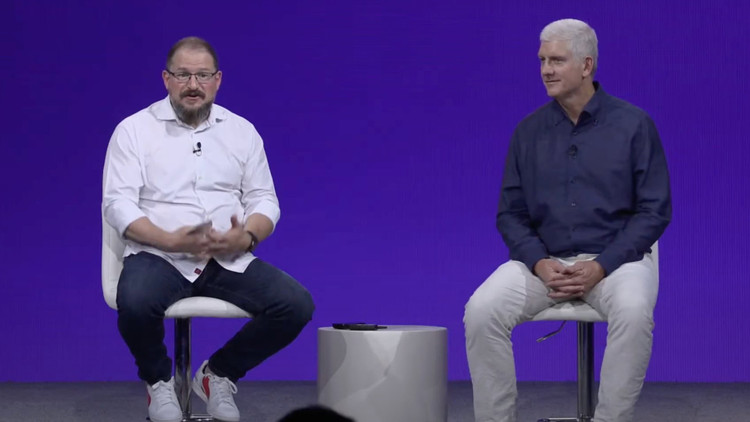
Qualcomm CEO Cristiano Amon (left) and Google's Senior Vice President of Devices & Services Rick Osterloh (right) announce a collaborative project to bring Android to PCs.
Although it's now known that Google is developing Android for PCs, many details remain undisclosed. Will Google discontinue the ChromeOS brand? Will existing Chromebooks receive the new operating system update, or will they be left behind? Will the OS only appear on budget devices, or will it target the high-end segment as well? What will the interface look like, and what new features will it include?
These are the big questions as Google continues to develop this platform. We may not have all the answers until closer to launch, but thanks to job postings and bug reports, we've uncovered some early details that shed some light on the project's direction.
Aluminium OS: Google's PC ambitions are gradually taking shape.
Over the weekend, a Telegram source named Frost Core shared a link to an attractive Google job posting for a 'Senior Product Manager, Android, Laptop and Tablet' position.
Although it was already known that Google was bringing Android to PCs, this job posting further specified a role related to "developing a new Android-based operating system called Aluminium." This confirms Aluminium is the codename for the new unified platform.
The name seems to be inspired by the project's origins: like Chromium (the open-source version of ChromeOS), Aluminium is also the name of a metal ending in '-ium'. The use of British English spelling — emphasizing the 'Al' prefix — may be Google's way of honoring Android as the project's core platform.
Similar to Android XR, Google says the new Aluminium OS is “built with AI at its core.” This indicates deep integration with Gemini, Google’s AI chatbot and large language model (LLM). At the Snapdragon conference, Rick Osterloh, Google’s Senior Vice President of Devices & Services, shared plans to bring the company’s AI ecosystem to PCs:
“This is another way for us to leverage all the AI advancements we’re jointly developing, from the Gemini model and virtual assistants to the entire application and developer community, and bring them to the personal computing field. I believe this will be how Android serves everyone across all computing device segments.”
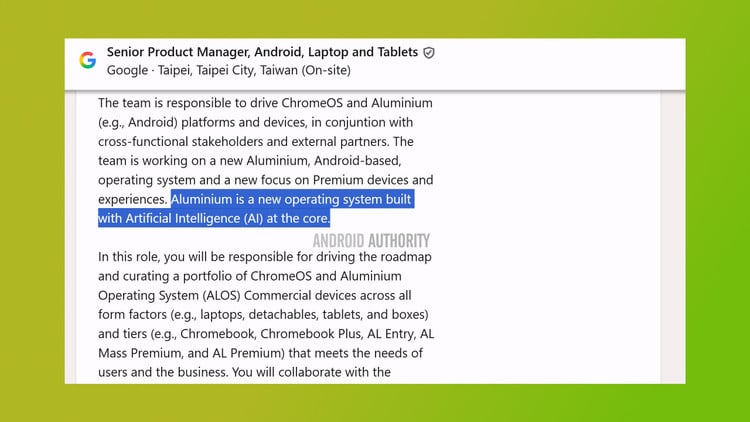
Google's job posting for a product manager shares the name Aluminium.
It remains unclear what new features Gemini will bring to Android PCs, but expectations are that the operating system will fully utilize hardware power. On some high-end smartphones, Gemini already offers many on-device AI features, requiring significant memory and processing power from the CPU, GPU, and NPU. There were concerns that Google would limit this new operating system to the low-cost segment, like current Chromebooks, leaving the high-end market to Microsoft and Apple. However, the job posting has dispelled those concerns.
The new Senior Product Manager role will “build the roadmap and manage the portfolio of commercial devices using ChromeOS and Aluminium Operating System (ALOS) across all formats (e.g., laptops, detachable devices, tablets, and boxes) and all segments (e.g., Chromebooks, Chromebook Plus, AL Entry, AL Mass Premium, and AL Premium) to meet user and business needs.”
This confirms that Android won't be limited to laptops; the roadmap also includes detachable devices, tablets, and 'boxes' (possibly mini-PCs similar to Chromebox or Mac Mini). Furthermore, the tiered structure—with 'AL Mass Premium' and 'AL Premium' segments alongside 'AL Entry'—suggests Google wants to take Android beyond the realm of inexpensive PC hardware. While the exact pricing for these segments is still unpredictable, it's clear Google is aiming for all-out competition—a strategy previously foreshadowed by the recent Chromebook Plus initiative.
Regarding Chromebooks, the job posting also raises questions about the future of ChromeOS. The announcement states that the person taking on this role will “develop ChromeOS and Aluminium (e.g., Android) platforms and devices,” building a roadmap and product portfolio encompassing both. This suggests the two platforms will coexist for some time. However, the person is also tasked with developing a strategy to “transition Google from ChromeOS to Aluminium ensuring future business continuity.” This confirms Google's intention to completely replace ChromeOS—a move that needs to be carefully executed to avoid impacting enterprise customers. This transition will likely involve multiple phases.
Support for legacy devices: Existing ChromeOS devices that cannot be upgraded to Aluminum OS may continue to receive updates until the end of their lifecycle. This means Google will have to maintain the ChromeOS source code for a few more years.
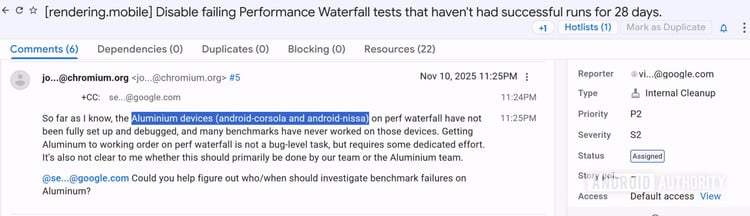
Optional Upgrade: Instead of forcing an immediate switch, Google could offer an optional upgrade roadmap for eligible devices. Currently, the company is testing Aluminium OS on development boards using MediaTek Kompanio 520 and 12th-generation Intel Alder Lake chips, so Chromebooks with these processors may be eligible for the update. However, switching operating systems on an existing device is a significant technical challenge requiring careful preparation.
Is ChromeOS really "dead"?
Even if Google completely changes the ChromeOS platform to Android, the company may still not want to abandon the name. While it doesn't have the large market share of Windows or macOS, the ChromeOS brand remains very familiar, especially in education and business. Although the job posting hasn't confirmed the final name, bug reports discovered by Frost Core suggest Google may retain the brand. Engineers have referred to the current platform as "ChromeOS Classic" and "ChromeOS Non-Aluminum," implying that the new Android-based version might take over the "ChromeOS" name.
Another possibility is that Google will use the name "Android Desktop" to align with its Android brand promotion strategy. However, "Android Desktop" might just be an internal name for this type of device. Since these references only appear in bug reports, the final commercial name remains to be seen.
When will Android on PC be released?
Google is actively developing this platform, with bug reports confirming the company is testing new Android 16 builds on development hardware. Google has confirmed the project will launch in 2026, although it's unclear whether that will be in the first or second half of the year. Given this roadmap, it's highly likely the first public release will be based on Android 17, expected to launch next year. We will continue to monitor the project for further updates before its official launch.
Source: https://khoahocdoisong.vn/du-an-dua-android-len-may-tinh-co-ten-ma-la-aluminum-post2149071698.html



![[Photo] Standing Committee member of the Party Central Committee Tran Cam Tu working with the Central Inspection Committee](https://vphoto.vietnam.vn/thumb/1200x675/vietnam/resource/IMAGE/2026/05/28/1779969579668_ndo_br_bnd-2495-jpg.webp)







![[GALLERY] A "billion-dollar" game that hasn't even been released yet is already driving gamers crazy.](https://vphoto.vietnam.vn/thumb/402x226/vietnam/resource/IMAGE/2026/05/28/1779977371733_goi-3-png.webp)






![[GALLERY] Japan's ambition for the largest "super battleship" in history.](https://vphoto.vietnam.vn/thumb/402x226/vietnam/resource/IMAGE/2026/05/28/1779975571048_nhat-tung-muon-dong-quai-vat-bien-500000-tan-manh-hon-ca-mot-ham-doi-jpg.webp)
![[GALLERY] Surviving power outages in hot weather is still possible thanks to these batteries.](https://vphoto.vietnam.vn/thumb/402x226/vietnam/resource/IMAGE/2026/05/28/1779975574934_du-1-png.webp)

![[GALLERY] Facebook and Instagram users need to take note of this](https://vphoto.vietnam.vn/thumb/402x226/vietnam/resource/IMAGE/2026/05/28/1779954873247_ig-1-png.webp)

![[GALLERY] LG makes a breakthrough with the first 1000Hz FHD gaming monitor.](https://vphoto.vietnam.vn/thumb/402x226/vietnam/resource/IMAGE/2026/05/28/1779942265656_ultragear-1000hz-monitor-jpg.webp)













































































Comment (0)