

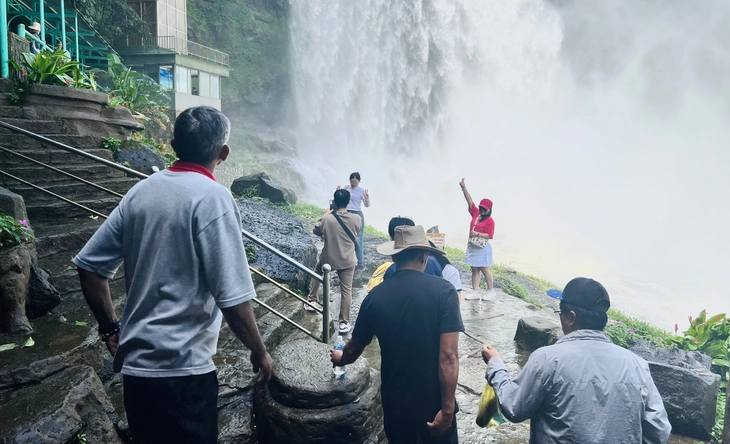
Some readers argue that travel is about enjoyment and experience, and that one shouldn't waste time preparing food to bring along - Photo: YEN TRINH
Following the article "Traveling with a pot of bun rieu (Vietnamese noodle soup), is it 'self-torture' or saving money?", Tuoi Tre Online received much lively debate from readers. The majority were divided into two camps: those who supported the idea and those who were disgusted by the sight of people carrying numerous food items while traveling.
If you're going to be too calculating when it comes to traveling, then don't go at all.
A reader from Da Nang recounted that near their house lives an elderly couple who, during the summer, park a 50-seater bus in front of their house for travel, visiting relatives, watching fireworks, etc. The bus contains a gas stove, a household gas cylinder, and pots and pans.
"They said they'd go to Tay Ninh for a trip, visit temples and shrines, and sometimes even give out gifts, filling up their cars with them before returning. With such a trip, I think all the restaurants and eateries will probably close down," this reader expressed.
Sharing the same view, Mr. Tu Ben said that tourism is for relaxation and to stimulate the local economy . If everyone brings their own food to eat during the trip, they should eat at home for better health.
Agreeing, Mr. Hien shared: travel is about relaxation, exploring new places, and experiencing local cuisine. If cooking takes time and is tiring, the travel experience will be less enjoyable.
Reader Lam Son Ha succinctly commented: "If you're going to be too calculating, then don't go; it will only cause trouble for your family."
Reader hdng****@gmail.com wrote: "Carrying so much luggage on a trip is bound to be exhausting." "If everyone is so frugal like this, it will affect the overall income of society," reader TD commented.
Meanwhile, Mr. Tran Tam advised: "Enjoy your trip to the fullest, don't bother bringing your own food and drinks. Saving money is only meaningful when it's done wisely."
Besides the inconvenience, some readers noticed that some of the food they brought along smelled bad and was cold. A user named phan****@gmail.com questioned: "It's so cold by the time we arrive, how can it taste good? After eating, do we have to buy a bucket of water to wash it clean, or do we just throw it in someone else's trash can?"
Similarly, Mr. Tuan commented that this type of tourism is mainly for gathering and eating, and that you can just find someone's spacious house, since you have to pay an entrance fee to enter a tourist area. "Setting up a picnic on the ground in a tourist area is really strange," he stated.
Sharing her experience, Ms. Kim said she used to bring her own food. She confided, "I don't have much money, so I have to save when I go on trips. But I find cooking and preparing meals too much trouble, not to mention sticky rice or chicken left in the car for a long time will get smelly and sometimes spoil." Later, her family stopped bringing their own food and chose more affordable, budget-friendly restaurants instead.
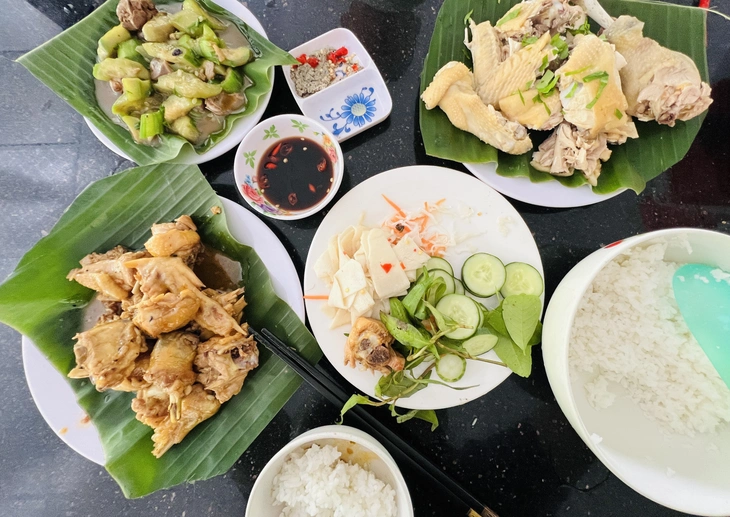
Bringing your own food while traveling can be a good idea, but some readers consider it torture - Photo: YEN TRINH
"We shouldn't judge other people's lives."
Some readers believe that whether or not to bring food depends on family preferences and whether the destination is a campsite or a resort. Bringing food to snack on while chatting is fine, as long as you don't litter.
Toan Nguyen believes that bringing food along when traveling is normal. There are many ways to spend money, and it's not necessary to go to restaurants where you might get ripped off. "Instead, use the money to buy souvenirs, local handicrafts, etc.," he wrote.
The Aloha account expressed that everyone should do whatever they like. Many people experience the local culture, including the food. Many others enjoy the scenery and only eat familiar dishes, so they bring their own food. "The point is that traveling is for relaxation and experiences; everyone has their own way, as long as it doesn't affect others."
Mr. Tuan said that what and where one eats is a personal choice. "Whether it's hard work or not, people aren't begging from anyone, so why criticize? If the service is reasonably priced and the food is delicious, why would anyone bring their own food?"
"As long as the family is happy and together, that's what matters and brings happiness. We shouldn't judge other people's lives," reader Anh Vũ advised.
Ms. Ngoc Bay said that traveling is an opportunity for families to enjoy time together. The process of preparing food adds to the memories.
"My family would be busy preparing this and that for a whole week before we left, packing lots of things, but it was during those moments that I felt even more love for my family."
Respecting differences is a message some readers have shared regarding this topic. Nhien Van commented: "If you're traveling alone, eat out; if you're traveling with a group, each person can bring their own dish. If you know how, it's not difficult at all. We eat at shared restaurants to get through the meal, but we still fondly remember the rice balls or the bowl of vermicelli soup."
Reader Sao Xet shared that even though he had money, he wanted to bring his own food, a portable stove, a gas stove, and a rice cooker to cook everything himself. Once there, the whole family would go to the local market. Everyone could buy whatever they wanted, and he would pay for it.
"Cooking is both an experience for the kids and a way to teach them survival skills. My wife thinks I'm stingy and torture myself. But when she goes to a restaurant, she complains about the prices, the food not being tasty, and not being filling," he confided.
There are also some opinions suggesting that it's better to bring light meals to avoid the hassle, such as fruit and pastries. "Back in the day, whenever my father took my siblings and me to Vung Tau, my mother would cook rice tightly packed in banana leaves and braised ribs, sliced into delicious pieces. Now, with improved living standards, people prefer to enjoy local food, but in my opinion, for short trips, preparing a few dishes is still more enjoyable," shared Mr. Tran Tai.
Similarly, reader Nguyen noted that sometimes traveling is both expensive and the food doesn't suit one's taste, leading to illness and regret over not bringing some simple food. "Many tourist destinations also rent out charcoal grills at campsites for occasions like this."
Ask your sisters for their opinion on whether or not we should bring food.
Amidst both positive and negative feedback, Mr. Tran Q. Loc revealed a trick to please the whole family. He explained that mothers and grandmothers, who are exhausted from cooking every day, prefer eating out to save themselves energy.
"Some people still prefer to prepare their own food. We usually ask the women for their opinions before deciding. But fruit is essential because when traveling in the hot sun, oranges, tangerines, guavas, and apples help to relieve fatigue and thirst," he concluded.
Sharing the same sentiment, Loanmai realized that bringing food or not bringing it along didn't matter. The important thing was that whoever wanted to cook should do it themselves, instead of making others do it.
"In a flexible way, Thuy Trang Le said that the preparation should depend on whether the group on the trip is young or a large family. My family usually brings along food, but it's usually snacks like cakes, sticky rice to eat along the way or as a snack. Before going, everyone should ask for the addresses of good restaurants beforehand, don't just stop at any place and eat something you're not satisfied with."
Source: https://tuoitre.vn/du-lich-mang-theo-noi-bun-rieu-mang-hay-khong-mang-do-an-la-tuy-sao-phai-phan-xet-20250901161849545.htm
![[Photo] Closing Ceremony of the 10th Session of the 15th National Assembly](/_next/image?url=https%3A%2F%2Fvphoto.vietnam.vn%2Fthumb%2F1200x675%2Fvietnam%2Fresource%2FIMAGE%2F2025%2F12%2F11%2F1765448959967_image-1437-jpg.webp&w=3840&q=75)

![[Photo] Prime Minister Pham Minh Chinh holds a phone call with the CEO of Russia's Rosatom Corporation.](/_next/image?url=https%3A%2F%2Fvphoto.vietnam.vn%2Fthumb%2F1200x675%2Fvietnam%2Fresource%2FIMAGE%2F2025%2F12%2F11%2F1765464552365_dsc-5295-jpg.webp&w=3840&q=75)






































![[OFFICIAL] MISA GROUP ANNOUNCES ITS PIONEERING BRAND POSITIONING IN BUILDING AGENTIC AI FOR BUSINESSES, HOUSEHOLDS, AND THE GOVERNMENT](https://vphoto.vietnam.vn/thumb/402x226/vietnam/resource/IMAGE/2025/12/11/1765444754256_agentic-ai_postfb-scaled.png)














































Comment (0)