

Today, August 1st, at Thai Nguyen University, the Ministry of Education and Training organized a seminar to gather feedback on the draft circular regulating standards for higher education institutions. At the seminar, Professor Vu Van Yem (Hanoi University of Science and Technology), representing the group of experts advising the Ministry of Education and Training on the draft, shared his views on the land area criteria for universities.
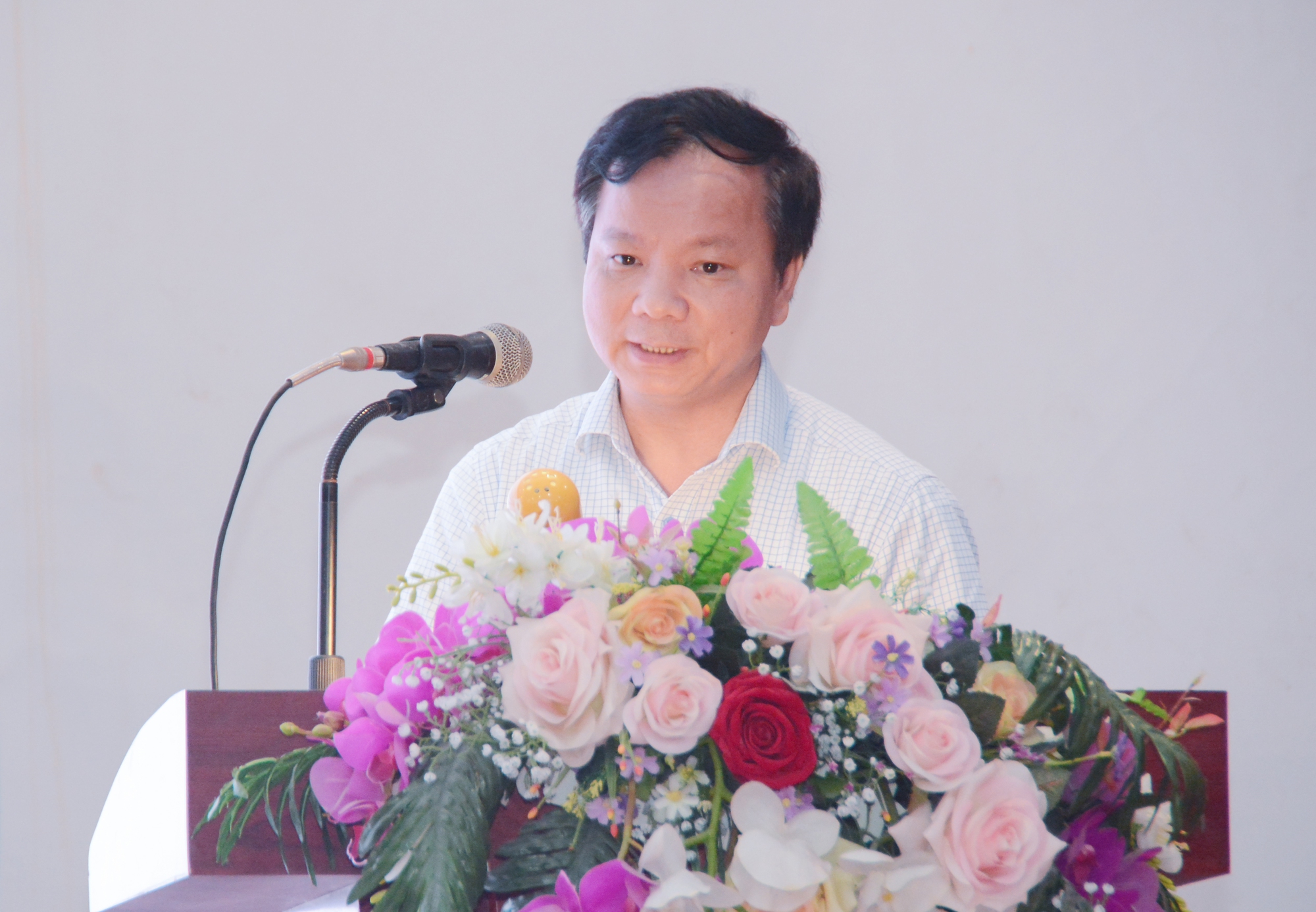
Professor Vu Van Yem ( Hanoi University of Science and Technology), representing the advisory group assisting the Ministry of Education and Training in developing the draft standards for higher education institutions.
According to the draft circular regulating the standards for higher education institutions, one of the criteria is the land area per full-time student. Specifically, the land area per full-time student, standardized according to the level of training, field of training, and campus location, from 2030 onwards, shall not be less than 25 m² in each locality where the educational institution has its headquarters or branches.
According to Professor Vu Van Yem, higher education institutions must have an environment, campus infrastructure, facilities, information systems, and learning materials that meet the requirements for ensuring the quality of teaching and learning. To create an environment and campus infrastructure worthy of a university, the university needs to be built on a sufficiently large area.
Currently, the construction standards issued in 1985 are still in effect. In addition, in May 2021, the Ministry of Construction issued Circular No. 01/2021/TT-BXD on national technical regulations for construction planning. However, these documents only provide general requirements for the construction of buildings. With the draft standards for higher education institutions, the Ministry of Education and Training plans to, for the first time, set specific requirements regarding the minimum area that a university campus must meet.
Professor Yem also stated that during the drafting process, there were two opposing viewpoints regarding this criterion. The first argued that, given the current era of digital transformation and the Fourth Industrial Revolution, where training activities can be conducted in virtual spaces, there is no longer a need for rigid regulations on land area for universities.
However, another school of thought argues that regardless of the era, a university must retain its original form; it must have sufficient space not only for conducting training and research activities, but also for students to have experiential learning within the university environment. It should not only be a place for studying, but also a place for working together with friends, and a place for students to experience social, cultural, and sporting activities…
"Personally, I support the second viewpoint. In the field of higher education management, many people have worked at or visited universities abroad many times and have seen that their campuses are very spacious, spanning hundreds of hectares. In contrast, our universities are generally very small, and very few have campuses that meet the requirements of a conducive educational environment. We don't expect our universities to be hundreds of hectares in size; we only dare to propose 25 m² /student, considering the feasibility factor," Professor Yem shared.
Professor Yem also stated that this standard is not uniform but has coefficients according to each training field. Specifically, the fields of technology, engineering, manufacturing and processing, architecture and construction have the highest coefficient at 1.5; arts, veterinary medicine, and health have a coefficient of 1.2; and the lowest coefficient is for training fields in the social sciences, business, management, and services, with a coefficient of 0.8.
Professor Yem said: "For public universities, the State, specifically the localities, ministries, and sectors (that have public universities), need to take responsibility for investing to achieve this standard."
Source link


![[Photo] Closing Ceremony of the 10th Session of the 15th National Assembly](/_next/image?url=https%3A%2F%2Fvphoto.vietnam.vn%2Fthumb%2F1200x675%2Fvietnam%2Fresource%2FIMAGE%2F2025%2F12%2F11%2F1765448959967_image-1437-jpg.webp&w=3840&q=75)

![[Photo] Prime Minister Pham Minh Chinh holds a phone call with the CEO of Russia's Rosatom Corporation.](/_next/image?url=https%3A%2F%2Fvphoto.vietnam.vn%2Fthumb%2F1200x675%2Fvietnam%2Fresource%2FIMAGE%2F2025%2F12%2F11%2F1765464552365_dsc-5295-jpg.webp&w=3840&q=75)







































![[OFFICIAL] MISA GROUP ANNOUNCES ITS PIONEERING BRAND POSITIONING IN BUILDING AGENTIC AI FOR BUSINESSES, HOUSEHOLDS, AND THE GOVERNMENT](https://vphoto.vietnam.vn/thumb/402x226/vietnam/resource/IMAGE/2025/12/11/1765444754256_agentic-ai_postfb-scaled.png)




































Comment (0)