

With many new regulations taking effect, many opinions believe that in the near future, violations by contract vehicles such as gathering passengers, picking up passengers outside the list, and setting fixed schedules will be prevented.
Contract vehicles operate on fixed routes.
Living and working in Hanoi , for many years now, every time he returns to his hometown in Quang Ninh, Mr. Tran Tuan Hung (in Thanh Xuan, Hanoi) chooses a Limousine to pick him up at home. Although the ticket price is higher, in return he does not have to waste time taking a motorbike taxi or taxi to the bus station and from the bus station back home.
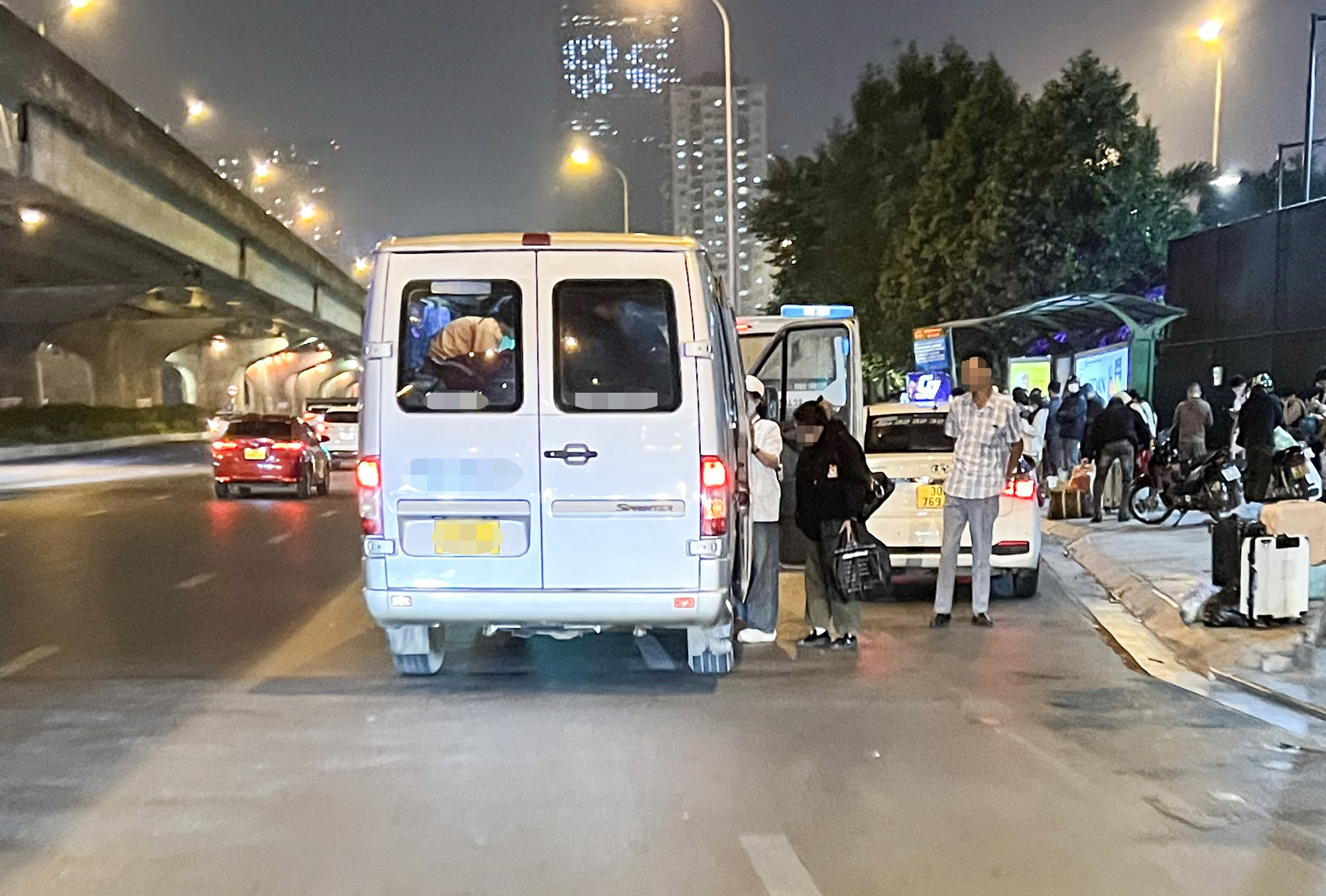
The new regulations are expected to prevent violations by ride-hailing vehicles such as picking up and dropping off passengers arbitrarily and in unauthorized locations. (Illustrative photo: Ta Hai)
Not only Mr. Hung, the type of contract car with more than 9 seats to pick up and drop off at home is chosen by many people, leading to a rapid increase in quantity. According to statistics of the Vietnam Road Administration, currently the whole country has only more than 17,000 fixed-route cars, but there are nearly 240,000 contract cars.
According to Mr. Nguyen Cong Hung, Vice President of the Vietnam Automobile Transport Association, contract vehicles with more than 9 seats operate on fixed routes. These vehicles do not enter stations, operate spontaneously, and stop to pick up and drop off passengers at any location or street. Passenger rights are also not protected when there is no travel insurance.
Mr. Hung said that the people's demand is very large, but we must find a way to prevent this demand from going beyond the law. To manage it, we can consider allowing it to operate at bus stations and use shuttle buses to pick up and drop off passengers like the fixed-route buses are doing, instead of opening offices everywhere and picking up and dropping off passengers at home like now.
Many new regulations
To control contract vehicles, Mr. Hung suggested that it is necessary to effectively and thoroughly utilize data from vehicle tracking devices. Individual transport businesses that lack the resources to invest in technology or a traffic safety monitoring department can participate in enterprises or cooperatives.
According to transportation expert Dr. Phan Le Binh, a legal framework needs to be established to manage business registration, tax collection, and terminal fees for picking up and dropping off passengers at designated locations. This would create a level playing field for fixed-route passenger buses.
From the perspective of State management, Mr. Do Quoc Phong, Deputy Head of the Department of Transport Management, Vehicles and Drivers, Vietnam Road Administration, said that contract vehicles with more than 9 seats operate on fixed routes and do not have to pay costs such as fees at both ends of stations, causing unfair competition with fixed-route vehicles.
Currently, the demand of passengers to be picked up at home by shared car or carpool is very high. The choice of passengers inadvertently contributes to violations.
To prevent disguised contract vehicles, Decree 158/2024 guiding the 2024 Road Law (effective from January 1, 2025) stipulates: Contract passenger transport businesses with more than 9 seats are not allowed to confirm reservations for each passenger, are not allowed to sell tickets, or collect money outside the contract signed before the trip.
Furthermore, fixed routes and schedules for serving multiple passengers are not permitted. Drivers are only allowed to pick up and drop off passengers at the locations specified in the contract; they are not allowed to pick up passengers outside the list, nor are they allowed to pick up or drop off passengers at the company headquarters, representative offices, or at a fixed location on any street.
Failure to file taxes will result in license revocation.
According to Mr. Nguyen Cong Hung, the Road Law allows contract vehicles with less than 9 seats to carry many passengers on the same trip on the same route.
While taxis must register, declare and post fares, contract vehicles with less than 9 seats can negotiate fares with customers, but there are no regulations to manage taxes when revenue cannot be controlled.
In the future, it is very likely that there will be an explosion of contract cars under 9 seats, and individuals who previously ran without permission will leave the business to run their own business. In addition, it is not excluded that businesses that are trading cars over 9 seats will switch to cars under 8 seats to do business.
Therefore, business conditions must be strictly controlled by forcing businesses to apply technology. Currently, most contract car businesses are using Apps (software) to book and sell tickets, so it can be legalized by requiring contract cars with less than or more than 9 seats to register an App, register a domain name, and from there, connect data to the management agency for control.
Explaining this concern, Mr. Do Quoc Phong said that, in the Road Law, contract vehicles are divided into 2 types: vehicles with less than 8 seats (not including the driver) and contract vehicles with more than 9 seats.
Both types of vehicles require passengers to sign a contract before each trip. Contract vehicles with fewer than 9 seats and taxis have similar business conditions. While contract vehicles with fewer than 9 seats can sign multiple contracts, vehicles with more than 9 seats only sign a single contract for the entire trip.
Regarding the risk of businesses converting to contract vehicles with less than 8 seats to collect passengers, Mr. Phong said that Decree 158/2024 has added a regulation: Businesses that do not declare taxes during business operations will have their transportation business licenses revoked along with many other regulations.
The Decree also raises business conditions for contract vehicles with more than 9 seats to be similar to fixed-route vehicles; there is a more open policy on business conditions for fixed-route vehicles.
Traffic violations will be subject to fines issued remotely.
According to Mr. Do Quoc Phong, implementing the Law on Ensuring Road Traffic Safety and Order, the Vietnam Road Administration has transferred the tasks of managing, exploiting, operating and receiving data from journey monitoring devices and surveillance cameras to the Traffic Police Department.
From January 1st, 2025, data from commercial transport vehicles has been transmitted to the Traffic Police Department. All activities of commercial transport vehicles and images from cameras installed on the road are transmitted to the Command Center of the Traffic Police Department. From there, violations are analyzed and filtered, and penalties are issued retrospectively.
Source: https://www.baogiaothong.vn/dua-xe-hop-dong-vao-khuon-kho-192250110123910385.htm



![[Photo] Prime Minister Pham Minh Chinh holds a phone call with the CEO of Russia's Rosatom Corporation.](/_next/image?url=https%3A%2F%2Fvphoto.vietnam.vn%2Fthumb%2F1200x675%2Fvietnam%2Fresource%2FIMAGE%2F2025%2F12%2F11%2F1765464552365_dsc-5295-jpg.webp&w=3840&q=75)
![[Photo] Closing Ceremony of the 10th Session of the 15th National Assembly](/_next/image?url=https%3A%2F%2Fvphoto.vietnam.vn%2Fthumb%2F1200x675%2Fvietnam%2Fresource%2FIMAGE%2F2025%2F12%2F11%2F1765448959967_image-1437-jpg.webp&w=3840&q=75)


















































![[OFFICIAL] MISA GROUP ANNOUNCES ITS PIONEERING BRAND POSITIONING IN BUILDING AGENTIC AI FOR BUSINESSES, HOUSEHOLDS, AND THE GOVERNMENT](https://vphoto.vietnam.vn/thumb/402x226/vietnam/resource/IMAGE/2025/12/11/1765444754256_agentic-ai_postfb-scaled.png)






































Comment (0)