

DNVN - The sharp decline in raw shrimp prices in the Mekong Delta provinces since May has posed further challenges for the shrimp industry.
Raw shrimp prices have dropped sharply.
According to data from the Vietnam Association of Seafood Processing and Export (VASEP), in the first five months of this year, Vietnamese businesses exported shrimp to 103 markets, bringing in $1.3 billion, a 7% increase compared to the same period last year.
However, the shrimp industry continues to face many challenges as the global economy shows no signs of recovery and inflation remains high.
In particular, the price of raw shrimp in the Mekong Delta region is trending sharply downward. According to VASEP's report on shrimp prices on June 12th in Kien Giang province: tiger shrimp prices decreased by 30,000 - 40,000 VND/kg depending on size compared to a month ago. Specifically, tiger shrimp of 20-30 pieces/kg are being bought by traders at 250,000 VND/kg, a decrease of about 40,000 VND/kg. Tiger shrimp of 50 pieces/kg, which were priced at around 130,000 - 135,000 VND/kg a month ago, are now down to 95,000 VND/kg.
Traders bought 100-count white-leg shrimp at 66,000-70,000 VND/kg, down about 20,000 VND/kg. 50-60-count white-leg shrimp at 73,000 VND, down 30,000 VND/kg. 70-80-count white-leg shrimp at 70,000 VND/kg, down 25,000 VND/kg.

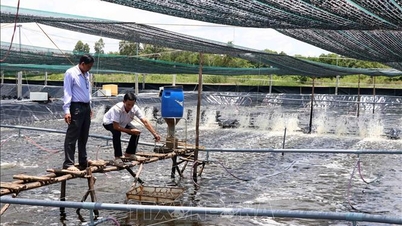
The shrimp industry continues to face many challenges, including a sharp decline in raw shrimp prices.
Similarly, the price of whiteleg shrimp in provinces such as Ca Mau, Bac Lieu, Soc Trang , and Ben Tre is also low, having dropped sharply compared to the beginning of the year.
Explaining the sharp drop in shrimp prices, some businesses and traders said it was due to oversupply. In addition, shrimp is in its peak season, with favorable weather conditions resulting in a large harvest. Simultaneously, companies purchasing shrimp for export have reduced their production. Shrimp export businesses are also facing numerous difficulties due to slow market demand, supply chain bottlenecks caused by rising freight costs and container shortages, and tensions in the Red Sea.
Meanwhile, shrimp prices from India, Indonesia, and Ecuador are offering low prices. World market prices remain low and Ecuadorian shrimp continues to be sold at increasingly low prices.
According to VASEP, the price of raw shrimp from major global suppliers has decreased. Specifically, the price of raw shrimp in China during week 25 (June 17-23) fell to near its lowest level in a decade due to peak seasonal production. Shrimp of size 60 pieces/kg decreased by 22% and shrimp of size 80 pieces/kg decreased by 25% compared to the previous week.
Ecuadorian shrimp prices in week 24 (June 10-16) reached approximately US$3.9/kg for the 20/30 size and US$3.5/kg for the 30/40 size. Prices for the 40/50, 50/60, 60/70, 70/80, and 80/100 sizes remained unchanged at US$3.3/kg, US$3.15/kg, US$2.8/kg, US$2.3/kg, and US$1.9/kg, respectively.
The oversupply has led to a sharp drop in prices, which in turn affects the profitability and sustainability of farmers' operations.
VASEP believes that shrimp prices in the coming time are unclear, because besides the market demand factor, it also depends on the main crop of shrimp powerhouses such as Ecuador, India, and Vietnam. Ecuador is even more difficult to predict because they can raise shrimp all year round.
According to some businesses, it is still uncertain whether shrimp prices will rise again. However, a further drop in shrimp prices is unlikely, as several businesses have recently raised their purchase prices, albeit not significantly. This indicates that businesses still have a demand for raw shrimp. Raw shrimp prices are likely to increase again by August at the latest, after the main harvest season in global supply sources, as demand from markets becomes more positive in preparation for the end of the year.
We need to promote the model of production linkage along the value chain.
Authorities have advised shrimp farmers to maintain a stable mindset, avoid harvesting shrimp in large quantities, maintain stable stocking densities, and extend the farming period to increase the size of harvested shrimp, ensuring quality, food safety, and higher selling prices, thereby increasing investment efficiency.
Alternatively, increasing stocking density can boost harvest yields, and gradual harvesting can be implemented, providing the remaining shrimp in the pond with a favorable environment for faster growth. Proactive coordination with relevant agencies and units is crucial to monitor the price fluctuations of raw shrimp, analyze the production efficiency of each harvested shrimp size, and forecast market demand trends.
In the long term, VASEP believes that in order to reduce production costs and create new momentum for shrimp farming, helping shrimp farmers ensure profitable production, more attention must be paid to promoting production linkage models along the value chain.
Furthermore, there is a strategic focus on developing the feed and supplies processing industry for shrimp farming, aiming for self-sufficiency. Simultaneously, continuous improvement of farming processes, strict control of seed quality and supplies, and especially effective environmental management are essential to establishing modern, sustainable shrimp farming models with low production costs and high profitability for shrimp farmers.
Moonlight
Source: https://doanhnghiepvn.vn/kinh-te/gia-giam-manh-nganh-tom-doi-dien-them-thach-thuc/20240701090355454

![[Photo] Prime Minister Pham Minh Chinh holds a phone call with the CEO of Russia's Rosatom Corporation.](/_next/image?url=https%3A%2F%2Fvphoto.vietnam.vn%2Fthumb%2F1200x675%2Fvietnam%2Fresource%2FIMAGE%2F2025%2F12%2F11%2F1765464552365_dsc-5295-jpg.webp&w=3840&q=75)

![[Photo] Closing Ceremony of the 10th Session of the 15th National Assembly](/_next/image?url=https%3A%2F%2Fvphoto.vietnam.vn%2Fthumb%2F1200x675%2Fvietnam%2Fresource%2FIMAGE%2F2025%2F12%2F11%2F1765448959967_image-1437-jpg.webp&w=3840&q=75)






































![[OFFICIAL] MISA GROUP ANNOUNCES ITS PIONEERING BRAND POSITIONING IN BUILDING AGENTIC AI FOR BUSINESSES, HOUSEHOLDS, AND THE GOVERNMENT](https://vphoto.vietnam.vn/thumb/402x226/vietnam/resource/IMAGE/2025/12/11/1765444754256_agentic-ai_postfb-scaled.png)





































Comment (0)