

From the days of attracting FDI simply to boost production and secure basic necessities, the story of attracting FDI has now entered a new phase as Vietnam has become a dynamic, adaptable, and deeply integrated economy .
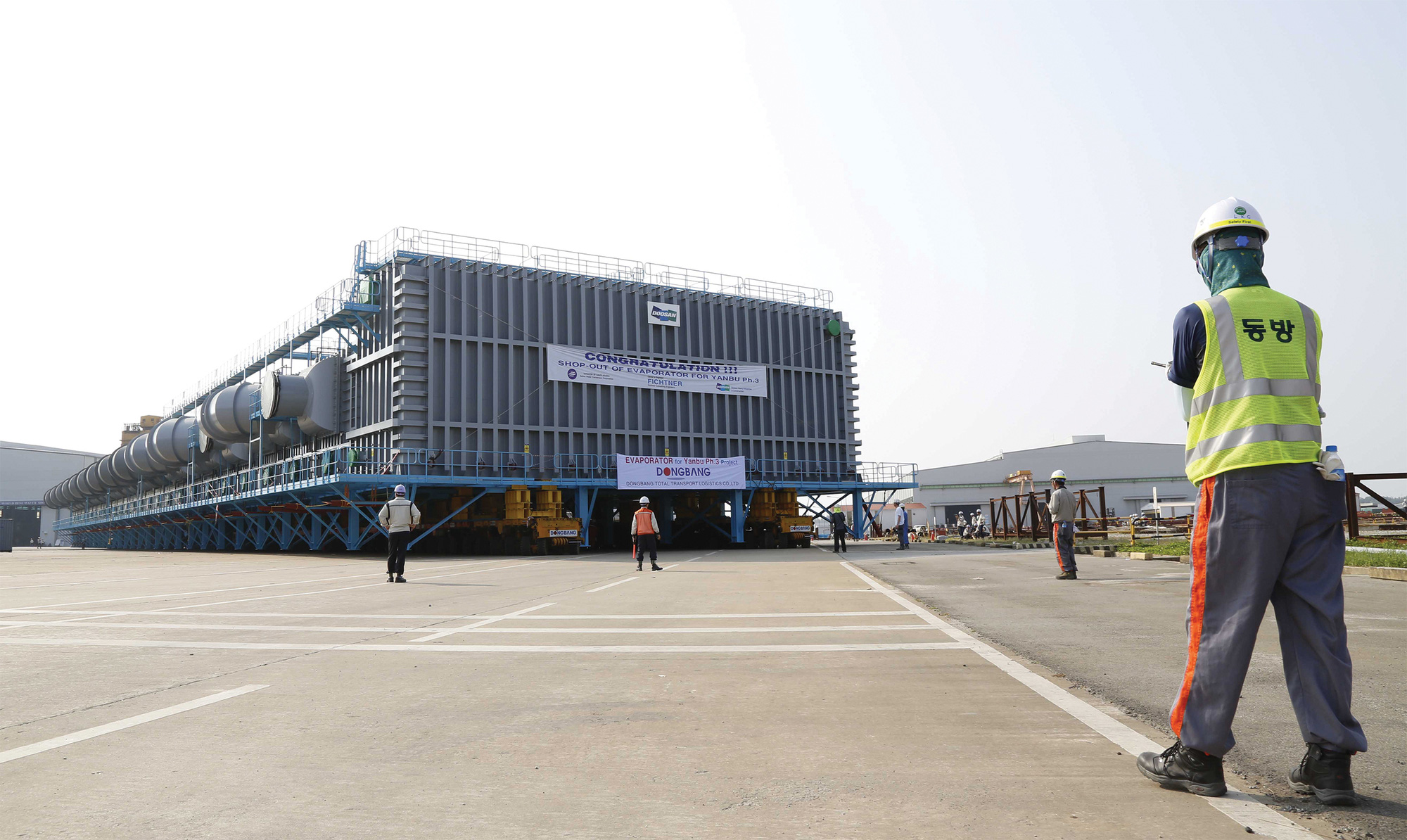
A 4,500-ton desalination machine manufactured by a Vietnamese FDI enterprise is being exported to Saudi Arabia. (Photo: DS)
In the office of Mr. Phan Huu Thang - former Director of the Foreign Investment Department, Ministry of Planning and Investment - the most prominent space is reserved for photographs he took with leaders and framed, color-printed statistics on FDI attraction from 1987 to 2000, hanging on the wall…
The first few months
At nearly 75 years old, the first director of the Foreign Investment Agency still seems to have plenty of energy when talking about attracting FDI.
Enthusiastically sharing about the projects he is working on in his role as chairman of the Vietnam Industrial Park Finance Association, he said that one of his biggest concerns is the still low occupancy rate in industrial parks.
Therefore, attracting investors, especially those in green finance and high-tech sectors, to industrial parks is what he wants to do most right now.
Recalling the past nearly four decades, he believes the journey of attracting FDI was filled with anxieties and caution. But then, when the first industrial park was opened in Dong Nai , the officials and leaders assigned to the task went to the site, personally arranging each desk and chair in the offices, their hearts filled with joy…
Initially, only Hanoi and Ho Chi Minh City had their projects approved, each with a capital investment of $40 million, while other localities received $10 million.
Gradually, localities began "competing" to issue permits. Mr. Thang recounted that back then, the permit issuance process was almost completed within a week, for many projects with small capital investments.
Riding the wave of FDI in the new era.
Over nearly four decades, Vietnam has been ranked among the top 16 most successful emerging economies in the world. Vietnam is gaining new strength and momentum in this era of national development.
Mr. Thang expects that Resolution 50 of the Politburo, with its shift in perspective from attracting FDI to a cooperative mindset, will contribute to improving productivity, quality, and restructuring the economy.
"Attraction is passive, involving inviting or even grabbing. But collaboration is a win-win situation, creating balance and a ripple effect."
"If we can do that, we can leverage the advantages of FDI flows and overcome internal shortcomings to build an independent and self-reliant economy..." - Mr. Thang said.
For effective FDI cooperation in the new context, the prerequisites are ensuring capital security, a favorable investment and business environment, unified and stable policies, and creating conditions for domestic enterprises to grow and cooperate.
Recounting the story of inviting Intel, Mr. Thang said it was a lesson about "preparing the nest to welcome the eagle" in the future.
At that time, the investment attraction team had a very compact composition, including Deputy Prime Minister and Minister of Foreign Affairs Pham Gia Khiem, a Deputy Minister of Science and Technology, the Secretary of the Ho Chi Minh City Party Committee, the Chairman of the Vietnam Chamber of Commerce and Industry (VCCI), and the Director of the Foreign Investment Agency. With a capital scale of 1 billion USD, Intel considered three locations: India, Thailand, and Vietnam.
In terms of comparative advantage, Vietnam is at a disadvantage. However, beyond meeting conditions such as location, human resources, and incentives, the most important factor in persuading investors was the confidence, determination, and decisiveness of Vietnamese leaders. Coupled with the potential they saw, Intel chose to locate its factory in the Ho Chi Minh City High-Tech Park in 2006, and it has been operating there ever since.
We need a strong team of domestic businesses.
However, concerns remain. According to Mr. Thang, FDI contributes 25% of total investment but accounts for up to 70% of exports.
We have not yet built a sufficient number of domestic businesses capable of cooperating and participating deeply in global supply chains.
The investment environment needs significant improvements, including reduced barriers and increased transparency, to attract more technology giants, emerging sectors like semiconductors, artificial intelligence, and the Internet of Things, as well as large investment funds.
Source: https://tuoitre.vn/goi-von-fdi-voi-vi-the-moi-20250107183441012.htm


![[Photo] Explore the US Navy's USS Robert Smalls warship](/_next/image?url=https%3A%2F%2Fvphoto.vietnam.vn%2Fthumb%2F1200x675%2Fvietnam%2Fresource%2FIMAGE%2F2025%2F12%2F10%2F1765341533272_11212121-8303-jpg.webp&w=3840&q=75)


![[Photo] The captivating scenery of the fragrant maple forest in Quang Tri](/_next/image?url=https%3A%2F%2Fvphoto.vietnam.vn%2Fthumb%2F1200x675%2Fvietnam%2Fresource%2FIMAGE%2F2025%2F12%2F10%2F1765353233198_lan09046-jpg.webp&w=3840&q=75)






















![[Video] The craft of making Dong Ho folk paintings has been inscribed by UNESCO on the List of Crafts in Need of Urgent Safeguarding.](https://vphoto.vietnam.vn/thumb/402x226/vietnam/resource/IMAGE/2025/12/10/1765350246533_tranh-dong-ho-734-jpg.webp)











































Comment (0)