

 |
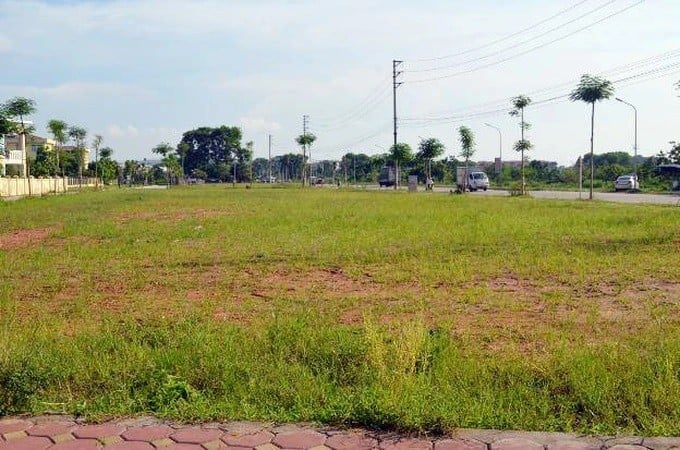
| Recent reports from several real estate research firms indicate that from Q2 2022 to Q2 2023, the land plot segment continued to experience very sluggish interest. (Source: Tien Phong Newspaper) |
Land auctions repeatedly suspended.
Recently, Dong Anh district (Hanoi City) has repeatedly posted notices temporarily suspending the organization of land use right auctions for the project to build technical infrastructure for the land use right auction area in Van Ha commune, Dong Anh district.
Specifically, on July 21st, Lac Viet Auction Company and Vietnam Auction Company simultaneously posted notices suspending the auction of land use rights for 28 plots in block LK1 and 20 plots in block LK3 of the project to build technical infrastructure for the land use rights auction area in Van Ha commune, Dong Anh district.
The reason for the suspension is based on Official Letter No. 1778/UBND-TNMT dated July 21st and Official Letter No. 755/QLDA-KHTH from the People's Committee of Dong Anh District and the Dong Anh District Investment and Construction Project Management Board regarding the temporary suspension of the land use rights auction at plots LK1 and LK3.
Previously, 28 plots of land in block LK1, ranging in size from 130.8 to 276.65 m2, were announced for auction on July 22nd with starting bids from 29.7 to 34.4 million VND/m2. Thus, the auction was unexpectedly suspended just one day before its scheduled date.
Twenty more plots of land in block LK3 were announced for auction on July 29th, with areas ranging from 126 to 270 m2 per plot and starting prices from 29.7 to 34.4 million VND/m2.
According to the announcement, customers who purchased auction participation documents and paid a deposit (if any) will have their document fees refunded within two working days from the date of the announcement (July 21).
In late April this year, Dong Anh district also announced the temporary suspension of land auctions for 44 plots of land in the X6 area of Ha Lo village, Lien Ha commune.
Accordingly, 44 plots of land will be auctioned in two phases, with the district auctioning 22 plots in each phase. As previously planned, the first phase of the land auction will be held on April 23rd and the second phase on May 6th. The plots of land range in size from 90 to 154 m2 per plot, with starting prices from 30.3 to 33.3 million VND/m2.
Previously, the auction of 44 plots of land that were temporarily suspended had been announced on March 18th. However, these plots were then announced for auction again in late April and early May before being suspended once more.
The real estate market remains sluggish due to buyer confidence.
Recent reports from several real estate research firms indicate that, from the second quarter of 2022 to the present, the land plot segment has continued to experience very sluggish interest.
When the market is booming, land plots receive a great deal of attention and are absorbed very quickly, but when the market slows down, land plots experience the deepest decline. This is because land plots are a segment with more speculative potential than a need for generating cash flow.
Some real estate experts assess that transactions in the land market remain sluggish due to buyer confidence. Difficulties regarding credit limits and loan interest rates have not been fully resolved, causing buyers to hesitate.
According to Mr. Nguyen Quoc Anh, Deputy General Director of Batdongsan.com.vn, real estate transactions are difficult to succeed because there is still a significant gap in expectations between sellers and buyers.
Specifically, according to the survey, among the reasons investors need to sell real estate, 49% are to restructure their investment portfolio; 23% are because they no longer need the property and are therefore selling it; and only 22% are due to financial difficulties, requiring them to transfer ownership to resolve economic problems.
"Because the number of sellers needing to 'get rid of' their properties due to financial difficulties is not high, most still hope to sell their real estate at a profit, with returns ranging from around 10%," Mr. Quoc Anh shared.
Regarding liquidity, many experts believe that if interest rates fall below 10% per year and the market warms up, the wave of real estate investment may resurface, and businesses may have more available cash flow.
Conversely, if lending interest rates remain high and the real estate market continues to be sluggish, then it is likely that money will remain in banks.
Could applying a 'K coefficient' to land prices 'miss' many large-scale projects?
Responding to the Ministry of Natural Resources and Environment 's request for comments and improvements to the draft Decree amending and supplementing Decree No. 44/2014/ND-CP on land prices, the Ho Chi Minh City Real Estate Association (HoREA) stated that the regulation requiring the application of the land price adjustment coefficient (K coefficient) method to land parcels and areas with a valuation price below 200 billion VND compared to the land price list is not realistic.
HoREA Chairman Le Hoang Chau said that the Association has just sent a document to the Prime Minister, the Ministry of Natural Resources and Environment, and the National Assembly's Economic Committee proposing the application of the "land price adjustment coefficient method" to calculate land use fees and land lease fees for all real estate and urban projects, without limiting it to "land plots with a value calculated according to the land price table below 200 billion VND."
According to Mr. Chau, Article 4 of the draft Decree amending and supplementing Decree No. 44/2014/ND-CP (Draft Decree No. 44) stipulates three methods for land valuation, including: the comparative method, the income method, and the land price adjustment coefficient method. Furthermore, the draft decree no longer includes the "surplus method".
Specifically, Clause 3 of Article 5 of the draft stipulates that "the land price adjustment coefficient method shall be applied to land valuation" in the case of: Determining the land price of a land parcel or area where the value calculated according to the land price table is less than 200 billion VND.
However, HoREA found that the regulation applying the "land price adjustment coefficient method" to land parcels and areas requiring a valuation of "less than 200 billion VND" compared to the land price list is unrealistic because it "omits" many larger-scale real estate, housing, and urban development projects.
"Because there is no suitable method to apply land valuation to the above cases, as the draft Decree 44 only stipulates 3 land valuation methods, and it is not possible to apply the comparative method or the income method to value land for calculating land use fees and land lease fees for land parcels and areas with a value exceeding 200 billion VND," Mr. Chau shared.
Therefore, in Mr. Chau's view, regulating the application of the land price adjustment coefficient method to all projects, regardless of whether the land plot or area is valued at "less than 200 billion VND according to the land price table" or "more than 200 billion VND," will contribute to ensuring transparency, fairness, and preventing revenue losses for the state budget.
Based on the analysis, the Chairman of HoREA emphasized that in order to meet practical requirements and apply the land price adjustment coefficient method to all real estate projects, commercial housing, and urban areas, the draft needs to remove the regulation "under 200 billion VND" and apply the land price adjustment coefficient method to all projects, regardless of whether the "land plot or area with a value calculated according to the land price table is under 200 billion VND" or "over 200 billion VND".
"If the regulations still stipulate that the land price adjustment coefficient method must be applied to land parcels and areas with a value below 200 billion VND, then the surplus method should be retained to determine the specific land price and calculate land use fees and land lease fees for land parcels and areas with development potential; large-scale land parcels and areas with a value exceeding 200 billion VND based on the land price in the land price table," Mr. Chau proposed.
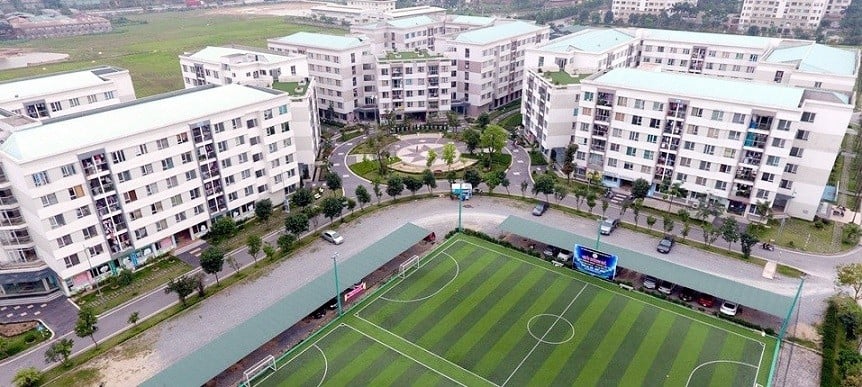 |
| Article 7 of the 2014 Housing Law clearly stipulates that there are three categories of entities entitled to own housing in Vietnam: domestic organizations, households, and individuals; Vietnamese people residing abroad; and foreign organizations and individuals as specified in Clause 1, Article 159 of this Law. (Source: Ministry of Construction) |
Conditions for recognizing ownership of housing
Article 8 of the 2014 Housing Law clearly stipulates the conditions for recognizing ownership rights to housing.
Who is eligible to own a home in Vietnam?
Article 7 of the 2014 Housing Law clearly stipulates that there are three categories of entities entitled to own housing in Vietnam: domestic organizations, households, and individuals; Vietnamese people residing abroad; and foreign organizations and individuals as specified in Clause 1, Article 159 of this Law.
Conditions for being recognized as having ownership rights to a house.
To be recognized as a homeowner, the first condition is that the applicant must be a domestic organization, household, or individual. For Vietnamese citizens residing abroad, they must have permission to enter Vietnam; for foreign organizations and individuals, they must meet the conditions stipulated in Article 160 of the 2014 Housing Law.
In addition, legal housing must be obtained through the following forms: For domestic organizations, households, and individuals, this can be through investment in construction, purchase, lease-purchase, receiving as a gift, inheritance, capital contribution, exchange of housing, and other forms as prescribed by law.
For Vietnamese people residing abroad, this can be done through purchasing or lease-purchasing commercial housing from real estate businesses or cooperatives (hereinafter referred to as real estate businesses); purchasing, receiving as a gift, exchanging, or inheriting housing from households or individuals; or receiving the transfer of land use rights in commercial housing construction investment projects that are permitted to sell land plots for self-construction of housing according to the law.
For foreign organizations and individuals, the procedures are as stipulated in Clause 2, Article 159 of the 2014 Housing Law.
Vingroup establishes a subsidiary with a charter capital of over 1.2 trillion VND in Nghe An.
Vingroup Corporation (stock code: VIC) has just announced a resolution regarding the separation of a subsidiary and the establishment of a new company.
Specifically, the Vingroup Board of Directors has approved the separation of Vinpearl Joint Stock Company, a subsidiary of the Group, and the establishment of a new subsidiary based on the separation of the aforementioned business, with the aim of restructuring internal ownership.
The newly established company is Vinpearl Cua Hoi Joint Stock Company, with its head office located at Binh Minh Street, Nghi Hai Ward, Cua Lo Town, Nghe An Province.
The projected charter capital of Vinpearl Cửa Hội is VND 1,263.8 billion. Of this, Vingroup's capital contribution is 99.99%. The company's main business is hotel and tourism services.
Prior to the separation and establishment of the new company, the Nghe An branch of Vinpearl Joint Stock Company was established in 2017. The representative of the branch was Ms. Vo Thi Phuong Thao.
In Nghe An, Vingroup is developing real estate projects such as Vinpearl Cua Hoi, Vincom Shophouse Vinh, and the renovation project of Zone B - Quang Trung apartment complex, Vinh City.
In 2022, Vinpearl Joint Stock Company collaborated with Melía Hotels International to announce a strategic cooperation roadmap. Melía Vinpearl Cửa Hội is one of 12 projects in which Vinpearl transferred management rights to Melía for a minimum period of 10 years.
This resort is a complex of villas and hotels spanning 38.7 hectares, comprising 184 hotel rooms located on an area of 5,000 square meters. The total investment for the project is nearly 900 billion VND. Construction began in June 2016 and the project was inaugurated in April 2017.
Source






















![[Photo] Prime Minister Pham Minh Chinh holds a phone call with the CEO of Russia's Rosatom Corporation.](/_next/image?url=https%3A%2F%2Fvphoto.vietnam.vn%2Fthumb%2F1200x675%2Fvietnam%2Fresource%2FIMAGE%2F2025%2F12%2F11%2F1765464552365_dsc-5295-jpg.webp&w=3840&q=75)










































Comment (0)