

The $13.7 billion arms deal with Poland—Seoul's largest ever—is seen as a milestone marking the strong development of its arms manufacturing industry, a stepping stone for South Korea to realize its ambition of becoming a top arms exporter.
A spectacular breakthrough
According to a report released by the South Korean Ministry of Defense , cited by the Korea JoongAng Daily, South Korea's arms sales in 2022 surged to over $17 billion, up from $7.25 billion the previous year. This dramatic increase of approximately 240% in a single year has made the country the world's eighth-largest arms exporter.
Seoul and Warsaw also agreed to establish a joint venture comprising defense companies from both countries, whereby South Korean weapons would be licensed for production in Poland, opening a gateway for South Korean weapons to enter Europe. It is expected that 500 out of 820 tanks and 300 out of 672 self-propelled artillery pieces under the agreement will be manufactured at factories in Poland, starting in 2026.
From the advantage of speed...
One reason Warsaw chose Seoul as its arms import partner was the speed of production. The first batch of 10 K2 Black Panther main battle tanks and 24 K9 Thunder self-propelled howitzers was delivered to Poland just months after the agreement was signed. Shortly after, another 5 tanks and 12 howitzers were delivered. In comparison, Hungary's order of 44 Leopard tanks from Germany, placed in 2018, has yet to be delivered to Budapest. The slow production speed of Germany's defense industry has led many partners to turn to South Korea as a promising alternative.
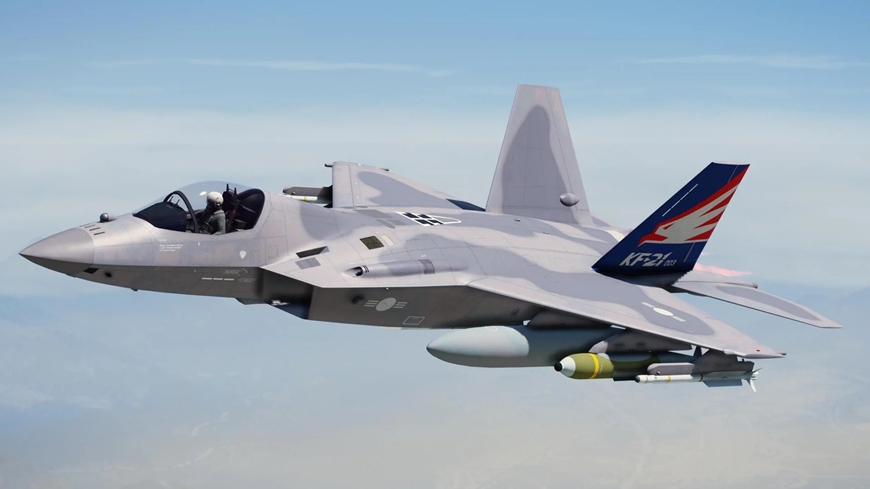 |
The KF-21 Boramae multirole stealth fighter jet of South Korea. Photo: mods.com |
...to the advantage of compatibility
A major advantage of South Korean weapons is their compatibility with US and NATO weapons systems. This means that when purchasing weapons from Seoul, EU countries—which traditionally rely on US arms supplies—essentially do not need to adjust or change their existing weapons systems. As a result, South Korea has become the third-largest arms supplier to NATO and its member states, accounting for 4.9% of the market share, according to the Stockholm International Peace Research Institute (SIPRI). However, this figure is still far behind the US (65%) and France (8.6%).
The compatibility of South Korean defense industry products with U.S. weapons systems is not only a deliberate choice but also a consequence of the transfer of technology from its ally, the United States, in building its military -industrial complex.
And the advantages of K-Defense
Cost-effectiveness, short delivery times, collaborative production, and technology transfer are some of the advantages that make South Korean weapons even more attractive. According to researcher Bang Jong-goan: "South Korean defense industry products have combat effectiveness equivalent to those of the US, UK, France, and Germany, but at a lower cost."
For example, in cold weather tests conducted by the Norwegian military, a South Korean K2 Black Panther tank costing $8.5 million demonstrated combat effectiveness equivalent to a German Leopard 2A7 tank costing $15.3 million.
This Northeast Asian nation is also a perfect testing ground for various types of weapons. Its diverse terrain, encompassing both flat and sloping landscapes, and the wide range of seasonal temperatures—from icy winters to scorching summers—allow for the production of a wide variety of weapons, meeting customer needs in all terrain and climate conditions.
 |
The K9 Thunder self-propelled artillery system is manufactured in South Korea. Photo: European Defence Review Magazine |
Market awareness
While automobile production is continuous and adjusted to consumer demand, the production of military equipment and weapons such as tanks, fighter jets, and self-propelled artillery is only carried out when orders are received. Ironically, while EU leaders were still debating with domestic businesses about whether the defense industry should prioritize production or wait for orders before ramping up, South Korean defense corporations were actively producing to meet Seoul's own defense needs while expanding their supply to the global market.
Understanding the reluctance of its partners to spend enormous sums on weapons, Seoul cleverly proposed cooperation with customers to establish production facilities and transfer technology in those countries. This helps them reduce their dependence on Seoul's production capabilities, easing the burden on South Korea, while simultaneously helping its partner nations strengthen their own defense industry production capabilities. The technology-sharing and defense cooperation agreements signed with India, Egypt, and Turkey mean that South Korea's weapons production capacity will significantly increase in the near future.
Global defense spending is projected to increase amid current global tensions. Based on this, South Korea aims to capture 5% of the global arms export market by 2027 and become the world's fourth-largest defense exporter.
Of course, South Korea is not the only player thriving in the global arms market. India, Turkey, Japan, and several other countries are also focusing their efforts on developing their defense industries to cope with the changing global security environment. To be competitive, Seoul will need to restructure its budget allocation, shifting from system development to technology research, diversifying its product range, and reducing its reliance on a few large companies.
HA PHUONG
Source



![[Photo] General Secretary and President To Lam presides over a meeting on preparations for the review of one year of operation of the three-tiered government system.](https://vphoto.vietnam.vn/thumb/1200x675/vietnam/resource/IMAGE/2026/06/02/1780391821195_a1-bnd-4595-9717-jpg.webp)






















































Comment (0)