

Singapore is accelerating the expansion of the District Cooling System (DCS), located underground in the Marina Bay area, which is considered the largest underground cooling network in the world today.
This is a key solution in the sustainable urban strategy, optimizing energy and space in the financial center of the island nation.
Currently, DCS is providing chilled water-cooled air conditioning to 27 buildings in the Marina Bay Financial District.
By 2030, the network will serve up to 50 buildings, as demand from new commercial and development projects continues to grow, according to Singapore Power (SP).
Speaking to VNA reporters in Singapore, Mr. Steve Seah, Director of SP's Sustainable Energy Solutions Project Management Board, said the system is designed according to a flexible expansion model.
“As more buildings choose to use chilled water from our system, the plant can easily increase its capacity. The design allows for additional chillers to be installed in stages, ensuring the network can always meet demand,” he said.

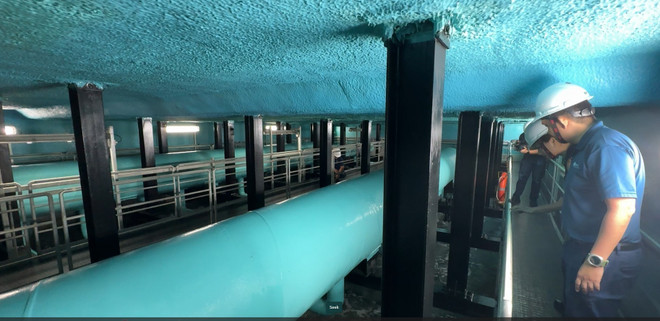
One of the key factors for the efficient operation of the network is that the system is completely underground.
DCS's chilled water pipes are deployed in the Common Service Tunnel - an underground tunnel that integrates many utilities such as electricity, wastewater and urban technical infrastructure systems.
Mr Steve Seah stressed that placing the entire network in underground tunnels brings three major benefits.
Firstly, it helps reduce the impact on the ground, avoiding excavation or disruption of urban activities in high-density construction areas such as Marina Bay.
Second is the optimization of connection, new buildings can quickly access the air conditioning system, shortening the system deployment time compared to installing separate equipment.
Third, the tunnel is extended to new developments, allowing SP to add pipelines and expand the network without affecting upstream operations.
The Marina Bay Cooling System operates through two plants located at Raffles Quay and Marina Bay Sands, connected by a series of underground pipes.
This strategic location helps distribute the cooling load evenly throughout the area, ensuring stability and high efficiency even during peak electricity consumption periods.
According to Mr. Steve Seah, this centralized model significantly reduces the area required for individual cooling systems in each building, thereby freeing up valuable commercial space.
In addition, centralized operations help optimize energy efficiency and reduce carbon emissions – in line with Singapore's urban greening goals.
Since the formation of the Marina Bay master plan, the Urban Redevelopment Authority of Singapore (URA) has worked closely with SP to incorporate district cooling infrastructure into the urban design.
This integration enables seamless underground piping networks between buildings, reducing individual investment costs and providing clear economic advantages for building owners when choosing DCS.
“The underground piping allows buildings to access district cooling more easily, while also saving significant costs compared to running their own chilled water systems. This is a sustainable and efficient solution for a high-density financial centre like Marina Bay,” said Mr. Steve Seah.
Singapore first deployed this cooling system in May 2006 at Raffles Quay, initially serving 15 buildings and now after expansion, the capacity has increased to 27 buildings./.
Source: https://www.vietnamplus.vn/he-thong-lam-mat-ngam-giai-phap-do-thi-ben-vung-cua-singapore-post1080913.vnp


![[Photo] Cat Ba - Green island paradise](/_next/image?url=https%3A%2F%2Fvphoto.vietnam.vn%2Fthumb%2F1200x675%2Fvietnam%2Fresource%2FIMAGE%2F2025%2F12%2F04%2F1764821844074_ndo_br_1-dcbthienduongxanh638-jpg.webp&w=3840&q=75)









































![[VIMC 40 days of lightning speed] Da Nang Port: Unity - Lightning speed - Breakthrough to the finish line](https://vphoto.vietnam.vn/thumb/402x226/vietnam/resource/IMAGE/2025/12/04/1764833540882_cdn_4-12-25.jpeg)





































Comment (0)