

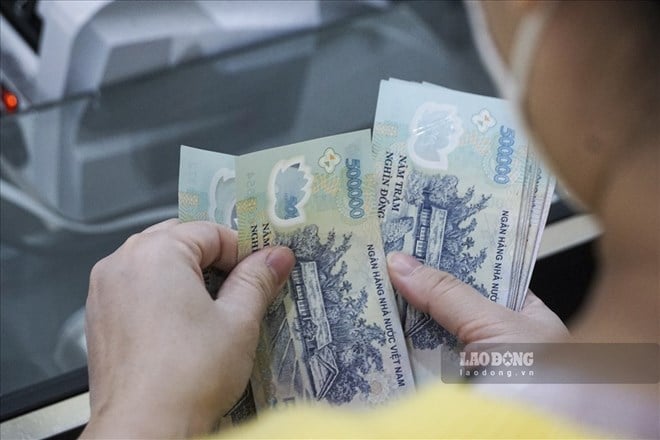
What is an overdraft loan?
An overdraft is a form of lending offered by credit institutions. Under this scheme, debit cardholders are allowed by the bank to spend more than the available balance in their checking account. This excess amount is called the overdraft limit. The bank will charge interest on the amount spent in excess of the limit.
For example: The bank grants the account holder an overdraft limit of 20 million VND. The actual balance in the account is 20 million VND. This means you are allowed to spend a maximum of 40 million VND. If you spend 25 million VND, the excess amount spent is 5 million VND. The bank will charge interest on this 5 million VND until you repay the excess amount.
Overdraft loans are mostly used to meet urgent borrowing needs for a short period. However, the interest rates are usually high, so people need to consider carefully before taking them.
Overdue overdraft
When a customer is unable to pay the full amount of interest and principal as stipulated in the contract by the due date, their debt will become overdue overdraft debt.
When overdrafts become overdue, borrowers will incur penalties, penalty interest, and other costs associated with debt management.
If the borrower fails to repay or makes only partial repayments of the overdraft balance exceeding the limit, the bank will terminate the loan and prematurely recover the entire overdraft balance.
For overdraft loans, borrowers who fail to make timely payments may have their cases transferred to debt collection companies, lose credit scores, or be taken to court to resolve disputes over the debt.
For example, you are granted an overdraft limit, specifically allowing you to spend more than the actual amount in your account, up to 100 million VND, for a period of one year. However, due to a late payment of 10 million VND, you are placed on the bad debt list (group 2).
To be removed from this list, borrowers must repay all their bank debts on time within 3 months.
Within 12 months from the date the Group 2 debt was incurred, if the borrower repays on time, their bad debt history on the Credit Information Center (CIC) will be cleared, and only then will they be able to borrow from banks as before.
Source


![[Photo] Prime Minister Pham Minh Chinh holds a phone call with the CEO of Russia's Rosatom Corporation.](/_next/image?url=https%3A%2F%2Fvphoto.vietnam.vn%2Fthumb%2F1200x675%2Fvietnam%2Fresource%2FIMAGE%2F2025%2F12%2F11%2F1765464552365_dsc-5295-jpg.webp&w=3840&q=75)

![[Photo] Closing Ceremony of the 10th Session of the 15th National Assembly](/_next/image?url=https%3A%2F%2Fvphoto.vietnam.vn%2Fthumb%2F1200x675%2Fvietnam%2Fresource%2FIMAGE%2F2025%2F12%2F11%2F1765448959967_image-1437-jpg.webp&w=3840&q=75)








































![[OFFICIAL] MISA GROUP ANNOUNCES ITS PIONEERING BRAND POSITIONING IN BUILDING AGENTIC AI FOR BUSINESSES, HOUSEHOLDS, AND THE GOVERNMENT](https://vphoto.vietnam.vn/thumb/402x226/vietnam/resource/IMAGE/2025/12/11/1765444754256_agentic-ai_postfb-scaled.png)








































Comment (0)