

According to experts from the Institute of Geology, the land subsidence in some residential areas occurs because the topsoil layer on carbonate rocks is being eroded underground into the karst caves beneath.
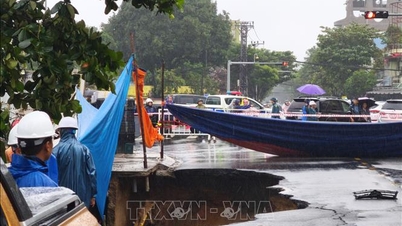
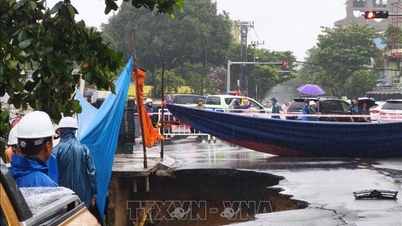
Land subsidence in Nam Son 2 area, Cam Pha, Quang Ninh from July 30 to the morning of August 1 caused the asphalt road and part of the sidewalk to sink 2.5m deep and 5m in diameter.
According to Dr. Tran Quoc Cuong from the Institute of Geology, Vietnam Academy of Science and Technology, there are two types of sinkholes (also known as death holes). Firstly, they are caused by the development of underground karst caves and the presence of weak soil layers in coastal areas. Secondly, they are triggered by factors such as fluctuations (raising and lowering) in groundwater levels related to tides and rainfall, increased load from structures, and backfilling soil layers.
In Vietnam, areas with similar geological conditions have experienced land subsidence due to karst underground spaces, such as: Quy Hop (Nghe An), Thuy Nguyen (Hai Phong); Bang Lung, Cho Don ( Bac Kan ). In Quy Hop, Nghe An, there were 11 subsidence points in just two months of 2021. Many sinkholes were 2-7 meters wide and 2-2.5 meters deep.
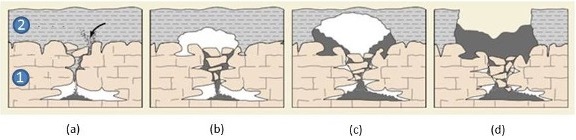
The subsidence process is illustrated in the figure below, with an example of a sinkhole located directly above the karst underground space (drainage zone). The development process from a to d is shown in the figure, where 1 (carbonate rock) and 2 (weak soil layer covering the surface of the underground carbonate rock).
Research by the Institute of Geology shows that in coastal areas, due to erosion of the cover layer above carbonate rocks (limestone), underground erosion occurs into the karst caves beneath. Due to stimulating factors, material from the vulnerable soil layer is eroded and drawn into the underground space through cracks and fracture zones of the carbonate rocks at the cave ceiling. The loss of the vulnerable layer can also occur at karst sinkholes.
Geological and tectonic structures are also considered indirect causes, creating favorable conditions for subsidence development. The development of land reclamation layers, especially in reclaimed land areas, also contributes to accelerating land subsidence processes. In addition, a significant triggering factor is groundwater level fluctuations related to tides and rainfall. According to Mr. Cuong, more detailed assessments are needed soon to support urban management and minimize the impact of land subsidence hazards.

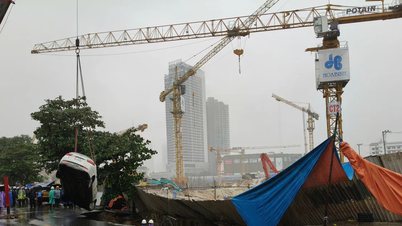
A sinkhole approximately 2.5 meters deep and 5 meters in diameter has appeared in Cam Pha City. Photo: Bao Long
According to experts from the Institute of Geology, people can identify signs related to land subsidence through unusual depressions or sinkholes on roads, cracks in walls, water loss, or a sudden increase in water consumption as shown on the meter (due to broken or damaged water supply systems caused by sinkholes).
For residential buildings in areas prone to sinkholes, Mr. Cuong advised that pile foundations should be used to minimize property damage.
Nhu Quynh
Source link























![[Image] Close-up of the newly discovered "sacred road" at My Son Sanctuary](/_next/image?url=https%3A%2F%2Fvphoto.vietnam.vn%2Fthumb%2F1200x675%2Fvietnam%2Fresource%2FIMAGE%2F2025%2F12%2F13%2F1765587881240_ndo_br_ms5-jpg.webp&w=3840&q=75)

































































Comment (0)