

 |
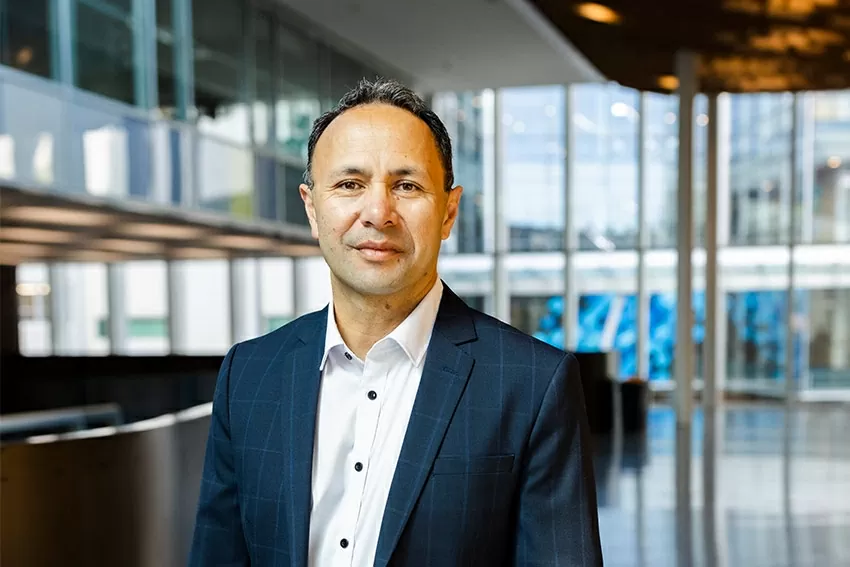
| Professor Damon Salesa, Vice-Chancellor of Auckland University of Technology (AUT) in New Zealand. (Source: AUT) |
Sharing his thoughts on the occasion of the 50th anniversary of the establishment of diplomatic relations between Vietnam and New Zealand (June 19, 1975 - June 19, 2025), Professor Damon Salesa, President of Auckland University of Technology (AUT), emphasized that New Zealand was one of the first countries to establish diplomatic relations with Vietnam after the reunification of this Southeast Asian nation.
Since then, Vietnam has been one of New Zealand's main trading partners, with the bilateral relationship developing steadily and becoming increasingly strong, as evidenced by the upgrading of Vietnam and New Zealand's relationship to a Comprehensive Strategic Partnership during New Zealand Prime Minister Christopher Luxon's visit to Vietnam in February.
As a member of the high-level delegation accompanying New Zealand Prime Minister Christopher Luxon on this visit, Professor Damon Sales believes that upgrading the relationship to a Comprehensive Strategic Partnership reflects the growing trust, shared values, and expanding opportunities between the two countries.
"The new framework is stronger and more structured for collaboration and co-creation between the two countries across all sectors, opening the door to greater government support for academic and research partnerships, student exchanges, and fostering joint investment in innovation initiatives and capacity building," the New Zealand scholar noted.
According to him, this is also an important milestone, demonstrating the high level of trust, ambition, and strategic alignment between the two countries, especially in the areas of economics, trade and investment, defense and security, education, and people-to-people connections. He also noted that both Vietnam and New Zealand have great ambitions to promote growth, with both sides aiming to increase trade turnover to US$3 billion by 2026.
New Zealand scholars have particularly noted that education is one of the key pillars in strengthening bilateral relations. New Zealand's world-class universities, including Auckland University of Technology (AUT), have built strong partnerships with Vietnamese higher education institutions through student and staff exchanges, joint research and programs, and capacity-building initiatives, initially the Colombo Plan and now the Manaaki Scholarship.
"These academic relationships lay the groundwork for broader collaboration in key areas in the future, supported by the rapid development of information technology and artificial intelligence (AI)," Professor Damon Sales emphasized.
During Prime Minister Luxon's visit, AUT signed a Memorandum of Understanding with Vietnam National University – Ho Chi Minh City University of Science (VNU-HCMUS) to expand its historic relationship with a new focus on research in computer science, AI, data science, and human-computer interaction.
Professor Damon Salesa affirmed that the memorandum of understanding between AUT and VNU-HCMUS helps to connect and bring Vietnam and New Zealand closer together, playing an important role in conducting research and training students right here in Vietnam to help Vietnam address its skills shortage.
As New Zealand's only technology university, AUT is uniquely positioned to support countries in the region, such as Vietnam, in conducting research, promoting common progress, and contributing to the new technology economy.
Vietnam is one of the most digitally connected countries in the Asia-Pacific region, boasting some of the best digital infrastructure in Asia and a digital economy estimated to grow by 20% annually. Meanwhile, New Zealand possesses expertise in ethical AI, digital inclusion, and technology-driven sustainable development areas, where significant shared value can be created and collaborations strengthened in fields such as digital transformation, the green economy, sustainable energy development, and high-tech agriculture.
Although relations between the two countries have developed significantly, Professor Damon Salesa believes there are still areas where Vietnam and New Zealand can further strengthen cooperation, including education with great potential for student exchange.
"This is a meaningful form of cooperation that helps build mutual understanding, strengthen people-to-people relationships, and train future leaders with a global mindset and cultural understanding," he said.
However, student exchange programs between New Zealand and Vietnam remain limited, despite Vietnam's vibrant culture, dynamic economy, and increasingly important role in the Asia-Pacific region. Professor Damon Salesa suggests several reasons for this imbalance, including the relatively low perception of Vietnam as a potential exchange or internship destination in New Zealand. Additionally, language barriers and logistical challenges make Vietnam a less viable study destination for many students.
Therefore, he suggested that better promotion of Vietnam as a potential destination, increased scholarships, and funding for exchanges at both institutional and government levels to make exchanges more accessible and attractive would be helpful. In addition, he recommended reopening direct flights between the two countries.
"The potential for cooperation between the two countries is enormous, both bilaterally and internationally. As two dynamic nations in the Asia-Pacific region, Vietnam and New Zealand share many common interests in sustainable development, education, innovation, trade, and regional stability. There are clear opportunities to expand relations in areas such as digital transformation, agriculture, tourism, education, and research to leverage the strengths of both countries. Universities can play a crucial role as a bridge connecting knowledge, people, and industries of the two countries," Professor Damon Salesa affirmed.
On the international stage, Vietnam and New Zealand also have great potential for cooperation on global issues such as climate change, food security, digital equity, and security within forums such as the Asia-Pacific Economic Cooperation (APEC) and the Comprehensive and Progressive Trans-Pacific Partnership (CPTPP).
Professor Damon Salesa concluded that success will be determined by the goodwill of both countries in engaging in a long-term strategic partnership by building a shared vision and investing in people, innovative, resilient, and globally connected infrastructure. In particular, education plays a crucial role in contributing to the future success of the partnership between the two countries, as well as Vietnam-New Zealand's contributions to the global community.
Source: https://baoquocte.vn/hoc-gia-new-zealand-giao-duc-gan-ket-con-nguoi-va-quan-he-song-phuong-318121.html


![[Photo] Prime Minister Pham Minh Chinh holds a phone call with the CEO of Russia's Rosatom Corporation.](/_next/image?url=https%3A%2F%2Fvphoto.vietnam.vn%2Fthumb%2F1200x675%2Fvietnam%2Fresource%2FIMAGE%2F2025%2F12%2F11%2F1765464552365_dsc-5295-jpg.webp&w=3840&q=75)


![[Photo] Closing Ceremony of the 10th Session of the 15th National Assembly](/_next/image?url=https%3A%2F%2Fvphoto.vietnam.vn%2Fthumb%2F1200x675%2Fvietnam%2Fresource%2FIMAGE%2F2025%2F12%2F11%2F1765448959967_image-1437-jpg.webp&w=3840&q=75)




































![[OFFICIAL] MISA GROUP ANNOUNCES ITS PIONEERING BRAND POSITIONING IN BUILDING AGENTIC AI FOR BUSINESSES, HOUSEHOLDS, AND THE GOVERNMENT](https://vphoto.vietnam.vn/thumb/402x226/vietnam/resource/IMAGE/2025/12/11/1765444754256_agentic-ai_postfb-scaled.png)








































Comment (0)