

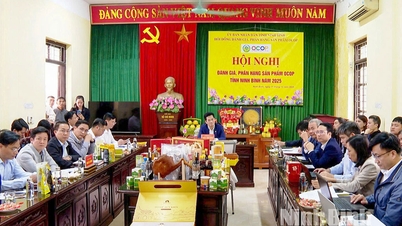
On the morning of December 12th, Ninh Binh province, in coordination with the Ministry of Construction and the Ministry of Culture, Sports and Tourism, organized a scientific conference on the theme "Discussing Millennium Heritage Cities and Policy Implications for Ninh Binh Province". Attending and chairing the conference were: Associate Professor Dr. Doan Minh Huan, Member of the Central Committee of the Communist Party of Vietnam and Secretary of the Provincial Party Committee; Dr. Nguyen Tuong Van, Deputy Minister of Construction; and Dr. Hoang Dao Cuong, Deputy Minister of Culture, Sports and Tourism.
Also attending were: Mai Van Tuat, Standing Deputy Secretary of the Provincial Party Committee and Chairman of the Provincial People's Council; Pham Quang Ngoc, Deputy Secretary of the Provincial Party Committee and Chairman of the Provincial People's Committee; Assoc. Prof. Dr. Nguyen Ngoc Ha, Deputy Editor-in-Chief of the Communist Magazine; experts, scientists , and managers; members of the Standing Committee of the Provincial Party Committee; leaders of the Provincial People's Council, Provincial People's Committee, and the Provincial National Assembly Delegation; members of the Provincial Party Committee; and leaders of departments, agencies, and localities in the province.
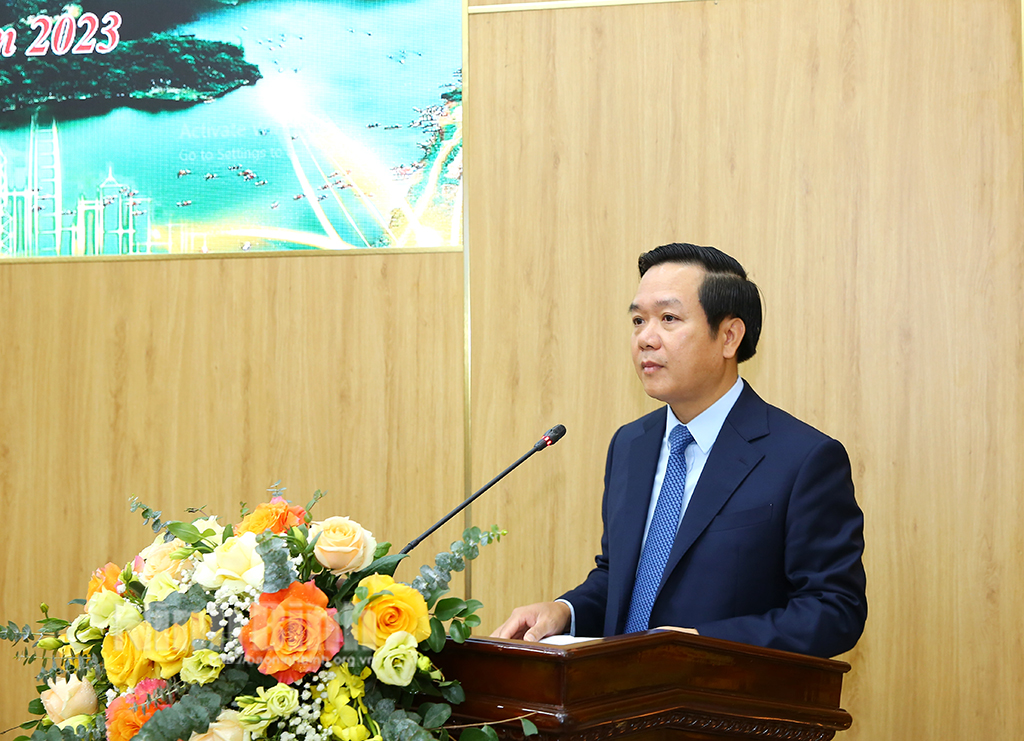
In his opening remarks at the conference, Comrade Pham Quang Ngoc, Deputy Secretary of the Provincial Party Committee and Chairman of the Ninh Binh Provincial People's Committee, emphasized: Throughout the thousands of years of our nation's history of building and defending the country, Ninh Binh has always been a strategic area, marking glorious historical milestones in protecting the independence, sovereignty , and territorial integrity of the nation. Currently, the remnants of Hoa Lu Ancient Capital in Truong Yen commune, Hoa Lu district, are one of the four core areas of the Trang An Scenic Landscape Complex, with two outstanding elements of culture and nature. It was recognized by UNESCO as a World Cultural and Natural Heritage site in 2014, the first and only dual World Heritage site in Southeast Asia; and has been assessed by the Director-General of UNESCO as one of the exemplary models in the world for successfully combining economic development and sustainable tourism while respecting nature and ensuring a harmonious balance of interests for the people, the State, and businesses.
Continuing the glorious historical tradition of our ancestors, in recent years, under the leadership and guidance of the Central Government, the Party Committee, government, and people of Ninh Binh have always been united, proactive, and creative, promptly identifying potentials and strengths and making timely, correct, and steadfast decisions to implement the "Green, Sustainable, and Harmonious" development strategy. This has helped Ninh Binh achieve comprehensive development: the economy has continuously grown at a considerable rate, its scale has expanded, and its structure has shifted in the right direction; since 2022, it has become a province that balances its own state budget and regulates revenue to the Central Government; per capita income by the end of 2022 ranked 12th out of 63 provinces and cities nationwide. In particular, Ninh Binh has developed harmoniously across regions and, along with the development process, has preserved its unique values and identity. Ninh Binh's tourism industry has made significant strides, ranking among the top 10 provinces with the highest number of visitors and becoming one of the key tourist destinations both domestically and internationally.
Given its unique natural, cultural, and historical characteristics and potential, the Party Committee and people of Ninh Binh province are determined to build Ninh Binh into a Millennium Heritage City and a centrally-governed city by 2035. This goal is consistent with the potential of Ninh Binh and the general development trends worldwide.
On August 23, 2023, the Ninh Binh Provincial Party Committee issued Resolution No. 16-NQ/TU on the reorganization of district and commune-level administrative units in Ninh Binh province for the period 2023-2030, which includes the following objectives by 2025: "To merge Ninh Binh City and Hoa Lu District, and simultaneously reorganize the subordinate commune-level administrative units, while defining the nature of the new administrative unit after the merger as a 'Ancient Capital - Heritage City,' based on unique values in natural geography - ecology, culture - history, and possession of world cultural and natural heritage. Simultaneously, to complete the criteria for recognizing the new merged administrative unit as a Type I city directly under the province" and the objective: "Towards building Ninh Binh province to basically meet the criteria of a centrally-administered city before 2030".
Comrade Pham Quang Ngoc, Chairman of the Provincial People's Committee, clearly stated: The strategic issue for Ninh Binh province is to build and develop Ninh Binh into a "Millennium Heritage City - Towards a centrally-governed city". According to Decision No. 1266 dated July 28, 2014, of the Prime Minister approving the General Planning of Ninh Binh urban area until 2030, with a vision to 2050; out of the total area of 21,000 hectares of Ninh Binh urban area, the Trang An World Cultural and Natural Heritage site accounts for approximately 12,000 hectares (57%), of which the core heritage area is 6,000 hectares, most notably Hoa Lu Ancient Capital with thousands of years of history as the capital of the first centralized feudal state of Vietnam.
According to the approved plan for administrative unit reorganization in the province, Ninh Binh city and Hoa Lu district will be merged to become one urban area, tentatively named Hoa Lu City. This means that almost the entire area of the Ninh Binh urban master plan will become Hoa Lu City in the future, and nearly 30% of the new city's area will be World Cultural and Natural Heritage sites.
To ensure the conference achieves high results, and to receive insightful contributions from researchers, experts, scientists, managers, and distinguished delegates, Chairman of the Provincial People's Committee Pham Quang Ngoc respectfully requests in-depth opinions focusing on two main points:
Firstly: Discussing millennium heritage cities, including the exchange of opinions on the scientific and practical basis for building urban criteria and classifying specific urban areas, suitable to the characteristics, forms, and functions of urban areas based on the cultural and ecological values of Ninh Binh province.
Secondly: Focus on clarifying the heritage value of Ninh Binh to serve as a basis for evaluating and analyzing achievements, limitations, causes, and drawing lessons learned. Based on that, propose tasks, solutions, and specific mechanisms and policies to promote the outstanding and unique cultural and historical values of the people and land of the ancient capital of Hoa Lu.
In this context, the group of mechanisms and policies plays a particularly important role and significance, serving as tools to support, encourage, motivate, promote, and maximize internal resources for investment and development. To fully utilize the province's potential and strengths, and to achieve the goal of building Hoa Lu city into a Millennium Heritage City in the future, Ninh Binh needs strong and appropriate mechanisms and policies.
Therefore, the focus will be on proposing a group of mechanisms and policies related to planning; a group on the preservation, restoration, and promotion of historical relics and heritage values; a group of urbanization methods and urban classifications suitable for the functions of heritage cities, avoiding the pressure of the "compact city" model that conflicts with the requirements for preserving and promoting the value of world cultural and natural heritage; creating suitable residential and livelihood models for residents in heritage cities aimed at effectively addressing both preservation and development goals; expanding opportunities for cooperation and promoting connectivity between heritage cities worldwide. The group of mechanisms and policies creating resources will focus on accessing capital for development investment; the group of mechanisms and policies on attracting investment will focus on considering specific mechanisms and policies regarding planning, land, and investment procedures to attract investors. A group of mechanisms and policies related to training and improving the quality of human resources.
The Chairman of the Provincial People's Committee expressed confidence that the issues discussed and analyzed through the presentations and exchanges at the conference would yield important and useful results for the management and development of Ninh Binh's millennium heritage city; promoting the outstanding and unique cultural and historical values of the people and land of the ancient capital of Hoa Lu and the outstanding global value of the Trang An World Cultural and Natural Heritage Site; and gradually building Ninh Binh province to basically meet the criteria of a centrally-governed city before 2030 and become a centrally-governed city by 2035, a typical millennium heritage city in the Asia-Pacific region.
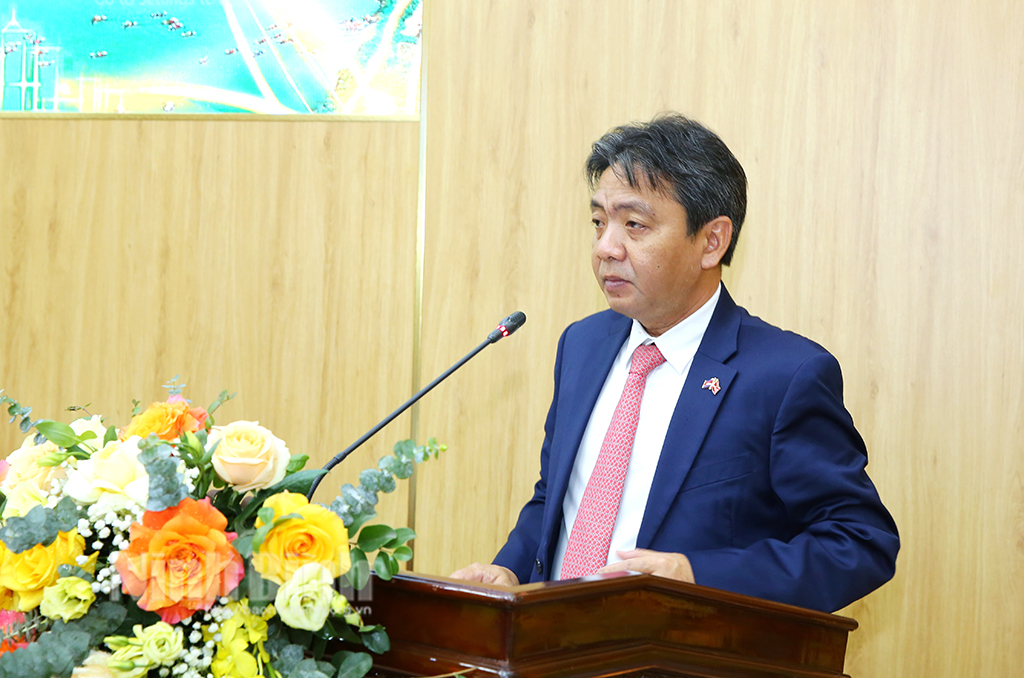
Speaking at the conference, Deputy Minister of Culture, Sports and Tourism Hoang Dao Cuong outlined the foundations for developing Ninh Binh city as a heritage, tourism, and scenic city. These include unique natural resources and natural heritage; typical cultural, historical, architectural, and humanistic heritage with significant potential for development within the context of national cultural and historical heritage; and Ninh Binh city and its surrounding areas being located within a cultural, historical, and natural landscape region, connecting with the Kim Son and Phat Diem coastal areas. Importantly, Ninh Binh city is not yet fully industrialized, and its development is still in its formative stages, offering ample opportunity for creating a new, unique, and distinctive model.
According to Deputy Minister Hoang Dao Cuong, the overarching and long-term principle is that Hoa Lu is a city where local people enjoy a peaceful life, and where people from other places find a place where history, nature, and the present coexist, a place where they can enrich their historical knowledge, enjoy sightseeing, and participate in cultural and sporting activities, festivals, etc., in a way that cannot be found anywhere else.
To further clarify issues related to heritage and urban development, and to offer Ninh Binh insights into establishing standards and robust mechanisms and policies for building a Millennium Heritage City in the future, the conference devoted considerable time to listening to presentations from experts, scientists, and managers.
Ninh Binh Newspaper will continue to update the content of the Conference.
Song Nguyen - Anh Tuan
Source











![[Image] Close-up of the newly discovered "sacred road" at My Son Sanctuary](/_next/image?url=https%3A%2F%2Fvphoto.vietnam.vn%2Fthumb%2F1200x675%2Fvietnam%2Fresource%2FIMAGE%2F2025%2F12%2F13%2F1765587881240_ndo_br_ms5-jpg.webp&w=3840&q=75)












































Comment (0)