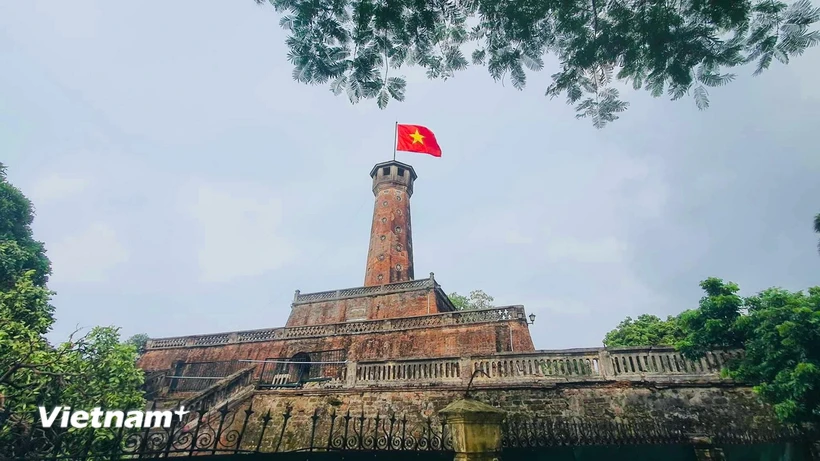
Anyone who has the opportunity to visit the flagpoles at famous landmarks in Vietnam cannot miss the chance to check in as a way of confirming that they have set foot there. Hanoi Flagpole. (Photo: Vietnam+)
Along the S-shaped strip of land that is Vietnam, from the northernmost point in Lung Cu, Ha Giang province, to the southernmost point at Rach Tau Cape, Ca Mau province, there are not only mountains, forests, and seas, but also famous flagpoles renowned for their sacredness, marking territorial sovereignty , maritime sovereignty, and the historical values they embody, expressing national pride as the national flag flies proudly in the wind. Anyone who has the opportunity to visit these flagpoles at famous landmarks in Vietnam cannot miss the chance to check in as a way of confirming their presence there.
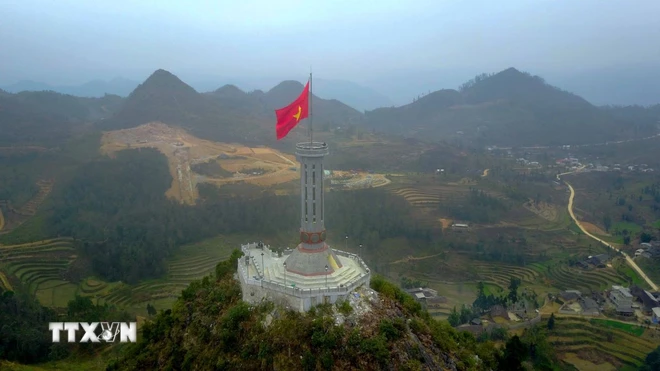
Lung Cu Flagpole
The Lung Cu Flagpole is a popular check-in spot for tourists visiting Ha Giang . This sacred structure, located at the northernmost point of the country, has a long history and has undergone numerous restorations and renovations. The current flagpole is over 30 meters high, octagonal in shape, decorated with Dong Son bronze drums, and topped with a 54m² national flag. The Lung Cu Flagpole is situated at an altitude of nearly 1,500 meters above sea level, approximately 3.3 km as the crow flies from the northernmost point of Vietnam and 24 km from Dong Van town. Built after the model of the Hanoi Flagpole, the flagpole has a total height of 34.85 meters and a flag measuring 54m², symbolizing the 54 ethnic groups living together in harmony and unity on Vietnamese territory. The flagpole's shaft is octagonal in shape, adorned with eight bronze drums and eight blue stone reliefs illustrating different periods of the country's history, as well as the people and customs of the ethnic groups of Ha Giang. To reach the top of the flagpole, visitors must climb 839 steps. The first section consists of 425 stone steps, from the foot of the mountain to the waiting area; the second section has 279 stone steps, from the waiting area to the base of the flagpole; and the third section has 135 steel steps inside the flagpole. At the top is an approximately 8-meter-high stainless steel pole, displaying the national flag, which is 9 meters long and 6 meters wide. Below the flagpole is a memorial house showcasing tools, costumes, and cultural products of the ethnic groups of Ha Giang. (Photo: Thanh Dat/VNA)
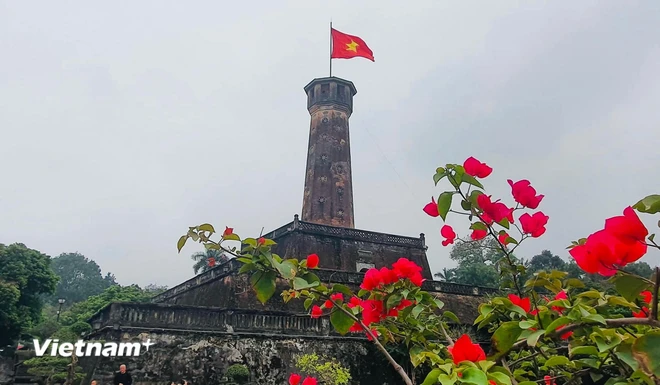
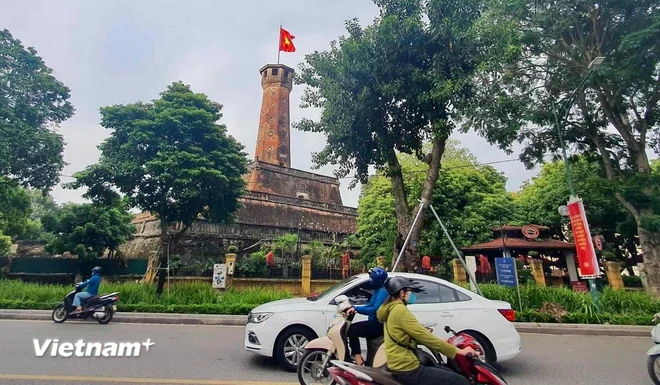
Hanoi Flagpole
The "Hanoi Flagpole" monument, located on Dien Bien Phu Street in Ba Dinh District, Hanoi, was built in 1812 during the reign of King Gia Long of the Nguyen Dynasty on the southern part of Thang Long Imperial Citadel, where the Tam Mon Gate of Thang Long Imperial Citadel was built during the Le Dynasty. This serves as a landmark, marking the starting point at the southern end of the central axis of the citadel. From here, following the "fishing path," through Doan Mon Gate, and then to the most important point, the center of the Imperial Citadel, the Kinh Thien Palace. The Hanoi Flagpole is now the most intact and magnificent structure in the Thang Long Imperial Citadel complex. The flagpole consists of three base levels and a column. The base levels are truncated square pyramids, gradually decreasing in size, stacked on top of each other, and clad in brick. The first level is 42.5m long on each side and 3.1m high, with two brick staircases leading up. The second level is 27m long on each side; The flagpole is 3.7m high and has four doors. The east-facing door has the inscription "Nghênh Húc" (welcoming the morning light), the west-facing door has the inscription "Hồi Quang" (reflected light), the south-facing door has the inscription "Hướng Minh" (facing the light), and the north-facing door has no inscription. The third level, each side measuring 12.8m and 5.1m high, has a staircase leading to the north. Above this level is the flagpole itself, 18.2m high; an octagonal cylinder, tapering towards the top, with each base side measuring approximately 2m. Inside the cylinder is a spiral staircase with 54 steps leading to the top. The entire structure is illuminated (and ventilated) by 39 fan-shaped openings. The top of the flagpole is an octagonal pavilion, 3.3m high, with eight windows corresponding to the eight sides. In the center of the pavilion is a cylindrical structure, 40cm in diameter and reaching the top, where the flagpole (8m high) is inserted. The entire flagpole is 33.4m high, or 41.4m including the flagpole itself. The Hanoi flagpole is one of the most intact and magnificent structures in the Thang Long Imperial Citadel area of Hanoi, which was recognized as a UNESCO World Heritage Site in 2010.
Nam Dinh flagpole
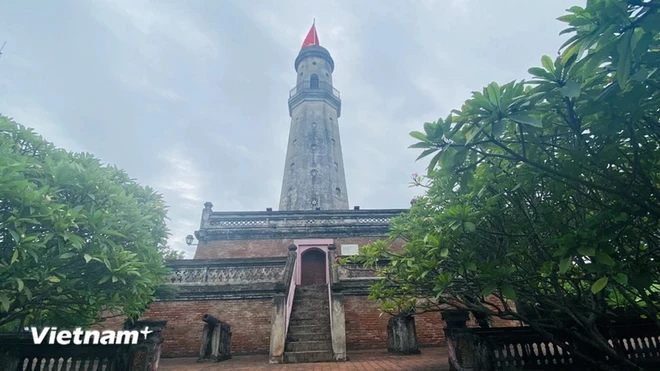
The Nam Dinh Flagpole, located on To Hieu Street in Nam Dinh City, is a national monument in Nam Dinh City. Completed in 1843 during the Nguyen Dynasty, it sits in the center of the ancient citadel of Nam Dinh. Also known as the flagpole tower, it is one of four flagpoles built in the early Nguyen Dynasty. Although damaged by bombs, the Nam Dinh Flagpole was restored to its original state in 1997. The flagpole is constructed of old, dark red fired bricks, with a total height of 23.84 meters, consisting of three main parts: the base, the tower, and the watchtower. Inside the tower is a spiral staircase with 54 steps leading up to the watchtower. From the top of the flagpole, one can see a panoramic view of the Nam Dinh city center. For nearly two centuries, the Nam Dinh Flagpole has witnessed many historical events and changes in the country and homeland. It is an ancient architectural work with historical and cultural value, and also a symbol that inspires patriotism. In 1962, the Nam Dinh Flagpole was recognized by the Ministry of Culture and Information as a national historical and cultural relic. (Photo: Vietnam+)
Hien Luong Flagpole
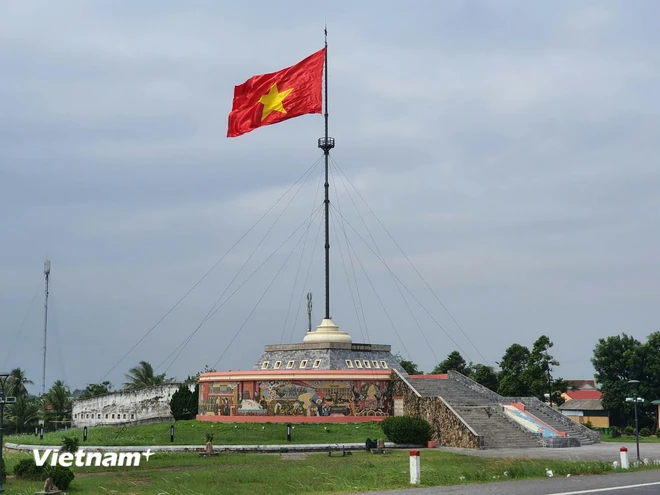
The Hien Luong flagpole is part of the Hien Luong-Ben Hai historical site in Quang Tri province. Besides the flagpole, the site also includes the Hien Luong bridge, the Joint House, ferry terminals, and the "Aspiration for Unification" monument complex. This complex is located at the intersection of the Ben Hai River and National Highway 1A (km 735), with the northern part belonging to Hien Luong village (Vinh Linh district) and the southern part to Xuan Hoa village (Gio Linh district). During the war against the US (1954-1975), the 17th parallel marked the division of the country. According to statistics, from May 19, 1956 to October 8, 1967, Vietnam flew 267 flags of various sizes, with 11 flagpole replacements and 42 flag replacements in 1967 alone due to damage from US-backed bombs and artillery. In 2005, on the occasion of the 30th anniversary of the reunification of the country, the People's Committee of Quang Tri province organized the reconstruction of the original Hien Luong flagpole (built in 1963) with a red flag with a yellow star, measuring 75m2 and 38m in height, including an 11.5m high base, in Hien Luong village, Vinh Thanh commune (on the north bank of the Ben Hai River). Due to its special value, the Hien Luong-Ben Hai Riverbanks were classified as a special national historical site. (Photo: Vietnam+)
Hue Monument
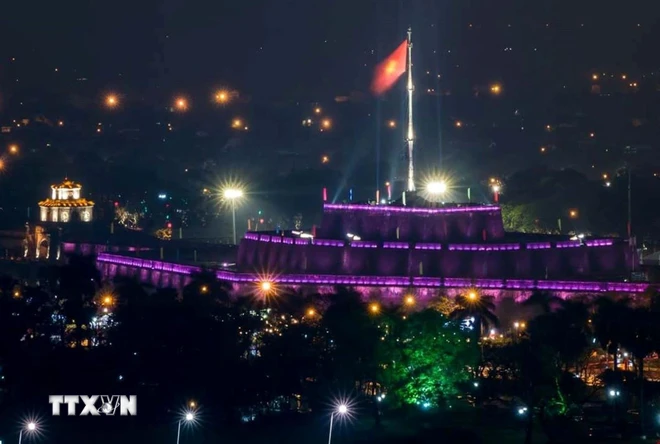
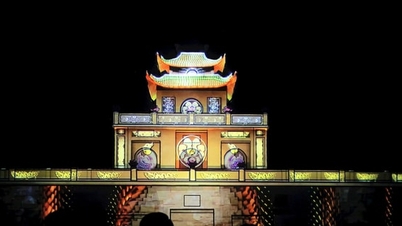
The Flagpole (also known as the Flag Tower) is an architectural relic from the Nguyen Dynasty. It was built in the 6th year of Gia Long's reign (1807) in the center of the southern side of the Citadel, within the Nam Chanh fortress. The Flagpole consists of two parts: the flag platform and the flagpole. The flag platform is a massive structure with three truncated rectangular pyramid-shaped tiers stacked on top of each other. The first tier is over 5.5m high, the middle tier is nearly 6m high, and the top tier is over 6m high. The total height of the three tiers is approximately 17.5m. Each tier is surrounded by a railing, and the floors of the tiers are paved with Bat Trang tiles. A walkway from the lower to the top tier opens on the north side. The top tier formerly housed two guard posts and a gun emplacement for cannons. The original flagpole was made of wood, consisting of two tiers and nearly 30m high. In the 6th year of Thieu Tri's reign (1846), the flagpole was replaced with a single wooden column over 32m long. In the 16th year of the reign of Emperor Thành Thái (1904), this flagpole was broken by a major storm, so it had to be replaced with a cast-iron pipe. In 1947, when the French reoccupied Huế , the flagpole was broken again by artillery fire. In 1948, the current reinforced concrete flagpole, with a total height of 37m, was built. During the Nguyễn dynasty, flags were used for all ceremonies, celebrations, processions, and even urgent announcements. An observation post called Vọng Đẩu was also placed at the top of the flagpole. Occasionally, guards had to climb Vọng Đẩu to use telescopes to observe the coastline. Along with the ups and downs of Huế, the Flagpole has witnessed many important historical events. On August 23, 1945, the flag of the Democratic Republic of Vietnam was flown for the first time at the top of the Flagpole, signaling the end of the monarchy. The Flag Tower is not only the central location of Hue city but also a symbol of the ancient capital. The Hue Citadel glows brightly at night. (Photo: Quoc Viet/VNA)
Thu Ngu Flagpole
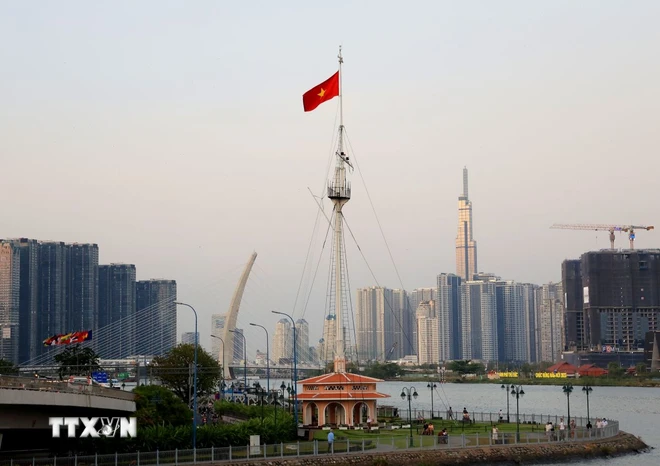
The Thu Ngu Flagpole is located on Ton Duc Thang Street, Nguyen Thai Binh Ward, District 1, Ho Chi Minh City. The flagpole was built by the French in October 1865, initially named Mat des signaux, meaning a signal pole for ships entering and leaving the waterways of the Saigon-Gia Dinh area. Standing alongside the flow of history, the flagpole is a witness to the historical events of Saigon-Ho Chi Minh City. One of the most notable events took place on June 5, 1911, when the young man Nguyen Tat Thanh departed from Nha Rong Wharf to seek a way to save the country. In May 2016, the Thu Ngu Flagpole was classified as a historical monument by the People's Committee of Ho Chi Minh City. Thu Ngu flagpole. (Photo: Hong Dat/VNA)
Hanoi flagpole at Ca Mau Cape
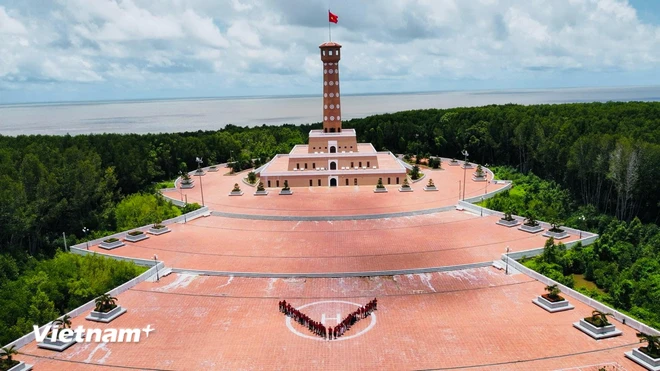
The Hanoi Flagpole at Ca Mau Cape was started on January 16, 2016, and inaugurated on December 10, 2019. Located within the Ca Mau Cape Tourist Area, the structure covers a total area of over 16,000 square meters, stands 45 meters tall (from the base to the top of the flagpole), and comprises three levels. The ground floor, themed "The Natural Formation and Succession Process," occupies approximately 400 square meters and displays 83 photographs, two models of the Forest Village, the Ca Mau Cape mangrove ecosystem, and typical animal specimens found in the Ca Mau Cape region. The first floor, with an area of approximately 320 square meters, displays over 55 photographs on the theme "Ca Mau Cape on the Path of Development." The second floor, with an area of approximately 152 square meters, houses images by the Hanoi City Museum on the theme "Ca Mau - The Heart of the Nation." The Hanoi flagpole at Ca Mau Cape is built to resemble the ancient Hanoi flagpole, reflecting the historical traditions of Thang Long Hanoi, a city with a thousand years of civilization. This is a gift from the Party Committee, government, and people of Hanoi to the people of Ca Mau province, expressing the deep affection of Hanoi for the Ca Mau Cape region, in the spirit of "Hanoi for the whole country, the whole country for Hanoi." Hanoi flagpole at Ca Mau Cape. (Photo: Vietnam+) Vietnamplus.vn




![[Photo] Prime Minister Pham Minh Chinh receives the Chinese Ambassador to Vietnam](https://vphoto.vietnam.vn/thumb/1200x675/vietnam/resource/IMAGE/2026/04/05/1775397481797_ndo_br_dsc-5512-jpg.webp)














































































Comment (0)