

Facing these challenges, at the seminar "Advances in disease detection, diagnosis and treatment" held in Hanoi on December 3, many international professors present in Vietnam presented solutions that open up new, less invasive treatment directions and bring about outstanding clinical results.
Phage therapy - a "weapon" against cancer
At the seminar, many big names in the world of biomedicine discussed bacteriophage therapy, also known as Phage therapy, which is mentioned as a "weapon" against the antibiotic resistance crisis and opens up new hope in cancer treatment.
Phage - a specialized virus that attacks bacteria - was discovered by British bacteriologist Frederick Twort in 1915, and then successfully applied clinically for the first time on a dysentery case in 1919 by French scientist Félix d'Herelle. However, in the 1930s of the last century, antibiotics were born and developed rapidly, and Phage gradually fell into oblivion. It was only when antibiotic resistance claimed the lives of millions of people each year that scientists rediscovered Phage with new hope.
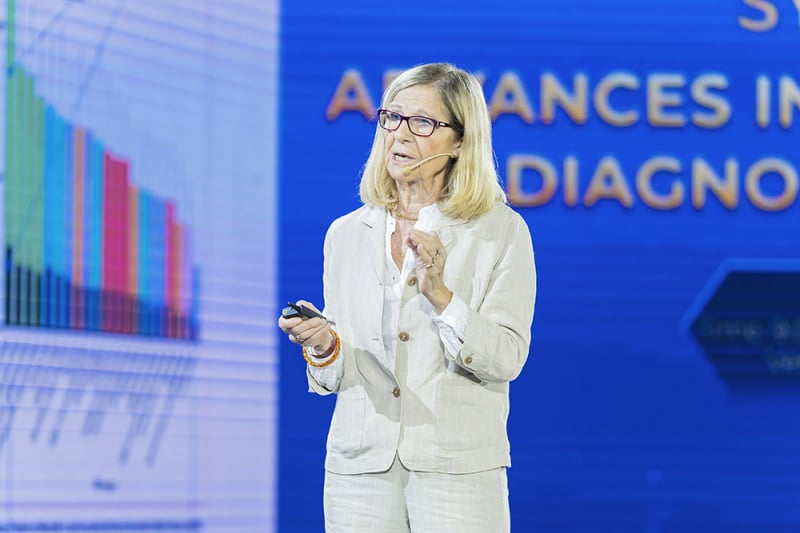
Prof. Pascale Cossart, a pioneer researcher in the field of cellular microbiology from the Pasteur Institute in Paris (France).
Professor Pascale Cossart, a pioneering researcher in the field of cellular microbiology from the Pasteur Institute in Paris (France), a member of the VinFuture Prize Council, commented: "This therapy has made new advances in the treatment of bacterial infections and can become a savior when all antibiotic therapies fail."
The advantage of Phage over antibiotics is that it attacks and kills pathogenic bacteria without harming human cells. In addition, each type of Phage usually only kills specific strains of bacteria, helping to protect beneficial microflora, something that broad-spectrum antibiotics cannot do.
She further cited that Georgia is one of the few countries that has been pioneering the use of phage therapy for hundreds of years. This therapy has even become a "hot" medical service, attracting Europeans to come for treatment instead of using antibiotics. The United States is also actively researching Phage with 4 major research centers at universities such as California, Yale, Diego, Texas.
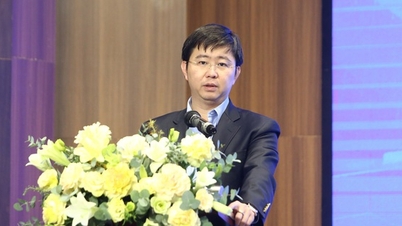
Not stopping at fighting bacteria, bacteriophages are opening up a promising application in cancer treatment, according to research by Professor Chuanbin Mao from the Chinese University of Hong Kong (China).
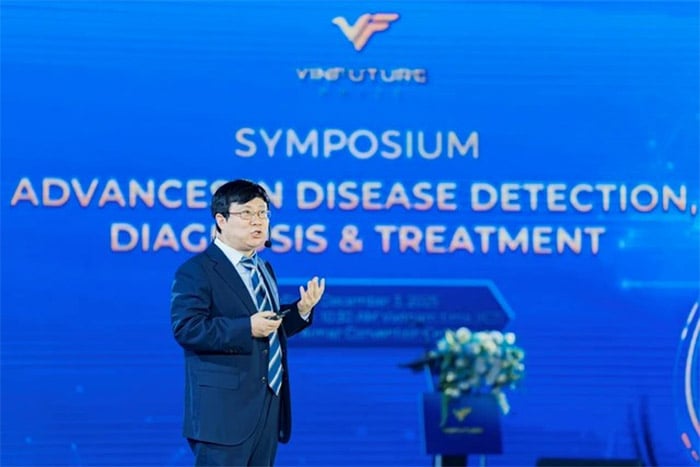
Prof. Chuanbin Mao from the Chinese University of Hong Kong (China).
With 20 years of experience in researching Phage, he believes that through genetic modification, Phage can form a supermolecular system with extremely sophisticated diagnostic and therapeutic functions. In treatment, Phage is modified to carry nano-enzymes, targeting cancer cells, generating oxygen in the hypoxic environment of the tumor, thereby helping photodynamic therapy work more effectively to destroy diseased cells.
Professor Chuanbin Mao also pointed out the advantage of this therapy is low cost thanks to the fact that Phage can be cloned in large numbers and genes can be easily adjusted to create new Phages with specific targets.
3D printing technology paves the way to save bone cancer patients in Vietnam
In recent years, world medicine has developed bone regeneration techniques using individually designed metal implants, but the cost is so high that most patients do not have access to it. In Vietnam, bone structure regeneration was almost impossible before 3D printing technology was applied.

Prof. Tran Trung Dung - speaker from Vinmec Healthcare System, VinUni University (Vietnam).
At Vinmec, Professor Tran Trung Dung and his teammates have changed this reality. Professor Tran Trung Dung said that in Vietnam, every year, about 200 patients are diagnosed with bone cancer. Many of these cases in young children are due to "subjective" family members, so when they are discovered, they are often already severe, very difficult to treat, or if they are treated, it is very expensive.
With a background in orthopedic surgery, biomedical technology and simulation techniques, his team has mastered the technique of 3D printing personalized implants for the most complex bone cancer cases. They rely on CT and MRI imaging data of each patient, create a three-dimensional bone model and design an implant that is absolutely suitable for the patient's anatomy. One case of pelvic bone cancer was forced to face the risk of permanent disability.
The team of doctors collected images, simulated the damaged bone structure and designed an implant to replace the entire damaged area. The surgery combined tumor removal, reconstruction and 3D implant fixation was successful. Two years after surgery, the patient was able to walk, had good motor function recovery and no significant complications.
Another patient had to have almost the entire femur amputated due to cancer. Vinmec has reconstructed the entire femur using a 3D printed model, helping to restore the supporting structure of the lower limb, ensuring long-term mobility. Cases that doctors could only shake their heads at because they could not reconstruct the anatomy have now become proof of the great progress of Vietnamese medicine.
Sharing more with reporters, Professor Tran Trung Dung said that what makes this technology successful is the “on-site design workshop” model. The 3D printing workshop located at VinUni allows engineers and doctors to work together right in the hospital environment. Doctors understand anatomy and surgery; engineers understand materials, structures and simulation, when they coordinate in real time, the implants created have high precision and are optimally suited to surgery.
This interdisciplinary combination brings Vietnamese medicine closer to the world's leading medical centers. More importantly, it helps patients restore their body structure instead of having to accept lifelong loss.
Despite the huge leap forward, medical 3D printing still faces one major hurdle: cost. In the US and Europe, the price of a 3D printed implant for bone regeneration surgery can be as high as $30,000 to $60,000. This is far beyond the average income and the affordability of most patients, even with commercial insurance. In Vietnam, the adoption of this technology is even more difficult because patients are almost 100% dependent on charity support.
Source: https://cand.com.vn/y-te/khi-cong-nghe-mo-duong-cho-chan-doan-va-dieu-tri-benh-the-he-moi-i790045/


![[Photo] Cat Ba - Green island paradise](/_next/image?url=https%3A%2F%2Fvphoto.vietnam.vn%2Fthumb%2F1200x675%2Fvietnam%2Fresource%2FIMAGE%2F2025%2F12%2F04%2F1764821844074_ndo_br_1-dcbthienduongxanh638-jpg.webp&w=3840&q=75)





































![[VIMC 40 days of lightning speed] Da Nang Port: Unity - Lightning speed - Breakthrough to the finish line](https://vphoto.vietnam.vn/thumb/402x226/vietnam/resource/IMAGE/2025/12/04/1764833540882_cdn_4-12-25.jpeg)









































Comment (0)