

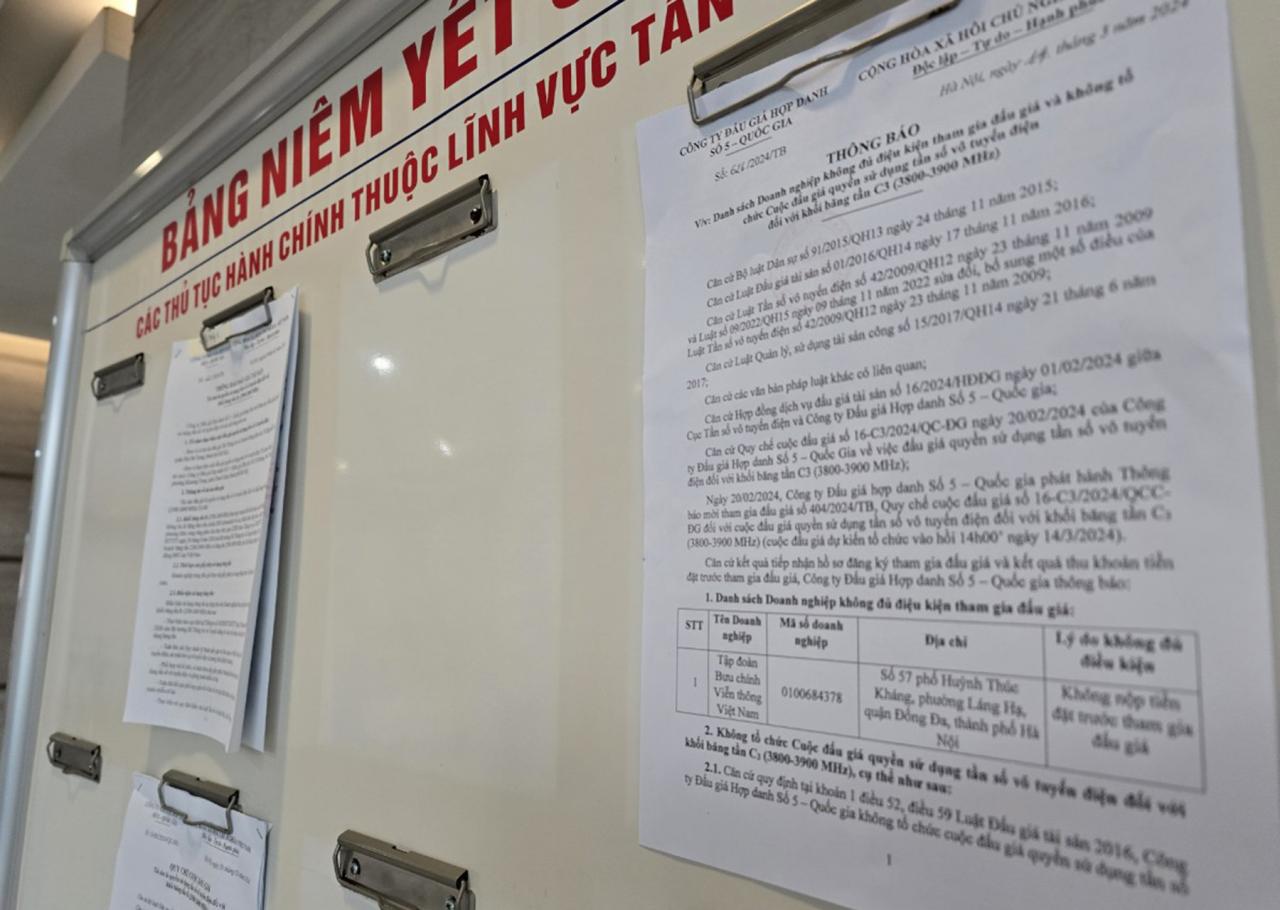
No auction will be held for the 3800-3900 MHz frequency.
The National Joint Auction Company No. 5 has announced the list of businesses that do not meet the eligibility requirements to participate in the auction and will not hold the auction for the right to use radio frequencies for the C3 band (3800-3900 MHz).
Previously, on February 20, 2024, the National Joint-Stock Auction Company No. 5 issued a notice inviting participation in the auction for the right to use radio frequencies for the C3 band (3800-3900 MHz), scheduled to be held at 2:00 PM on March 14, 2024.
However, based on the results of receiving registration applications and collecting deposit payments, the National Joint-Stock Auction Company No. 5 announces the list of businesses that did not meet the eligibility requirements for participating in the auction and did not pay the deposit. Therefore, the auction for the right to use radio frequencies in the C3 band (3800-3900 MHz) could not be held due to the lack of the minimum number of eligible businesses as stipulated.
The National Joint Auction Company No. 5 will refund the document purchase fee and deposit to the enterprise that purchased the documents and submitted a valid registration application no later than 2 working days from the scheduled auction date.
The starting price for the 3800 MHz to 3900 MHz frequency band for 15 years of use is over 1.956 billion VND. Businesses must commit to deploying a minimum of 3,000 5G base stations and officially providing terrestrial mobile telecommunications services using the 3700-3800 MHz or 3800-3900 MHz frequency bands no later than 12 months from the date of being granted the license to use the respective frequency bands in the auction.
At the time of officially providing terrestrial mobile telecommunications services using the 3700-3800 MHz or 3800-3900 MHz frequency bands, businesses must deploy at least 30% of the committed number of radio base stations within the first two years from the date of being granted the license to use the respective frequency band through auction.
Previously, on March 8, 2024, the B1 2500-2600 MHz frequency band auction was held, marking a new historical milestone for Vietnam as it transitioned from allocation and competitive bidding to auctioning for frequency allocation.
After 24 rounds of bidding, Viettel was the winning bidder for the right to use the 2500MHz - 2600MHz frequency band. Having won the B1 2500 - 2600 MHz band, Viettel will no longer be eligible to participate in the next auction. Vietnamobile did not participate in the 2500 - 2600 MHz band auction and did not provide an official reason.
What are the differences in 5G frequency bands for different carriers?
Experts believe that the 5G network frequency bands in Vietnam for the three network operators, as planned, are 2500-2600 MHz, 3700-3800 MHz, and 3800-3900 MHz, and all have a similar number of compatible terminal devices because these are all common frequency bands for 5G networks worldwide .
On the other hand, due to global competition and trade factors, most 5G terminal devices are designed by vendors to be compatible with and support multiple frequency bands in order to be commercially available in various markets, especially in common bands in addition to specialized bands.
Experts point out that 5G frequency bands are divided into four groups: Low bands (below 1GHz), Mid bands 1 (1GHz-2.6GHz), Mid bands 2 (3.5-7GHz), and High bands (24GHz-48GHz). According to IMT 2020, high-frequency bands offer larger bandwidth, higher speeds, lower latency, and higher capacity; however, high-frequency bands are limited in terms of coverage.
Thus, each licensed frequency band has different advantages and disadvantages, and it is difficult for any single band to fully utilize its advantages and overcome all its disadvantages due to its specific characteristics and technological factors. Low-frequency bands offer wider coverage but slower speeds, while high-frequency bands offer higher speeds but narrower coverage.
Specifically, the 2500-2600 MHz band that Viettel won in the auction is called the "golden band" because it is lower than the 3700-3800 MHz and 3800-3900 MHz bands, thus offering wider coverage. Securing this band gives the network operator an advantage in terms of lower investment compared to those holding the 3700-3800 MHz and 3800-3900 MHz bands. Furthermore, this band can be used for 4G networks. The starting bid price for this band was also higher than the other two 5G bands.
The 3700-3800 MHz and 3800-3900 MHz frequency bands will be auctioned off next. Due to the lack of coverage, more base stations will need to be invested in, resulting in higher infrastructure investment costs. However, these bands offer the advantage of higher access speeds compared to the "golden band" of 2500-2600 MHz.
Going forward, if the Ministry of Information and Communications continues to put the 700 MHz band up for auction, this band will have even greater coverage and provide an investment advantage for the winning bidder, but it will have slower speeds than the three 5G bands that the Ministry of Information and Communications is auctioning this time.
Therefore, bidding to acquire a particular frequency band is a matter for each network operator, based on their own calculations. However, for customers, they don't care which frequency band or technology the network operator uses; what matters is the quality of services the network operator provides, and the experience and convenience it offers.
Therefore, after the 5G spectrum auction, network operators will enter a new race: providing better service experiences and conveniences for customers, as well as new 5G business models. When investing in 5G networks, the most crucial factor determining a network operator's success is which one best serves its customers and generates profits.
Source





























![[Video] The craft of making Dong Ho folk paintings has been inscribed by UNESCO on the List of Crafts in Need of Urgent Safeguarding.](https://vphoto.vietnam.vn/thumb/402x226/vietnam/resource/IMAGE/2025/12/10/1765350246533_tranh-dong-ho-734-jpg.webp)





















































Comment (0)