

Recently, the Federal Statistical Office (Destatis) announced that the German economy grew slightly by 0.2% in the third quarter of 2024. This information surprised experts because it reversed the forecast that the economy could fall into a technical recession.
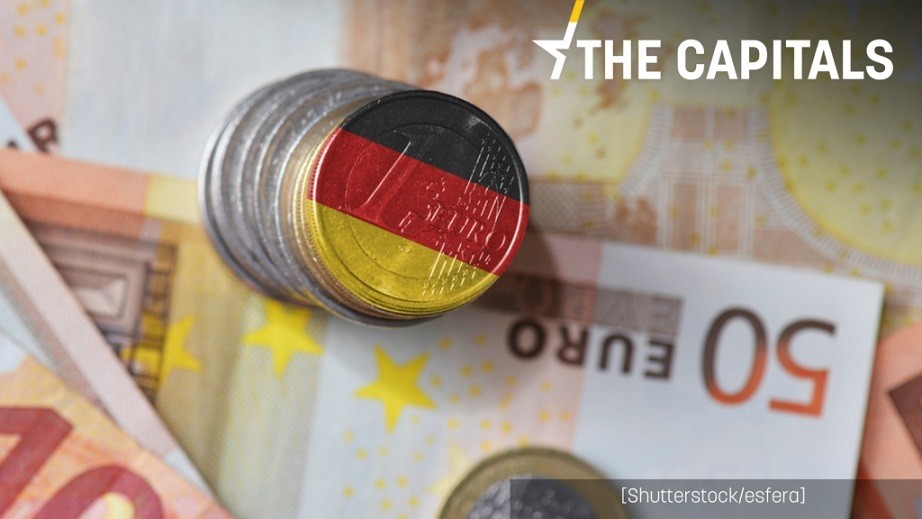 |
| The German economy experienced slight growth. (Source: Shutterstock/esfera) |
According to preliminary statistics from Destatis, the Gross Domestic Product (GDP) of Europe's largest economy was boosted by increased government and household spending. However, Destatis also adjusted its figures for the second quarter of 2024, predicting a 0.3% contraction instead of the previously estimated 0.1%.
Prior to the release of these figures, the German Ministry of Economics predicted "a new mild slowdown" in the third quarter of this year. The ministry stated: "The economy is unlikely to emerge from this period of weakness in the third quarter of 2024."
If the forecast is correct, after two consecutive quarters of GDP decline, the German economy will fall into a technical recession.
Despite modest growth, headwinds have damaged a crucial industry that accounts for 20% of Germany's GDP.
In its latest report, the German Federation of Industries (BDI) stated: "The manufacturing sector is experiencing a severe shortage of orders."
The BDI found that industrial output in the third quarter of 2024 fell by 3% compared to the same period in 2024, noting that this would be "the third consecutive decline," with the drop being particularly severe in Germany's leading automotive manufacturing sector.
Meanwhile, the head of German automaker Volkswagen also announced that it is considering closing at least three factories in Germany and cutting tens of thousands of jobs, as Europe's largest automaker faces fierce competition from China, particularly in the electric vehicle sector.
Struggling with high costs and slowing sales in China, Volkswagen's net profit for the third quarter of 2024 fell 64% to €1.58 billion ($1.7 billion).
Besides Volkswagen, BMW and Mercedes-Benz also lowered their annual growth forecasts in September 2024, due to declining demand from Asia's largest economy.
Long-standing structural challenges are exacerbating Germany's difficulties, including factors such as a complex bureaucracy, a lack of investment in infrastructure, an aging workforce, and a costly green energy transition.
Looking ahead, Alfred Kammer, Director for Europe at the International Monetary Fund (IMF), affirmed that Europe, as the leading power, needs structural reforms and investment in public infrastructure. To achieve this, he suggested that Germany "may have to loosen its debt brakes."
Germany was the only major economy to experience a decline in GDP in 2023, and the government forecasts a further slight decrease in 2024.
However, Europe's largest economy is expected to see a recovery from 2025 onwards, as inflation falls and higher wages are projected to boost consumption.
Source: https://baoquocte.vn/kinh-te-duc-ven-may-mu-buoc-qua-suy-thoai-kho-khan-dang-can-quet-nganh-chiem-toi-20-gdp-292050.html
























![[Image] Close-up of the newly discovered "sacred road" at My Son Sanctuary](/_next/image?url=https%3A%2F%2Fvphoto.vietnam.vn%2Fthumb%2F1200x675%2Fvietnam%2Fresource%2FIMAGE%2F2025%2F12%2F13%2F1765587881240_ndo_br_ms5-jpg.webp&w=3840&q=75)































































Comment (0)