

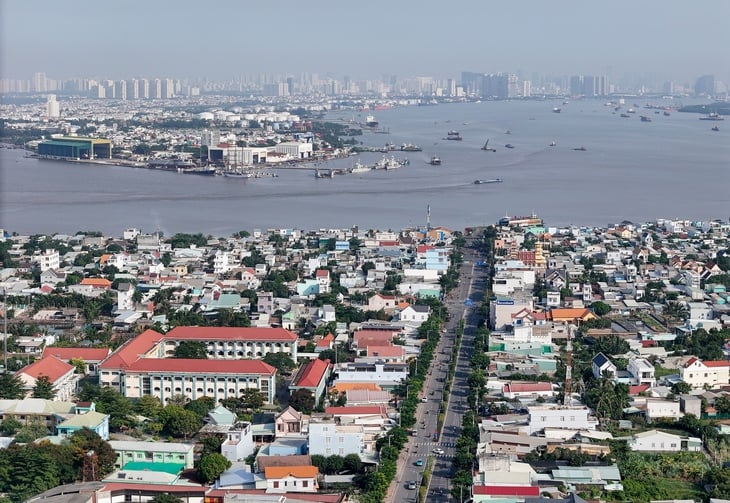
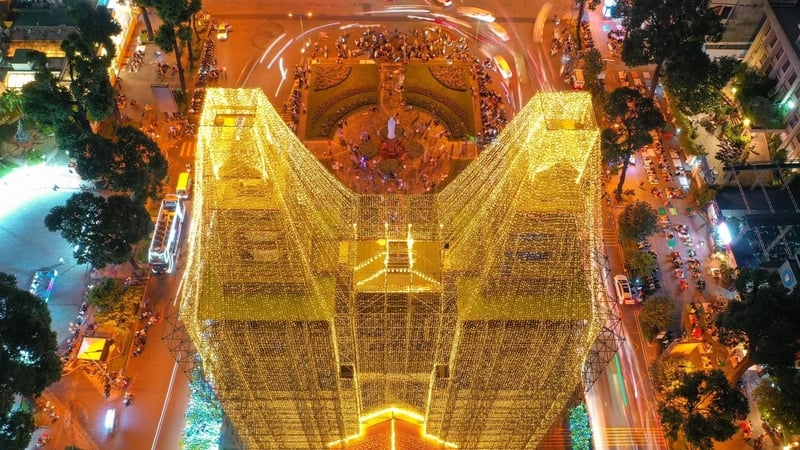
The completion of Can Gio Bridge helps people travel more conveniently, avoiding the situation of "crossing the river by ferry" - Photo: CHAU TUAN
The Can Gio bridge project has a starting point connecting Nguyen Luong Bang street - 15B street (Nha Be commune), the end point connecting Ben Luc - Long Thanh expressway intersection and Rung Sac street (Binh Khanh commune).
The total length of the route is about 6.3km, including the main bridge of more than 2.9km, the approach road and small bridges on the route of more than 3.2km. The bridge is designed with 6 lanes (4 motor lanes, 2 mixed lanes), speed of 80km/h.
The project is proposed to be invested under the PPP method, BT (build - transfer) contract type with a total preliminary investment of about 13,201 billion VND (including loan interest and investor profit).
The project is divided into two sub-projects, in which sub-project 1 - compensation, support, resettlement will use the city budget with about 2,533 billion VND. And sub-project 2 is to build Can Gio bridge under BT contract with about 10,668 billion VND (including loan interest).
According to the Ho Chi Minh City Department of Construction, implementing the Can Gio bridge project under the PPP method will help reduce budget pressure in the context of the city's huge demand for investment in transport infrastructure.
If public investment is used, the city must prioritize capital allocation for Can Gio Bridge, which means cutting capital for other projects. This is very difficult, because most of the project portfolio is urgent and needs to be implemented immediately to enhance connectivity and reduce congestion.
When investing under the PPP method, the city will mobilize maximum non-budgetary resources to develop transport infrastructure, speed up project completion, and meet socio-economic development requirements. This is also consistent with the policy of attracting socialized resources.
Private sector participation will also bring greater efficiency and sustainability through management capacity, innovation and application of advanced technology.
Based on comments from relevant departments and units, the Ho Chi Minh City Department of Construction said that the pre-feasibility study report for the Can Gio bridge project has been completed, ensuring compliance with legal regulations and meeting the conditions for submission to competent authorities for appraisal and decision on investment policy under the PPP method.
Therefore, the Department of Construction of Ho Chi Minh City proposed that the City People's Committee assign the Department of Finance (the standing agency of the City Appraisal Council) to organize the appraisal and submit it to the competent authority to decide on the project investment policy according to regulations.
Building Can Gio and Phu My 2 bridges under urgent mechanism, shortening implementation time by 1 year
On December 2, in a report to the Ho Chi Minh City People's Committee on the implementation of investment procedures for Can Gio Bridge and Phu My 2 Bridge, the Ho Chi Minh City Department of Construction proposed applying the mechanism of "urgent projects that must be implemented immediately" to complete them soon, connect synchronously with the traffic network, and meet the travel needs of the people.
When implementing these two projects as "urgent projects that must be implemented immediately", it will help shorten the implementation time by about 1 year.
Specifically, with Can Gio bridge, if following the normal procedure, it will take until September 2026 to select an investor and at the earliest February 2027 to start construction.
When applying in the urgent form, the project can choose an investor in December 2025, and start construction in April 2026. Thanks to that, the completion date is also reduced to December 2028, instead of extending to December 2029.
Source: https://tuoitre.vn/lam-cau-can-gio-theo-phuong-thuc-ppp-se-nhanh-va-co-nhieu-loi-the-20251205173815804.htm


![[Photo] Cat Ba - Green island paradise](/_next/image?url=https%3A%2F%2Fvphoto.vietnam.vn%2Fthumb%2F1200x675%2Fvietnam%2Fresource%2FIMAGE%2F2025%2F12%2F04%2F1764821844074_ndo_br_1-dcbthienduongxanh638-jpg.webp&w=3840&q=75)

![[Photo] 60th Anniversary of the Founding of the Vietnam Association of Photographic Artists](/_next/image?url=https%3A%2F%2Fvphoto.vietnam.vn%2Fthumb%2F1200x675%2Fvietnam%2Fresource%2FIMAGE%2F2025%2F12%2F05%2F1764935864512_a1-bnd-0841-9740-jpg.webp&w=3840&q=75)


























































Comment (0)