


Professor Dang Hoang Minh informed that the rate of mental health problems in many population groups in Vietnam is increasing - Photo: THUY DUONG
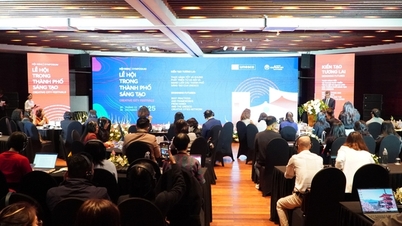
At the international scientific conference "Interdisciplinary approach in mental health care for women and families" held on December 5 in Ho Chi Minh City, Prof. Dr. Dang Hoang Minh (University of Education , Vietnam National University, Hanoi) said that recent studies show that the rate of mental health problems in many population groups in Vietnam is increasing at the same rate as in developed countries.
While the need for mental health care is growing, Vietnam still lacks human resources. Currently, there is only one psychiatrist per 100,000 people, much lower than the recommendation of the World Health Organization (WHO).
In addition, there is also a shortage of non-physician mental health professionals such as clinical psychologists, clinical social workers, occupational therapists, etc.
The mental health service system is mainly focused on hospitals, while there is a lack of community-based care programs, specialized models for each population group, and a lack of integration of mental health services into primary health care.
In terms of policy, Vietnam also lacks modern, synchronous regulations and a strong enough legal foundation for this field.
At the conference, international experts emphasized that mental health is a global public health issue, with about 1 billion people suffering from mental disorders, the most common of which are depression and anxiety.
More than 70% of the global burden of disease due to mental health lies in developing countries; 80% of people with the disease also live in these countries.
A meta-analysis of 23 low- and middle-income countries found that the prevalence of emotional disorders in children and adolescents was generally higher than in developed countries.
In women, especially during pregnancy and postpartum, emotional disorders are more common: pre- and post-natal depression, pre- and post-natal anxiety.
According to experts, women are more vulnerable to mental health problems due to the intersection of biological factors (hormonal changes during puberty, postpartum, pre-menopause, etc.) and socio-cultural factors (gender roles in family care, inequality, low income, violence, etc.).
Professor Minh emphasized that to achieve the health goals in the Sustainable Development Agenda (SDG) by 2030, Vietnam needs to promote reform of the mental health care system, expand early and interdisciplinary services, especially targeting women and families - groups that are most affected but have little access to professional services.
Source: https://tuoitre.vn/khoang-trong-lon-trong-cham-soc-suc-khoe-tam-than-benh-nhieu-chuyen-gia-it-2025120516171574.htm


![[Photo] 60th Anniversary of the Founding of the Vietnam Association of Photographic Artists](/_next/image?url=https%3A%2F%2Fvphoto.vietnam.vn%2Fthumb%2F1200x675%2Fvietnam%2Fresource%2FIMAGE%2F2025%2F12%2F05%2F1764935864512_a1-bnd-0841-9740-jpg.webp&w=3840&q=75)
![[Photo] National Assembly Chairman Tran Thanh Man attends the VinFuture 2025 Award Ceremony](/_next/image?url=https%3A%2F%2Fvphoto.vietnam.vn%2Fthumb%2F1200x675%2Fvietnam%2Fresource%2FIMAGE%2F2025%2F12%2F05%2F1764951162416_2628509768338816493-6995-jpg.webp&w=3840&q=75)










![[Video] Dong Do Hospital celebrates 15 years of operation](https://vphoto.vietnam.vn/thumb/402x226/vietnam/resource/IMAGE/2025/12/06/1764980267666_img-2287-5359-png.webp)





![[Infographic] Air pollution and recommendations from the Ministry of Health](https://vphoto.vietnam.vn/thumb/402x226/vietnam/resource/IMAGE/2025/12/05/1764950568593_screen-shot-2025-12-05-at-222015-png.webp)

















































































Comment (0)