

That always haunts me, leaving me with a lingering sense of regret and sorrow, a constant reflection on the exemplary lives of martyrs, their mothers, and wives in peacetime. It also fuels my thoughts on the meaning of life and the qualities of the Ho Chi Minh's soldiers in an increasingly vibrant and complex world. Those sacrifices, even in peacetime today, must be cherished and preserved. We must live more worthily of the blood and bones of these martyrs. The simpler their sacrifices were, the more immeasurable the grief of those still living. Those bright sources of light have been and continue to illuminate the paths that soldiers walk shoulder to shoulder. One man died right at my workplace. Just yesterday, he called me on a business trip, giving me instructions about the job. And yet, only a few days later, he lies there, his bones barely visible, in a zinc coffin draped with the red flag with a yellow star. Tears seem meaningless to us, his fellow soldiers and comrades. Nearly thirty years have passed, yet I can still vividly see that coffin draped with the red flag bearing a yellow star.
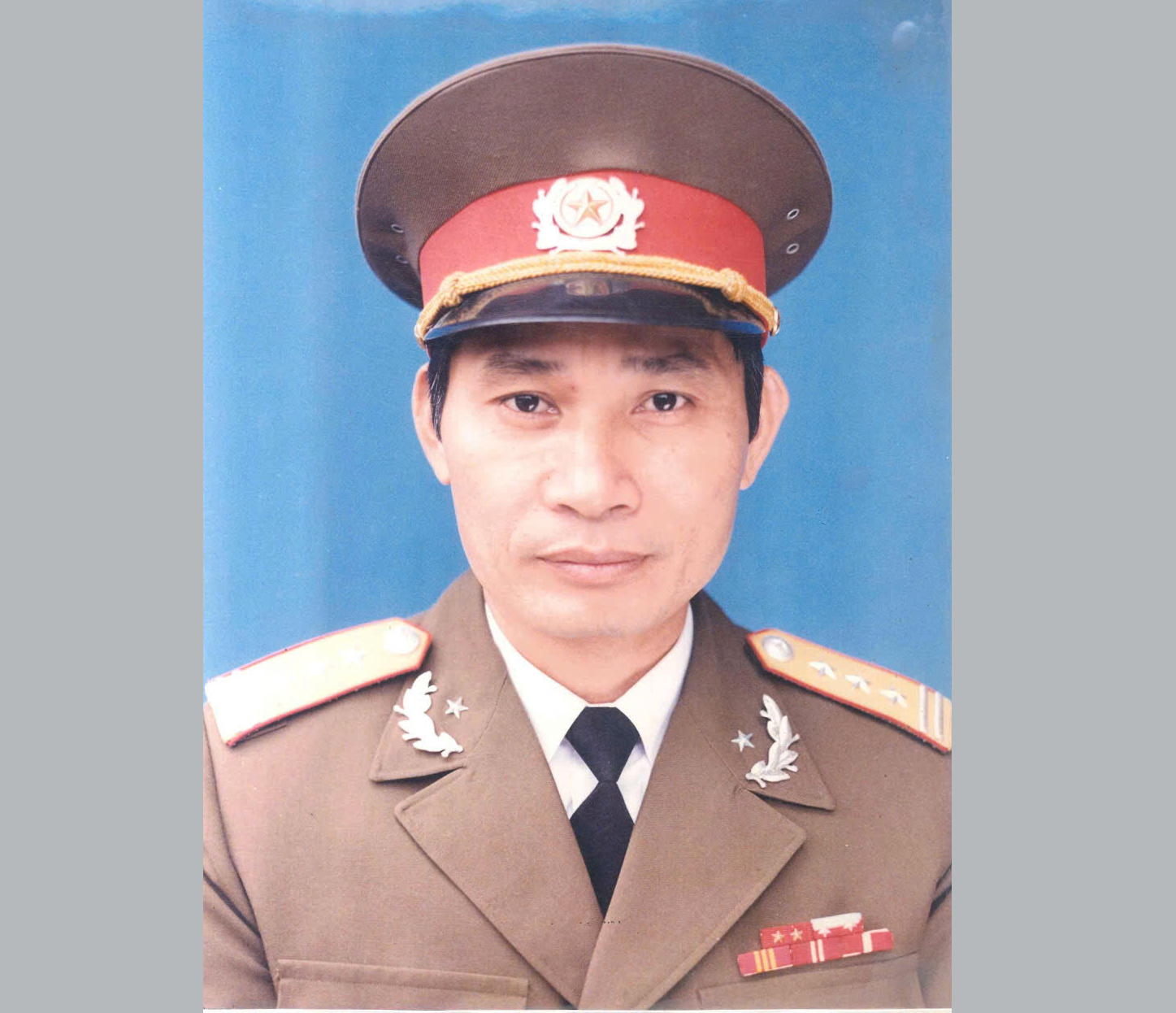 |
Portrait of Martyr, Lieutenant Colonel Nguyen Duy Thanh. |
He is a fallen soldier - Lieutenant Colonel Nguyen Duy Thanh.
When I joined the People's Army Television (February 1997), he already had decades of experience, with numerous reports ranging from the intense battlefields to the magnificent parades accompanying high-ranking military delegations in Europe and Africa. A son of Yen Thang, Yen Mo, Ninh Binh, he was both elegant and incredibly approachable. Each person in the television and news agency had their own personality, but within it all remained a heart full of love and affection. They might argue fiercely about their profession, criticize weaknesses, vehemently point out substandard footage, and harshly condemn superficial or careless commentary, but outside the meeting room, they would embrace each other with love and respect. Vietnamese people always support each other; the older generation sets an example and guides the younger generation, and the younger generation listens and practices what their elders teach. That's what makes him so valuable. Nguyen Duy Thanh was such a person. I joined the People's Army Television with the inferiority complex of a young person, who had never studied or worked in the profession—a profession known for its fierce competition. Many of the older colleagues had already achieved success and become television personalities. It was they who extended their hands to welcome me, the youngest member. Nguyen Duy Thanh said: "Come down to the unit with me. That's where young people like you train and grow."
I remember his words vividly and threw myself into the army. Those days were very hard. At four in the morning, I would wake myself up, quietly slip out of my warm bed, light a fire, eat a bowl of rice with pickled vegetables, then clatter to the bus station and take the bus to the office at 84 Ly Thuong Kiet Street. My house was in a small district in Hung Yen province, and the journey to the office was over twenty kilometers, taking more than an hour. Every day I was at the office before six in the morning. Being from a farming family, I was determined to compensate for my lack of education and professional skills with diligence and hard work. The writer Chi Phan, then Head of the People's Army Television Department, had his private office on the second floor already lit up. His diligence instilled in me, not through words, but through my constant actions. I prepared the newspapers, neatly arranged on the desk, then quickly boiled water, prepared tea, and set out the teacups so the officers could begin their early morning briefing. This work continued day after day. I naturally took on the role of the agency's liaison. Needing documents typed up: ready. Needing to deliver official documents to Vietnam Television: ready. Needing to guard the gate and arrange parking for collaborators' motorbikes and bicycles: ready. I joined the television family naturally and somewhat peacefully like that. Everyone also wholeheartedly guided me in my profession. Every word, every frame, every light, even the ways of life and manners—the senior colleagues sincerely passed them on to me.
Duy Thanh was a very skilled and experienced mentor. He was a man of few words, but when we talked privately, he always offered guidance on the profession. He assured me that I could follow in his footsteps. He always encouraged me to work on long documentaries about culture and sports . He said, "You must leverage your literary strengths in television to create a unique style and establish your career." The fateful summer of 1998, when we said goodbye to him before he left with a high-level delegation to visit Laos, coincided with him assigning me a long documentary about the Thể Công football team. The team was on the verge of winning the championship, but Duy Thanh had already spotted weaknesses and strategic shortcomings in the military team. Duy Thanh loved football very much. He was a close friend of the then-head coach, Vương Tiến Dũng.
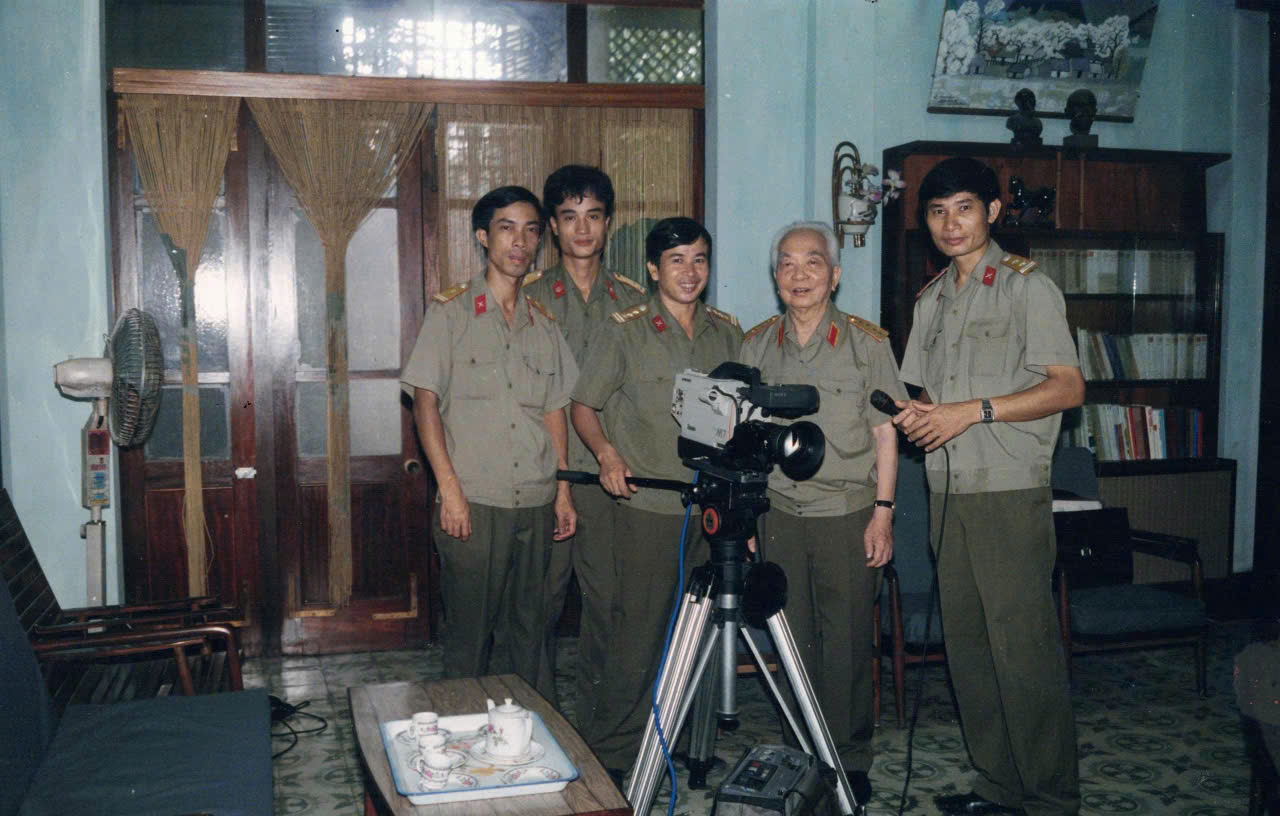 |
Journalist Nguyen Duy Thanh (far right) and his colleagues during an interview with General Vo Nguyen Giap in 1996. (Archival photo) |
The day before he left for Laos, he invited some young reporters for a beer near the Flagpole Stadium that afternoon. Over glasses of frothy white beer, he instructed me on interviews with fans of the Thể Công team. He said we needed to discipline them to ensure the team's sustainable growth. He said that any signs of a "star" in the team were starting to decline. I suggested waiting for him to return because I wasn't sure I could approach those influential figures in the football world. He told me to be bold. We're doing this for the profession, for the team, not for anyone's personal fame. He had already called them. He completely trusted me with the commentary. He said if I wrote less "ohs and aches," it would be sharper. He said I was still "writing literary stuff" in my commentary. Commentary needs literary quality, but it absolutely must avoid "writing literary stuff." His advice, even after his death, in the excellent film reviews that won my awards, contained a great deal of wisdom from his guidance.
The very next afternoon (May 25, 1998), the entire office fell silent upon hearing the news: The plane carrying the delegation had crashed in Xieng Khouang.
In the evening, the news was broadcast.
We were in shock. No one said a word to anyone. Everyone was silent, bewildered, and in pain, yet still hoping for some kind of miracle.
The most stressed person is probably his wife.
She came to the office with the belief that he hadn't died. She insisted he was still alive. Even if the plane had crashed, he was still alive in a forest in Laos. She asserted this for a day. She asserted this for many days. The entire office was tense. Not only the television station, but also higher-level agencies were busy, pouring all their efforts into the search at that time. Accessing the crash site on a mountaintop over two thousand meters high was extremely complicated during the rainy season in Laos, where it was gloomy day and night. Special forces battalions from both countries cleared rocks and traversed the forest to reach the target to determine who was missing and who was still alive, constantly reporting bad news. Even General Chu Huy Man, a seasoned soldier who had fought in several wars, was extremely anxious, because his son, Lieutenant Colonel Chu Tan Son, was also in the task force.
But the harsh reality continues to unfold.
The delegation included generals and officers on the flight; all of them perished.
That devastating news struck us soldiers in peacetime with a fatal blow. During the lengthy funeral, there were moments when we felt we couldn't bear it any longer. Looking at the rows of zinc coffins draped with red flags lying silently in the Gia Lam airport hall, no one could hold back their tears. Outside, the rain poured down. Thunder rumbled incessantly. Flashes of lightning streaked across the gray, rain-soaked sky. From dawn, in the deserted hall, I felt a chill as I watched the General's shoulders tremble and the white hair of Mr. Chu Huy Man, who was embracing the zinc coffin draped with the flag of his comrade, of his son. How could this battle-hardened general have ever foreseen such a sacrifice? For decades, fighting the French and the Americans, wherever there was gunfire on the southwestern and northern borders, this battle-hardened general, one of the pillars of our army, was present. Now he sits there, beside the red flag with a yellow star covering the body of his son. That was too much for a father like him to bear. I stood there frozen, unable to move or turn away from the hall, and tears just streamed down my face.
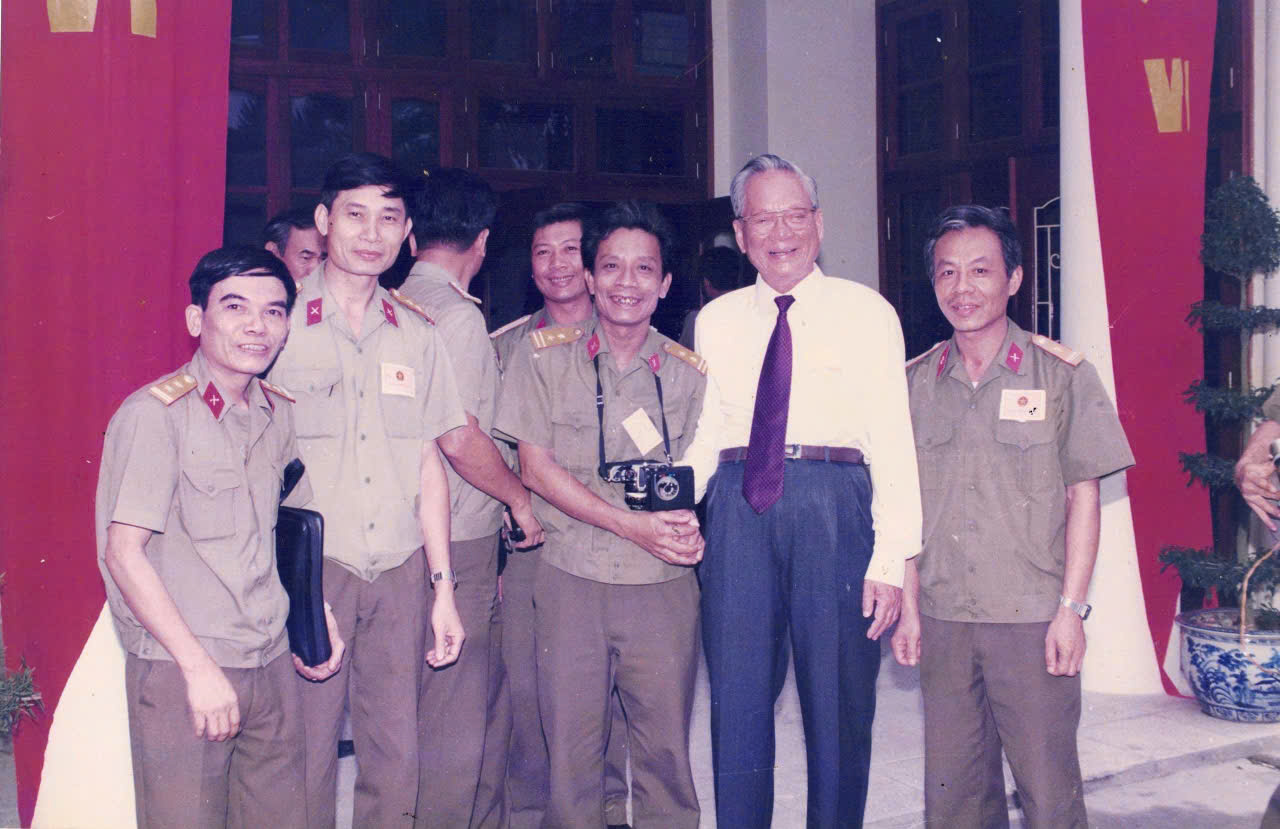 |
| Journalist Nguyen Duy Thanh (second from the left) and his colleagues pose for a photo with President Le Duc Anh (1997). (Archival photo) |
Unexpectedly, Nguyen Duy Thanh's parents were the strongest. His father, with his white hair, supported his daughter-in-law and grandchildren, who were as withered as banana leaves, beside the grave being filled with earth. Thunder continued to rumble in the sky, further testing the resolve of those still alive. I had never witnessed a funeral with so many people and so many tears. Nguyen Duy Thanh's younger brother, Viet – then an officer in the Foreign Affairs Department of the Ministry of National Defense – suppressed his grief and worked with the relevant agencies to arrange the funeral. Later, I became quite close to him and realized that whenever a loved one sacrifices their life, those around them experience a remarkable growth, even if it's unspoken.
This was the first time I had witnessed a war hero in peacetime.
Later, in remembrance of him, and remembering the advice of Lieutenant Colonel and Martyr Nguyen Duy Thanh, I often went to join the soldiers, especially wherever our soldiers had sacrificed their lives, I would be there early. Going was part of the assignment, of course. But I also went because of the compelling urge of my heart. My family and lineage have many martyrs. During my trip to Dien Bien Phu, visiting the martyrs' cemetery, I was speechless before the martyrs, many of whom bore the Phung family name. Lighting incense sticks, my heart ached under the blue sky and white clouds. More than half a century has passed, yet those who sacrificed their lives at eighteen or twenty years old still seem so young. Beneath the ground lie the bones of the deceased. Some bodies are not intact. There are even empty graves, just earth and soil. But it was they who made the national flag fly high, who created the dignified and beautiful land we live in today. Visiting the Citadel Cemetery, the National Martyrs' Cemetery on Highway 9, and the Truong Son National Martyrs' Cemetery, before countless white graves, tens of thousands of golden stars twinkled on the tombs of our brothers and sisters. The wind blew gently. The grass was green. The sky was blue. The rivers flowed green across our motherland. And in the distance was the vast blue sea where our ancestors once laid their bones and shed their blood. Every year, returning to these cemeteries to offer incense to our brothers and sisters, we are always filled with an unceasing sense of sorrow and grief. Every being is born of parents. No one wishes for war, so that young men and women in their late teens and early twenties must sacrifice themselves for the Fatherland. Our Fatherland, its first and eternal beauty is the beauty of the heroic martyrs who sacrificed themselves, including those who died in peacetime, like Lieutenant Colonel and Martyr Nguyen Duy Thanh.
Source: https://www.qdnd.vn/phong-su-dieu-tra/ky-su/liet-si-nha-bao-thuong-ta-nguyen-duy-thanh-anh-luon-trong-trai-tim-toi-842704



![[Image] Vietnam's colorful journey of innovation](/_next/image?url=https%3A%2F%2Fvphoto.vietnam.vn%2Fthumb%2F1200x675%2Fvietnam%2Fresource%2FIMAGE%2F2025%2F12%2F14%2F1765703036409_image-1.jpeg&w=3840&q=75)





































![[Image] Vietnam's colorful journey of innovation](https://vphoto.vietnam.vn/thumb/402x226/vietnam/resource/IMAGE/2025/12/14/1765703036409_image-1.jpeg)























Comment (0)