

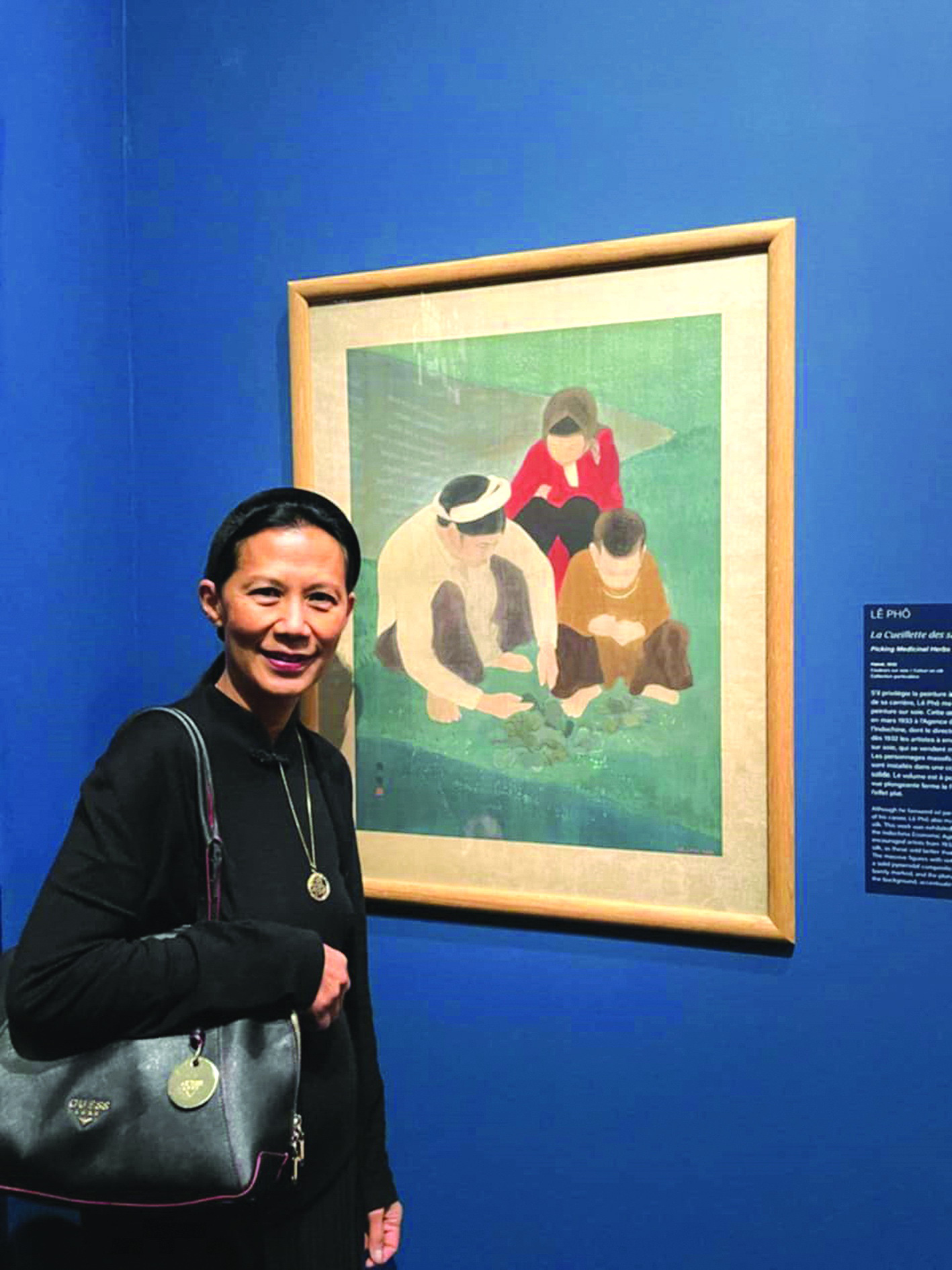
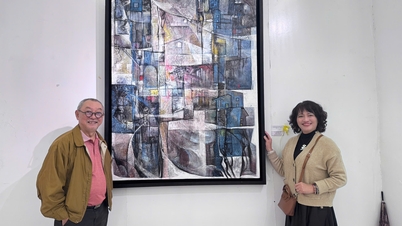
Collector Loan de Fonbrune at the opening of the exhibition on Le Pho, Mai Trung Thu, and Vu Cao Dam, Cernuschi Museum, November 2024. Photo: KIM POURNIN
Loan de Fontbrune, a French woman of Vietnamese descent and a renowned professional collector of Asian art, talks about that journey when she returns to Vietnam at the end of 2024.
How did you begin your journey of collecting and researching art?
From a young age, I was fascinated by fine arts, ancient art, and reading books about the cultures of countries like China. My family lived in Cholon at the time, and we were among the last French people to leave Vietnam, only leaving because we were forced to in 1979. My father was a very famous surgeon, and my mother was the head nurse specializing in anesthesia.
When I left Vietnam, I was around 20 years old, teaching French to people preparing to return to France. I was able to buy myself two paintings by the artist Tú Duyên, along with five or six other small paintings on ivory by Đới Ngoan Quân. Đới Ngoan Quân had taught at the Saigon School of Fine Arts and was very famous for his technique of using Chinese ink to paint ink wash paintings on small pieces of ivory, especially for carving an entire poem in Chinese characters along with his signature and seal onto a grain of rice.
While in France, I learned Chinese, Japanese, and Vietnamese, and was exposed to the culture and history, which made me even more fascinated and eager to study it in greater depth. In 1991, I married Yves Sicre de Fontbrune, a collector and owner of an art gallery in central Paris and the art magazine Cahiers d'Art. He was a renowned gallery owner specializing in trading works by famous artists, including Picasso.
I learned a great deal from him, traveling the world with my husband, visiting museums, auction houses, galleries, and private collections… I delved deeper into the study of Vietnamese art by pursuing degrees from institutions such as the Academy of Fine Arts and Archaeology (part of the Sorbonne University), the Louvre School (at the Louvre Museum), and the Graduate Academy of Fine Arts.
I later became a historian of Asian art and culture.
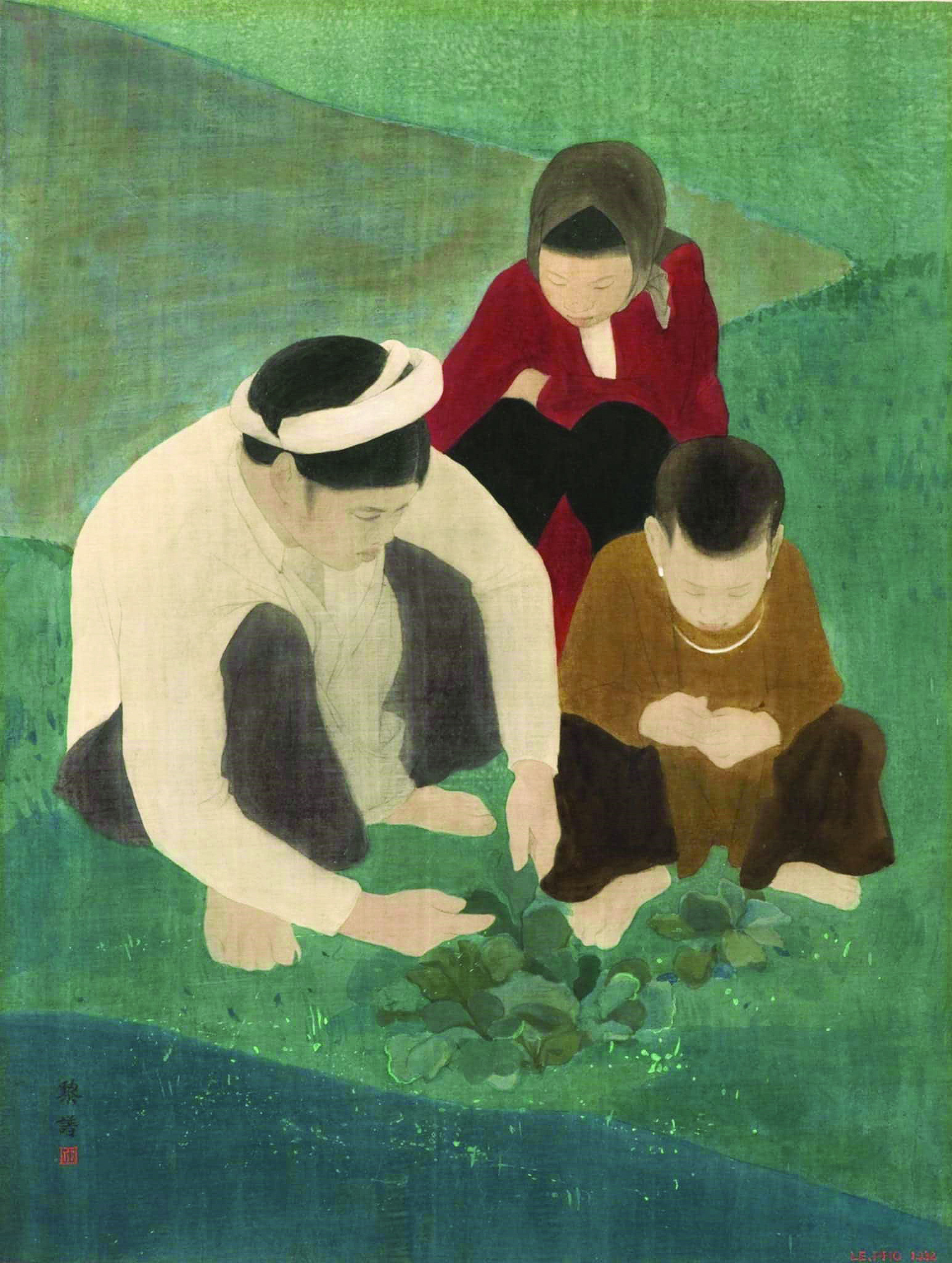
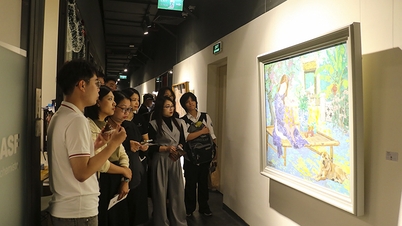
The painting "Picking Vegetables" by the renowned artist Le Pho.
As I interacted with and learned more about Vietnamese goods, I started paying more attention to them. I noticed everyone talked about Chinese, Japanese, and Korean goods, but no one mentioned Vietnamese items. I myself wanted to know how to distinguish Vietnamese goods from antiques and artifacts from other Asian countries.
Whenever I go for a walk, visit galleries, or see a flea market, I'm very happy to come across Vietnamese items, like meeting an old friend. I buy them because they're cheap back then; the sellers don't know much about their value. A teacup, a box, or a piece of pottery—they become my memories. I do my own research and learning to understand and distinguish Vietnamese items.
Luckily, my husband was quite well-off at the time. Knowing my passion, he sponsored me and also studied art. Gradually, he became very knowledgeable about Vietnamese art, especially painting. Back then, antiques were more common than paintings. Later, I came across paintings by Vietnamese artists and bought those I found beautiful because they were very affordable, even though I didn't know the artist's name, like the paintings by Dinh Minh. I bought most of my works in France.
I started collecting in the 1990s, when Vietnamese art was virtually uncollected, and I was the only one. Therefore, anyone who had anything would bring it to me to sell. I bought it out of affection for the familiar things of my homeland. For example, oil paintings of flowers by Le Pho were auctioned off at the weekend for about 3,000 francs.
I remember my husband saying, "At this price, why not buy a print by Picasso?" I replied that I wanted to buy paintings by Vietnamese artists because nobody knew them, and I enjoyed collecting works by them. Back then, there were many paintings by famous Vietnamese artists that were occasionally put up for auction, but nobody paid attention to them.
Then I started collecting paintings, antiques, books, documents—I bought everything. After a while, I became more selective, only buying things that were very beautiful and in perfect condition. I have a small museum in my house, displaying only Vietnamese items, such as books, paintings, and antiques...
There are many works of art that I find very special, because I didn't look for them, or even if I did, I wouldn't have found them, but somehow they came to me. For example, the painting "Spirit Possession" by Nguyen Phan Chanh. My husband's friend invited him to the house of someone who wanted to sell antique books. Upon entering the apartment, my husband saw the painting "Spirit Possession." The homeowner said her husband bought it for her from the 1931 colonial exhibition. I cherish this painting because the image is so familiar and was published in the magazine L'Illustration in 1932.
Another fortunate coincidence was the rare silk painting "Teacher and Student" by Pham Hau, which I bought when a friend saw it hanging in an old woman's house. I only knew Pham Hau through his lacquer paintings, so this was a very special piece.
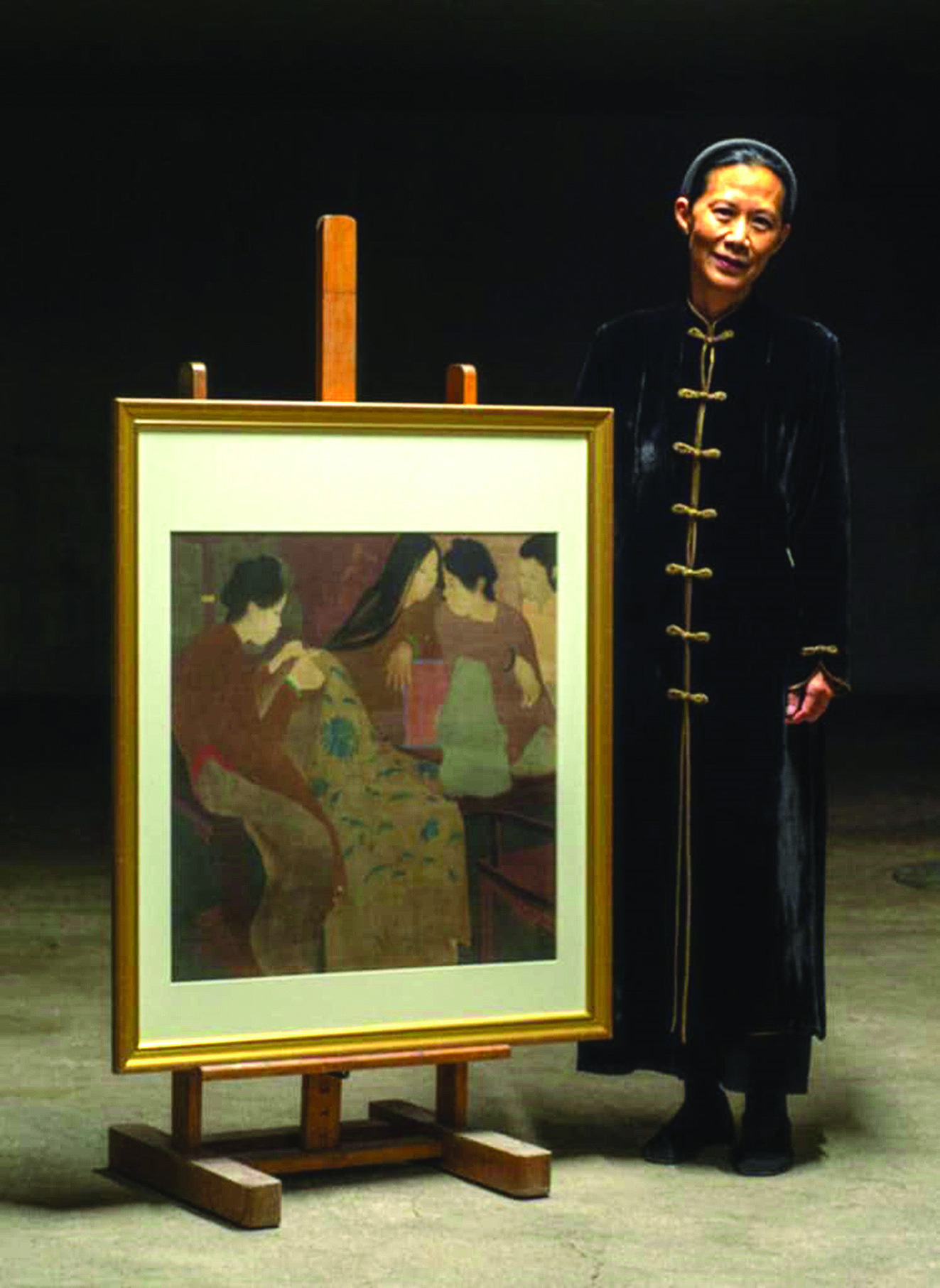
I remember once seeing two very beautiful silk paintings by To Ngoc Van being auctioned. I told my husband that those two paintings were beautiful and rare, because To Ngoc Van usually painted in oil. My husband gave me 200,000 francs, which was a lot of money back then.
But I couldn't buy any because the price was too high. I was very disappointed, but I finally managed to buy Le Pho's silk painting "Picking Vegetables" for 200,000 francs (laughs). I was very sad that I couldn't buy To Ngoc Van's painting of girls sitting and embroidering. Luckily, a few years later, the gallery that bought that painting agreed to sell it to my husband as a birthday gift for me. So the painting returned to me after so many years. I was very touched.
I am a collector, not a gallerist, because I don't deal in goods. I only sell things when absolutely necessary, like after my husband passed away, when I needed finances to cover family expenses. But I don't sell things that I cherish or love.
I think that's a way to protect Vietnam's cultural heritage. When you find items connected to Vietnam abroad, it's a matter of fate. For example, I bought many things in France, I also had the opportunity to buy paintings by Vu Cao Dam at Christie's London, ancient Hoi An pottery auctioned in the US, and in Japan I came across an ancient Chu Dau pottery piece. For me, that's a way to preserve heritage.
When did you start thinking about preserving that heritage?
When I started collecting, it was like meeting an acquaintance on the street. But since I began researching, I've realized that these are important artifacts from centuries ago that have found their way into my hands. For example, pottery is very fragile, but some pieces from the Ly Dynasty have survived to my time. It's my duty to preserve them and continue sharing them, so that my descendants, the younger generation, can continue to preserve them.
I am merely a guardian in the present, leaving a legacy for future generations. Therefore, I am always willing to share my knowledge with young collectors who wish to learn more.
How large is your collection?
I never count the number of artworks. I don't count the antiques either, and I've gone through many house moves and haven't been able to document the collection yet. I occasionally go into storage to look around, but I haven't seen everything. Many pieces are so delightful to see when I open them, like the ivory carving I bought in 1979 and put away; I was so happy to finally open it and admire it later.
My collection includes many exceptionally rare items because I know what I'm buying. I specialize in antique ceramics and am a member of the museum's antique ceramics research society. Later, I became fascinated with Indochina-era paintings and books.
I have some mother-of-pearl inlaid wooden trays that I've never seen before, perhaps I'm the only one who has them, made during the Trinh Dynasty, because we usually have items from the Nguyen Dynasty. These are very unusual and unique items that have come to me. Therefore, I want to create a museum so that people know about the value of these objects.
I'm keeping my entire collection in France. One reason is that the Vietnamese climate isn't good for preservation. I'm saddened to see how artworks are preserved in Vietnam. I've met descendants of great artists who wanted to sell their entire collections to me, but when I went to see them, I couldn't buy a single piece because they were all damaged.
Many people buy very expensive paintings from abroad but bring them back to Vietnam without knowing how to preserve them. Or some people buy antique paintings but want to repaint them, adding more vibrant colors. For example, someone bought a silk painting by Le Pho and told me they wanted to have it repainted to make the colors darker. I was so scared that I had to stop them from touching it.
With my collection, I want to create a private museum, both to display artifacts and to have a library of books for researchers and students to consult. Currently, I don't have a place to do this.
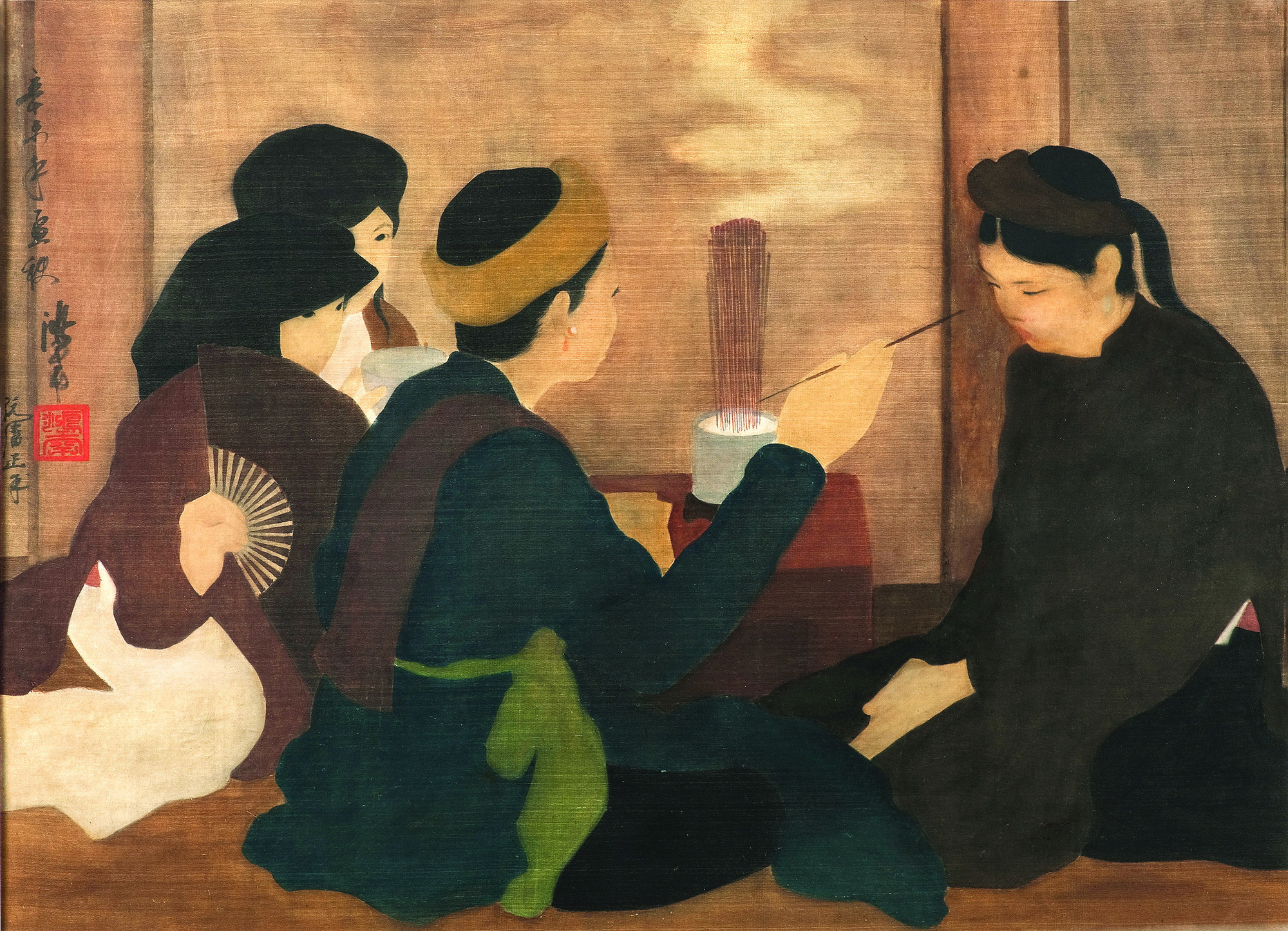
The painting "Lên Đồng" by the renowned artist Nguyễn Phan Chánh
How did your research play a role in your collecting process?
Research is very important. We must study, not just focusing on Vietnam, but also broadening our understanding of world culture and art. Vietnamese artists from the past, when they came to France, visited museums everywhere. They met other artists to broaden their perspectives.
The problem with Vietnamese people when studying art is that they rarely focus on the context outside of Vietnam. It's important to have a broader perspective, to know about the culture and history of other countries.
Abroad, they are very diligent in researching and learning about other countries. Exhibitions are always packed with people, many of whom come from other cities or provinces. Exchanging ideas is very important.
Do you work extensively with Vietnamese collectors?
In the old days, art collectors in Vietnam were very rare. During my time living in Vietnam from 2000 to 2014, I met some of those old collectors. I came back here and bought paintings by artists from the Gia Dinh School of Fine Arts; at that time, nobody in Vietnam paid any attention to them.
The Vietnam Museum also didn't have any pre-1975 artists from the Saigon School of Fine Arts, so I was able to buy many paintings, filling up the entire room, and I was able to choose some very beautiful and inexpensive works.
Or on occasions like buying paintings to support charitable activities during Tet, such as those by artists Nguyen Trung and Le Trieu Dien, I would go shopping with my husband. At that time, I didn't know Le Trieu Dien or Nguyen Trung, but I bought them because they looked nice.
How do you build a significant collection?
I don't hide what I know, because I love to share. Nearly 20 years ago, I remember a collector in Vietnam I met by chance on a plane. He asked me about my art collection, and I told him I bought paintings by Indochinese artists because the prices were so cheap and nobody paid attention to them. That's how he gradually built his collection.
Collecting depends on each person's financial ability, but first and foremost, buy what you find beautiful and appealing. Along with that, you must educate and research yourself; don't buy based on market trends or what others are doing. Start slowly. If you buy expensive items, you must research thoroughly because there are many fake paintings these days. I think self-learning is the first step in everything.
I don't often meet Vietnamese collectors, but in a relatively new market like Vietnam, you have to learn on your own, because collecting is not an easy job. In the beginning, I also bought the wrong antiques. But if you don't make mistakes, you can't improve or gain experience.
There's always a beginning and a price to pay for mistakes. I've observed that collectors in Vietnam are wasting money buying expensive items that turn out to be fakes. Perhaps it's because they haven't seen real paintings before, and are more familiar with fakes, so sometimes they can tell a real painting is a fake.
Basically, learning is a lifelong endeavor. I'm very grateful for any feedback I receive. As a scientist , I need evidence and original documents for everything I do.
Given the current situation where many Vietnamese works of art are being forged, what are your thoughts on this?
I don't know how. I just think buyers should look around too. Whatever their purpose for buying, they should do their own research and learn on their own.
Counterfeit works are detrimental to the reputation of Vietnamese art , as in the regrettable case of painter Bui Xuan Phai, whose works should have been as valuable as those of his contemporaries, but due to the abundance of forgeries, they could not be sold.
I know the families of painters like Mai Trung Thứ, Vũ Cao Đàm, and Lê Phổ in France; they are very respectable and honorable towards their fathers and their legacy. They wouldn't stand idly by if they saw fake paintings by their fathers. Actions that disrespect previous generations would severely damage the reputation of the artists.
The only solution is for buyers to be careful to avoid buying fake paintings. To know if it's a fake, you have to see the real thing. It's impossible for a painting by a talented artist to have a signature that looks like a child's. A real painting has soul and moves you, while a fake one looks lifeless. Next, you have to study the colors, the signature, the lettering on the painting, the frame, the front and back. In other words, if you pay attention, the chances of buying a fake are very low.
A positive aspect of the current collecting environment is that many young collectors are starting to get involved. They are genuine collectors. They have limited funds, but they enjoy it, so they research and improve themselves.
What are your views on the role of art in society?
For me, art plays a very important role. You have to have passion for it; art makes life more beautiful and brings people together in a positive way. Art is a universal language. Art is boundless. Art helps you reach for beauty, not just focus on business and money.
In 1991, Loan de Fontbrune was appointed by the Guimet National Museum – one of the world's largest Asian art museums – to the position of manager of Southeast Asian antiquities. This process helped to complete the historical records of many valuable artifacts important to Vietnamese art at the museum, such as Blues de Hue porcelain, textiles, wood, stone, and metal objects, statues, and religious artifacts.
She is an advisor to many museums in France and Europe, such as the Paris Museum of Natural History, the Sèvres National Museum of Ceramics, the Limoges Museum, and the Royal Belgian Museum of Art and History. She has played a significant role in helping Vietnamese handicrafts and fine arts become more widely known in Europe, and is the author of many valuable documents and research works on Vietnamese art.
In 2002, the exhibition she advised, entitled "Vietnam: Art and Culture, from Past to Present" - the first exhibition on Vietnamese art in Belgium - displayed 450 artifacts from Vietnam and across Europe. This exhibition contributed to the passage of the Cultural Heritage Law in Vietnam because it borrowed several hundred very valuable artifacts from 13 museums in Vietnam.
In 2012, she was a guest curator for the exhibition "From the Red River to the Mekong - Visions of Vietnam" at the Cernuschi Museum, the first large-scale exhibition to comprehensively showcase the history of Indochinese art.
In 2014, she was appointed a correspondent member of the French Academy of Overseas Studies in the fields of education , literature, archaeology, and fine arts. Prior to that, other notable figures included King Khai Dinh, cultural figure Pham Quynh, and Nguyen Tien Lang.
Source: https://cuoituan.tuoitre.vn/loan-de-fontbrune-nguoi-gin-giu-di-san-viet-nam-o-phap-20250123104010235.htm





























































Comment (0)