

(NLĐO) - The Ministry of Health has proposed abolishing outdated regulations on handling violations of population policy, including disciplinary action against Party members for having a third child or more.
The decision not to discipline Party members who have a third child or more is consistent with the amendment of legal regulations. This is the content of a recent document from the Central Party Office announcing the Politburo 's opinion on amending Party and State regulations related to population policy.
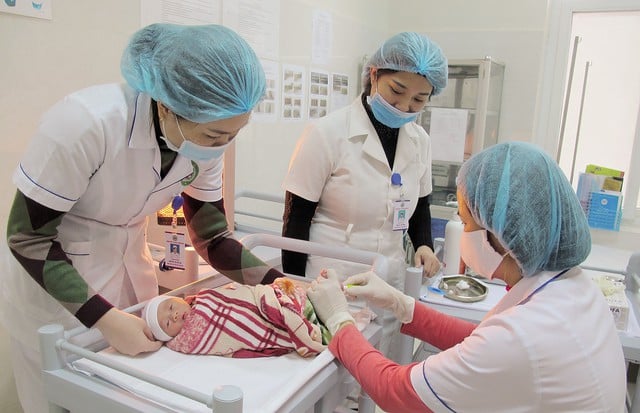
Population policies are being adjusted to suit the new situation.
Previously, according to various regulations, including the 2017 Central Resolution on population policy in the new situation, having a third child was considered a violation of population policy and could result in disciplinary action such as reprimand, except in a few specific cases.
This regulation was created to emphasize the pioneering and exemplary role of officials and Party members in implementing policies and guidelines on population, while also limiting births to prevent a population explosion.
In recent years, when analyzing population policies, many experts have argued that this regulation needs to be changed. Having children should be considered a responsibility, duty, and right of each individual, contributing to the sustainable development of the country.
Professor Nguyen Dinh Cu, former Director of the Institute of Population and Social Issues (National Economics University, Hanoi), believes that the policy of "not disciplining Party members who have a third child or more" is a very urgent policy, especially in the context of Vietnam's birth rate trending sharply downward, particularly in urban areas.
This expert assesses that, if implemented, the regulation would be a breakthrough in policy, contributing to improving and halting the current decline in birth rates, "paving the way" for amending other regulations, specifically amending the 2008 Population Ordinance, developing a Population Law, and creating a synchronized regulation within the political system.
According to the Ministry of Health, from 1999 to 2022, Vietnam's fertility rate remained stable around the replacement level (2.1 children per woman). However, in the last two years, the fertility rate has decreased rapidly, from 1.96 children per woman in 2023 to 1.91 children per woman in 2024 - the lowest level in history. This is also the third consecutive year that Vietnam's fertility rate has fallen below the replacement level.
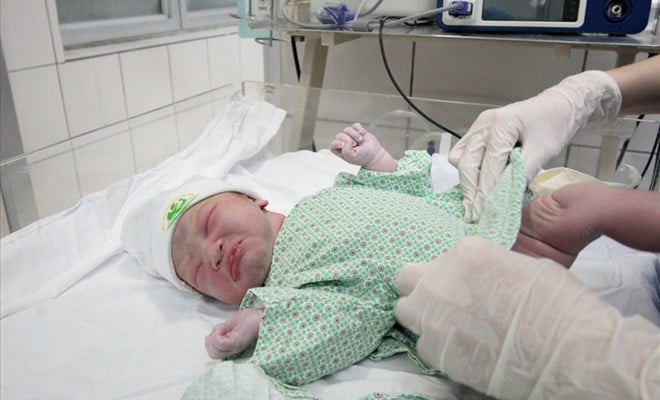
Newborn care at a medical facility
People with less than primary education have an average fertility rate of 2.35 children, while those with more than high school education have only 1.98 children. At the same time, the average age of first marriage in our country is changing towards later marriages.
The number of localities with fertility rates below the replacement level is trending upwards. Specifically, there were 22 provinces in 2019, 27 provinces in 2023, and 32 provinces in 2024. Ho Chi Minh City and most provinces in the Southeast and Mekong Delta regions have fertility rates significantly lower than the replacement level (1.39-1.74 children per woman).
Currently, Vietnam's fertility rate is among the top 5 lowest in Southeast Asia. Compared to the regional average (2.0 children per woman), Vietnam is only higher than Brunei (1.8 children per woman), Malaysia (1.6 children per woman), Thailand, and Singapore (1.0 child per woman).
According to a representative from the Population Department (Ministry of Health), at the end of December 2024, the Ministry of Health submitted a preliminary report on the 7-year implementation of Resolution 21, reviewing the Party's regulations related to handling violations of population policy. The report proposed abolishing regulations on handling violations of population policy that are no longer appropriate. Initially, the regulations on the number of children will be abolished, and disciplinary action will not be taken against Party members who have a third child or more.
Directing government agencies, ministries, and departments; and provinces and centrally-administered cities to advise and submit to competent authorities policies to support and encourage couples to have two children, prioritizing and focusing on provinces with low birth rates and ethnic minority populations.
The Ministry of Health forecasts Vietnam's population for the period 2019-2069. In the case of a sharp decline in birth rates as in the low scenario, after 2054, the population will begin to experience negative growth, and the rate of decline will become increasingly significant.
During the period 2054-2059, the population decreased by an average of 0.04% per year, and the decrease at the end of the forecast period (2064-2069) is 0.18% per year, equivalent to an average decrease of 200,000 people per year for Vietnam.
Conversely, if the replacement fertility rate remains stable throughout the forecast period, then the population will still experience a slight increase by the end of this period.
Source: https://nld.com.vn/ly-do-bo-y-te-de-xuat-khong-ky-luat-dang-vien-sinh-con-thu-3-196250221145223963.htm





























![[Image] Close-up of the newly discovered "sacred road" at My Son Sanctuary](/_next/image?url=https%3A%2F%2Fvphoto.vietnam.vn%2Fthumb%2F1200x675%2Fvietnam%2Fresource%2FIMAGE%2F2025%2F12%2F13%2F1765587881240_ndo_br_ms5-jpg.webp&w=3840&q=75)



























































Comment (0)