

This is a large language model (LLM) developed by Chinese scientists that can command military drones to attack enemy radar systems.
 |
According to the SCMP, scientists in China's defense industry have developed an AI capable of enhancing the performance of electronic warfare drones.
This large language model (LLM), similar to ChatGPT, can command drones equipped with electronic warfare weapons to attack enemy aircraft radars or communication systems.
Test results showed that its decision-making performance in air combat not only surpassed traditional artificial intelligence (AI) techniques such as reinforcement learning but also outperformed even highly experienced professionals.
This is the first widely published study to directly apply large-scale linguistic models to weaponry.
Previously, this AI technology was primarily limited to war rooms, providing intelligence analysis capabilities or assisting human commanders in decision-making.
The research project is being jointly undertaken by the Chengdu Aircraft Design Institute of the China Aviation Industry Corporation and Northwestern Polytechnic University in Xi'an, Shaanxi Province.
This institute is the design unit for China's J-20 heavy stealth fighter jet.
According to an article published by the project team on October 24th in the peer-reviewed Journal of Detection & Control, the work is still in the experimental phase. Among existing artificial intelligence technologies, LLM is the one with the best ability to understand human language.
The project team provided LLM with a wealth of resources, including "a series of books on radar, electronic warfare, and related document collections."
Other documents, including air combat records, weapons depot setup records, and electronic warfare operating manuals, were also included in the model.
According to the researchers, most of the training materials are in Chinese.
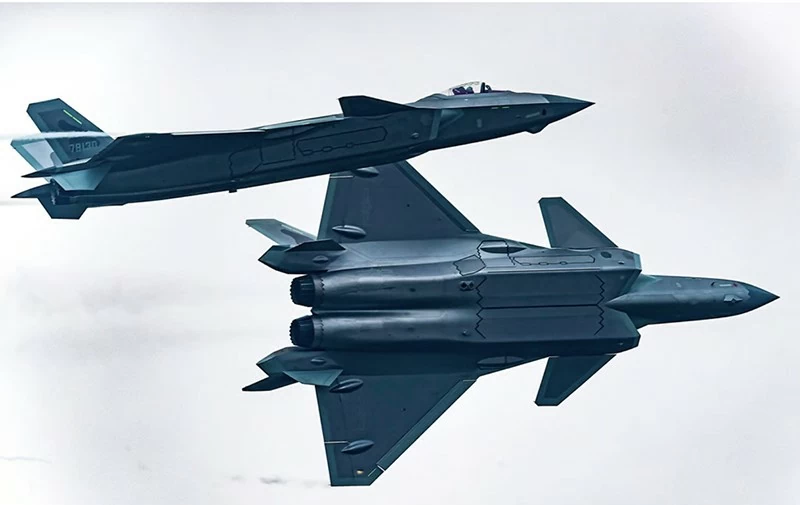 |
| The designer of China's J-20 stealth fighter jet is part of a research team involved in the AI project. Photo: Weibo |
In electronic warfare, the attacking side releases specific electromagnetic waves to suppress radar signals emitted by the target.
Conversely, the defending side will attempt to evade these attacks by constantly changing signals, forcing the opponent to adjust their strategy in real time based on monitoring data.
Previously, it was believed that LLM was unsuitable for such tasks because of its inability to interpret data collected from sensors.
Artificial intelligence also typically requires longer thought processes and fails to achieve millisecond-level response times—a crucial element in electronic warfare.
To avoid these challenges, scientists have delegated the processing of raw data to a less complex reinforcement learning model. This traditional AI algorithm excels at understanding and analyzing large amounts of digital data.
The “observed value vector parameters” extracted from this preliminary process are then converted into human language via a machine translator. The grand linguistic model then takes control, processes, and analyzes this information.
The compiler converts the responses of the large model into output commands, which ultimately control the electronic warfare jamming machine.
According to the researchers, test results have confirmed the feasibility of this technology. With the support of reinforcement learning algorithms, the generated AI can rapidly adjust attack strategies up to 10 times per second.
When compared to traditional AI and human expertise, LLM proves superior in generating a multitude of decoy targets on the enemy's radar screen. This strategy is considered more valuable in the field of electronic warfare than simply jamming with noise or deflecting radar waves away from real targets.
Source



![[Photo] Closing Ceremony of the 10th Session of the 15th National Assembly](/_next/image?url=https%3A%2F%2Fvphoto.vietnam.vn%2Fthumb%2F1200x675%2Fvietnam%2Fresource%2FIMAGE%2F2025%2F12%2F11%2F1765448959967_image-1437-jpg.webp&w=3840&q=75)



















































![[OFFICIAL] MISA GROUP ANNOUNCES ITS PIONEERING BRAND POSITIONING IN BUILDING AGENTIC AI FOR BUSINESSES, HOUSEHOLDS, AND THE GOVERNMENT](https://vphoto.vietnam.vn/thumb/402x226/vietnam/resource/IMAGE/2025/12/11/1765444754256_agentic-ai_postfb-scaled.png)















































Comment (0)