

According to Jens Eskelund, President of the European Chamber of Commerce (EuroCham) in China, given the current tensions, a trade war between the European Union (EU) and China would be "unavoidable"
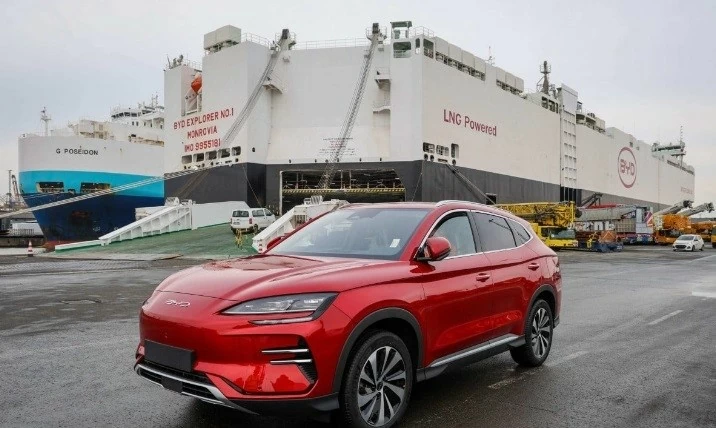 |
| EU tariffs on Chinese electric vehicles are expected to take effect later this month. (Source: AFP) |
"A full-blown trade war is increasingly likely if nothing changes," Jens Eskelund said at a meeting on October 9.
The announcement came a day after China formally imposed provisional anti-dumping measures on imports of spirits from the EU, targeting French brands including Hennessy and Remy Martin, days after the 27-nation bloc voted to impose tariffs on Chinese-made electric vehicles (EVs).
China's Ministry of Commerce said that preliminary investigations have determined that the dumping of spirits from the European Union has caused "significant damage" to the country's industry.
As Beijing accused Brussels of “blatant protectionism”, Mr Eskelund urged Chinese authorities to look at the bigger picture and seriously examine European concerns about the government ’s policies.
“I think the electric car drama of the past several months has been a distraction from the broader issues at play in bilateral trade. There is clearly a huge increase in Chinese exports, fueled by domestic deflation. In the first seven months of the year, Chinese exports to the EU soared to an all-time high while imports from the EU fell sharply,” Eskelund cited.
According to this official, since 2017, the Chinese economy has grown by 40%, but during that period, European exports to China have decreased by 30%.
Chinese government data shows that producer prices – the cost of goods at the factory gate – have fallen for 23 consecutive months, leaving companies with no choice but to export their products overseas.
This has led to a surge in imports of high-tech goods into Europe, which, by Western standards, is relatively open to Chinese products.
Meanwhile, recent efforts by the Chinese government to boost consumption in the world's second-largest economy have so far failed to achieve the expected results.
Beijing's stock market continued to fall after data on economic stimulus measures released failed to meet expectations, leaving many investors indifferent to the Asian country's growth prospects.
In Europe, the movements of Asia's number one economy are also being closely watched, as deflation and weak consumer demand are believed to be major factors fueling tensions between Beijing and Brussels.
Although analysts are still avoiding the term "trade war," escalating tensions between the two sides are predicted to soon bring China and the EU closer to a bitter trade dispute.
On October 8, China's Ministry of Commerce announced that Beijing is investigating alleged dumping practices among EU dairy and pork producers and is considering increasing tariffs on "imported large-engine gasoline vehicles."
Technical negotiations between the two sides to reach an agreement on electric vehicles are still ongoing. Most recently, the European Commission (EC) rejected several proposals from Chinese Chambers of Commerce requesting a minimum price for imports from the country.
An industry source also revealed that there is still a "big gap" between what Chinese negotiators are willing to offer and what the EC is willing to accept.
Source: https://baoquocte.vn/chu-cich-eurocham-trung-quoc-mot-cuoc-chien-thuong-mai-la-khong-the-tranh-khoi-289670.html























































































Comment (0)