

Ho Chi Minh City has approximately 230 traditional markets spread across its districts, including Thu Duc City. In contrast to the bustling crowds before the Covid-19 pandemic, current purchasing power in these markets has plummeted, with some experiencing a drop of over 70%. Finding ways to help these traditional markets survive is a major concern for all levels of government, relevant agencies, and businesses.
The makeshift market is surrounded.
Observations made on November 25th at several traditional markets in Ho Chi Minh City showed that the number of shoppers was not high. The number of shoppers was being diverted to nearby makeshift markets.
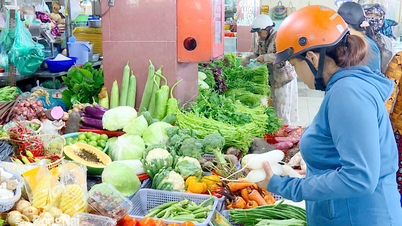
Typically, the area surrounding Nhat Tao Market (District 10) – the section where Nguyen Duy Duong intersects with Ba Hat Street – is occupied by local residents selling all kinds of fruits, vegetables, and other produce. Occasionally, fruit carts also appear, offering a side hustle. Prices are competitive, 3,000-5,000 VND cheaper per item compared to prices inside the market.
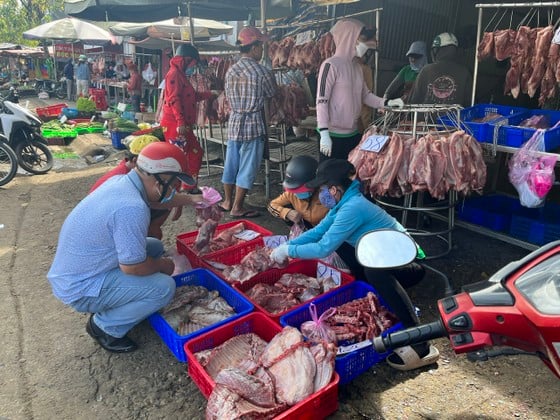 |
Buyers select pork displayed on the roadside at an impromptu stall in front of the Hoc Mon wholesale market on the afternoon of November 25. Photo: THI HONG |
"Buyers ride motorbikes, pull over to the side of the road to buy vegetables, fruits, meat, and fish, then quickly head home instead of stopping at the market," said Ms. T., a small trader at Nhat Tao market.
Similarly, the storefront of Hoa Hung Market (District 10) - the section along Cach Mang Thang Tam Street - is also being used by local residents to sell fruits, meat, fish, etc. People traveling through this section of road frequently encounter traffic congestion due to the chaotic trading situation and goods spilling onto the road.
The Hoa Binh market area (District 5) is no exception, with many residents utilizing available space for on-site business. The Hanh Thong Tay market (Go Vap District) is no better, surrounded by shops selling clothes, food, and all sorts of other goods.
Pork is sold along the road in the residential area of My Hoa 4 hamlet, Xuan Thoi Dong (Hoc Mon) on the afternoon of November 25th. Photo by: THI HONG |
In wholesale markets like Binh Dien and Hoc Mon, competition for customers and prices between traders within the market and vendors at informal stalls is also common.
Specifically, along Nguyen Thi Soc Street (near Hoc Mon wholesale market) and the main road in My Hoa 4 residential area, Xuan Thoi Dong (Hoc Mon), there is always a huge crowd of shoppers. Various types of pork are sold at relatively cheap prices, and seafood is piled in basins or on plastic sheets on the ground… Motorbikes drive back and forth, and those who like something will stop to buy. As for food safety and hygiene, it's a matter of luck. Various types of vegetables cost around 20,000 VND for 3 bunches. Seafood (snails, shrimp, etc.) costs from 35,000 to 150,000 VND/kg. Pork ranges from 58,000 to 120,000 VND/kg, which is 20,000-30,000 VND/kg cheaper than in traditional markets, depending on the type.
"All the pork is fresh, freshly slaughtered. We buy it directly from the wholesale market and bring it here, so it's very safe," said Ms. H., a vendor in My Hoa 4 residential area.
Rearranging and repurposing markets.
The reality is that informal markets are thriving while traditional markets are losing customers and can't compete, causing much frustration among small traders. Ms. H., who sells various seafood at Hoa Hung market, shook her head, unhappy when asked about purchasing power: “Purchasing power has decreased by nearly 50% compared to before the Covid-19 pandemic. Buyers are now hesitant to go to the market; they buy wherever is convenient. Not to mention, each stall has to pay extra for electricity and water… while informal vendors don't pay any fees. How can we compete like that?”
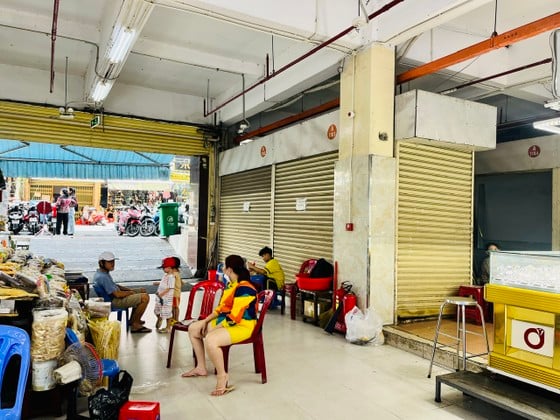 |
The ground floor of An Dong Market was deserted, with some stalls displaying "closed" signs at noon on November 25th. Photo: THI HONG |
The management boards of wholesale markets such as Binh Dien and Hoc Mon have repeatedly petitioned local authorities and relevant agencies (Department of Industry and Trade, district police, etc.) to intervene and dismantle these unauthorized markets, but after a while, the situation returns to its previous state.
Not only the aforementioned traditional markets, but also some "key" markets included in the plan to increase tourism and attract international visitors, such as An Dong and Binh Tay, are not doing any better.
Calculating the number of customers from morning until 5 PM on November 25th, Ms. L. sighed, saying that dozens of people visited and inquired about prices, but only 5 actually bought anything. The total value of the orders was very small, only a few hundred thousand dong. After deducting all expenses (electricity, water, staff, etc.), the profit was less than 100,000 dong per day.
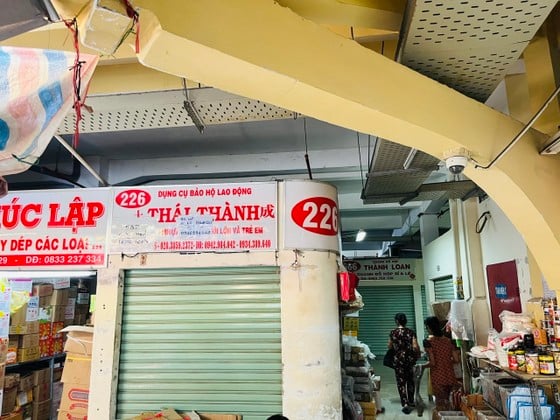 |
Numerous stalls display "for rent" signs at Binh Tay Market, District 6. Photo: GIA HAN |
Ms. T., a small business owner with three stalls selling fashion clothing at An Dong Market, said she had to close two stalls, keeping only one, because business was slow. Similarly, stalls were locked up and "for rent" signs were also displayed at Binh Tay Market (District 6)...
According to Ms. M., a small business owner specializing in confectionery at Binh Tay Market, those who have managed to stay in business until now are very passionate about their work. They hope for a boost in consumer demand at the end of the year. "We are doing many things to retain consumer demand, such as selling online through Zalo, Facebook, etc.," Ms. M. said.
Impromptu markets surround the Hoc Mon wholesale market. Reported by: ANH XUAN |
A few days ago, the Ho Chi Minh City Department of Industry and Trade announced that it had coordinated with districts, counties, and Thu Duc City to enhance the purchasing power of traditional markets; and at the same time, strengthen connections with provinces and cities to promote trade and find outlets for the markets. Currently, the Ho Chi Minh City Department of Industry and Trade is reviewing and reassessing the markets or will convert their functions to help them operate more effectively.
Economic experts also suggest that the key is to improve service quality, prevent vendors from overcharging customers, ensure food safety and hygiene, and properly sort and dispose of waste. Generally, tourist destinations tend to be cleaner and more civilized; conversely, places that are messy and have poor service quality will find it difficult to attract visitors.
Terrified by the makeshift market.
In the late afternoon and evening, along Pham Van Bach street (connecting Tan Binh and Go Vap districts), which is only about 3km long, there are dozens of stalls selling all kinds of vegetables, fruits, meat, and fish...
Similarly, the makeshift stalls along Duong Thi Muoi Street, Tan Thoi Hiep 21 (the section intersecting Tan Thoi Hiep 06), and Trung My Tay 13 in District 12 are also a nightmare for residents.
Street vendors are competing to set up stalls on the sidewalks, encroaching on half of the road lanes in order to attract customers. There have been instances of pedestrians being hit by vehicles due to collisions with these street stalls.
Furthermore, the vendors even brazenly park their carts right in the middle of the road, obstructing traffic and detracting from the urban landscape. However, upon seeing urban order enforcement officers conducting inspections, the vendors quickly move their carts to another location, only to return shortly afterward to resume their business.
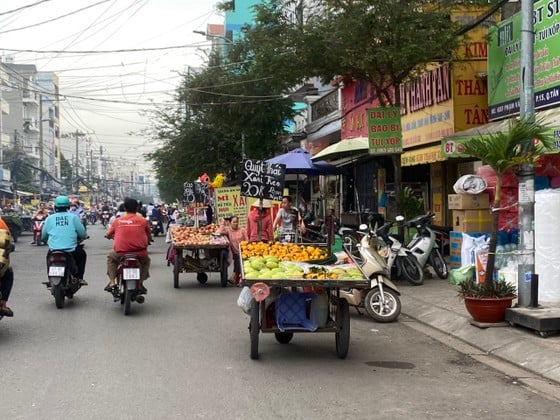 |
Street vendors' carts on Pham Van Bach Street. Photo: HAI NGOC |
Supporting small business owners in promoting their products online.
To help small traders increase sales and attract customers, the management boards of An Dong and Binh Tay markets have recently been continuously holding training sessions and providing support to the traders.
Ms. Nguyen Ngoc Que Phuong, Head of the Binh Tay Market Management Board, said that the board is working alongside traders to innovate, improve service quality, and increase sales; and applying information technology to online sales. Currently, the board has introduced to domestic and international tourists characteristic souvenir products, such as fashionable fabric bags, tea sets, and glass cups printed or engraved with images of Binh Tay Market…
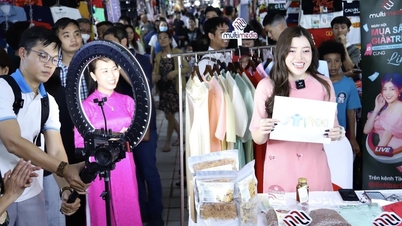
Ms. Nguyen Thi Ngoc Ha, Deputy Head of the Management Board of An Dong Trade and Service Center (also known as An Dong Market), further informed that the Economic Department of District 5 has organized many training sessions for traders on applying information technology to sell goods on TikTok, Zalo, Facebook, livestream, etc., in order to attract shoppers.
At Ben Thanh Market, vendors have adopted cashless payment methods such as QR codes and POS machines, which are quite convenient.
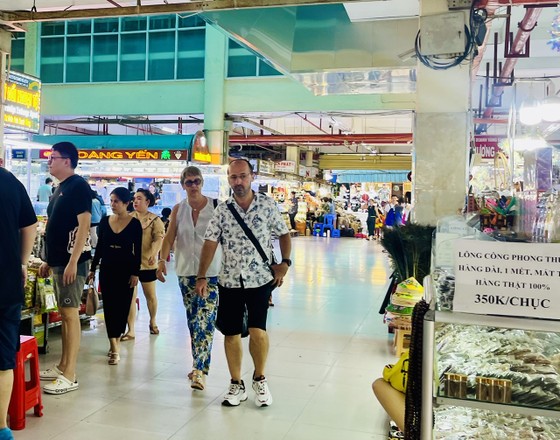 |
International tourists visit An Dong Market on the afternoon of November 25th. Photo: GIA HAN |
Source


![[Photo] Prime Minister Pham Minh Chinh holds a phone call with the CEO of Russia's Rosatom Corporation.](/_next/image?url=https%3A%2F%2Fvphoto.vietnam.vn%2Fthumb%2F1200x675%2Fvietnam%2Fresource%2FIMAGE%2F2025%2F12%2F11%2F1765464552365_dsc-5295-jpg.webp&w=3840&q=75)





























































Comment (0)