

The merger of provincial administrative units, making Dak Nong a part of Lam Dong (according to the resolution effective after July 2025), has created a vast Central Highlands region, rich in development potential and cultural diversity. In particular, the intangible cultural heritage of the M'nong people, especially the Nau M'pring folk song and the Ot N'drong epic, have emerged as invaluable assets that need to be preserved and promoted.
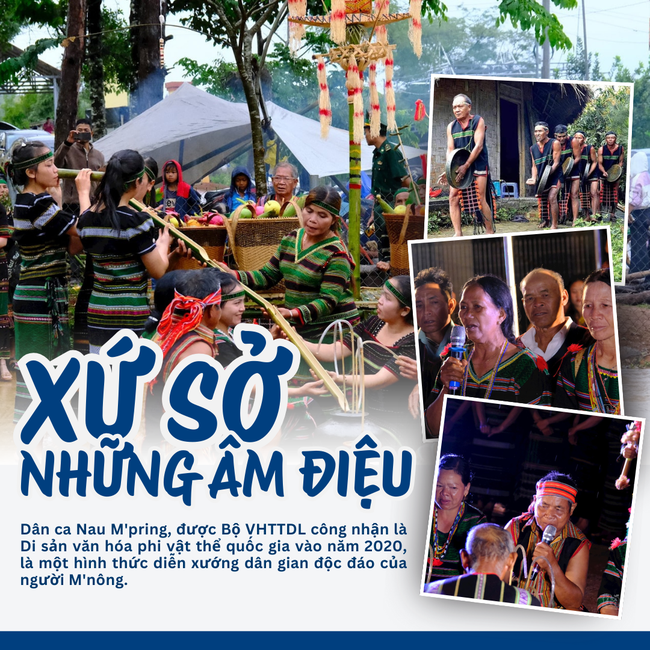
Cultural foundation of the “Land of Melodies”
Nau M'pring folk song, recognized by the Ministry of Culture, Sports and Tourism as a National Intangible Cultural Heritage in 2020, is a unique form of folk performance of the M'nong people. This genre has no musical accompaniment, is composed from slash-and-burn agriculture and passed down through many generations orally. Nau M'pring consists of two basic components: lyrics and music. Lyrics are formed on the basis of rhymed words (Nao m'pring), both daily colloquial but concise, and rich in lyricism with images, rhythm and rhyme. In terms of musical scale, M'nong folk songs are rich from 3 to 7 tones, but mainly use the 5-tone scale.
The genres of Nau M'pring reflect the whole life, classified by performance form and ritual form. In terms of performance form, Nau M'pring can be Solo (Solo), which is the most popular form, usually sung by one person to express personal thoughts and feelings. A typical example of this form is Lullaby (Mpơ n'him kon). The deep, steady melody of the lullaby contains the dreams of grandmothers and mothers about the healthy future of their children and grandchildren, as described in the song "Going to the forest": "My dear, quickly grow up/My dear, hold a basket to catch fish/My dear, hold a crossbow to shoot squirrels". In contrast to solo singing, the form of Antiphonal singing is often divided into two groups singing in competition with each other, the most popular is Love Song (Tăp ta Weu). This is where men and women get to know each other, confess their love, and make promises through metaphorical and affectionate songs, the content is often inspired by natural landscapes and love between couples.
In addition, Epic singing (Ót N'drông) is a narrative form, taking place during nights around the fire or during festivals. These are grand heroic songs, combining speech, chanting and accompanying dance movements, retelling legends about the gods and heroes of the nation.
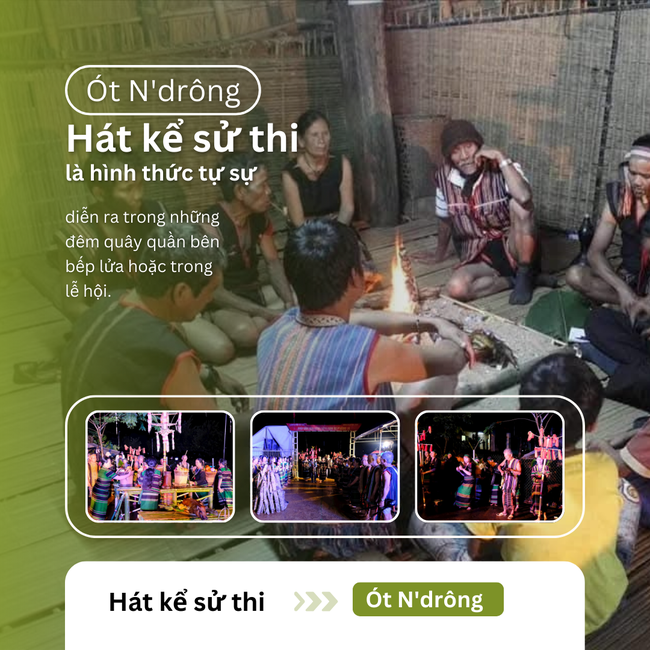
Besides the forms of daily performances, M'nong folk songs also exist in ritual forms associated with spirituality. Religious folk songs (Praying to the god Bưh Rrah) are often sung in ceremonies and festivals to ask the gods to bless the community to overcome difficulties and have a good harvest. Waiting folk songs (M'prơ) are popular among young men and women when they are away from their lovers, singing lyrics containing longing, often sung in watchtowers on the fields. All these forms show that M'nong folk songs are everyday speech that has been artistically transformed, bearing ethnic and local nuances, highlighting identity.
M'nong heritage is associated with community life and folk knowledge.
On the other hand, M'nong culture is a complex system of knowledge, not only including singing but also customs, practices, customary laws and folk knowledge. M'nong folk songs play a role as a means of protecting and transmitting knowledge about nature, society and people. Lyrics explain natural phenomena such as sun, rain, wind, storms, thunder, day and night; at the same time guide how to behave with nature in production labor, hunting, gathering; and regulate behavior between people. All these characteristics originate from slash-and-burn agriculture and a pre-class society. Folk songs are a form of communication between people and the supernatural world and a place to praise the brave people who protect the village and beautiful nature.
In addition to folk songs, the M'nong heritage also includes the Epic Ot N'drong (National Intangible Cultural Heritage), a majestic epic that reflects the depth of thought about the formation of the universe, humans and society. The epic is a majestic picture, containing legends related to gods, expressing the dreams and aspirations of humans before the mysterious nature. The singing and retelling of the epic uses a rich poetic language, skillfully combining artistic techniques such as comparison, contrast, simulation, and hyperbole, often used to portray the personalities of characters and events.
M'nong art is also prominent through traditional hand-weaving (National Intangible Cultural Heritage) and sculpture art associated with elephants. Folk knowledge related to domesticated elephants is an inseparable part, where elephants are considered members of the community and the greatest asset. The M'nong have a huge treasure of elephant worship rituals (worshiping imported elephants, praying for elephant health, praying when elephants give birth...) showing respect for animals that bring luck.
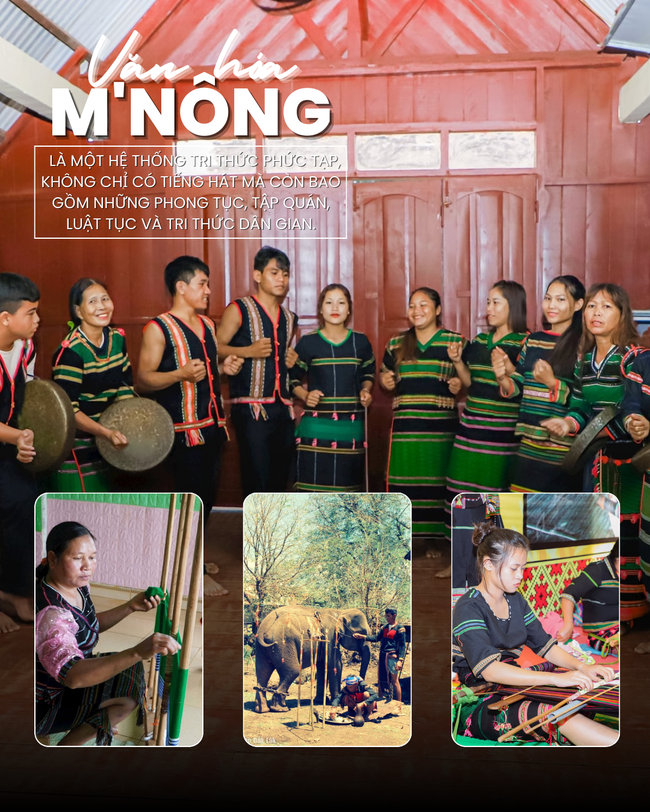
The image of elephant tusks is also a powerful artistic symbol, often sculpted in tombs with the motif of a pair of elephant tusks mounted on a bronze pot, representing power and prosperity. These decorative patterns bear a distinct mark, reflecting the soul and feelings of the residents who were once famous for hunting and taming wild elephants, while affirming that the M'nong culture is a unique human resource of the Central Highlands.
Promoting heritage values associated with tourism
With the merger, the expanded Lam Dong region possesses these valuable heritages. The work of preserving and promoting the M'nong cultural heritage is placed in a new context, associated with the Dak Nong UNESCO Global Geopark - the international tourism brand of the region. Currently, the entire expanded Lam Dong region still has a valuable human resource, including about 301 artisans who know and sing folk songs, 12 artisans who remember and sing the Ot N'drong epic, and 698 artisans who know how to weave traditional brocade (according to data at the end of 2024).
To preserve Nau M'pring and other heritages, the government has been implementing intensive conservation activities. Specifically, the province has regularly organized training courses on preserving M'nong folk songs, taught traditional brocade weaving and weaving skills to the younger generation, and collected and recorded more than 80 high-quality M'nong folk songs for permanent preservation. Along with that, the organization of the restoration of dozens of traditional festivals such as the Rain Praying Festival, the Water Wharf Worshiping Festival, the Tam R'nglap Bon Festival... has created a lively performance space, helping the community practice the heritage.
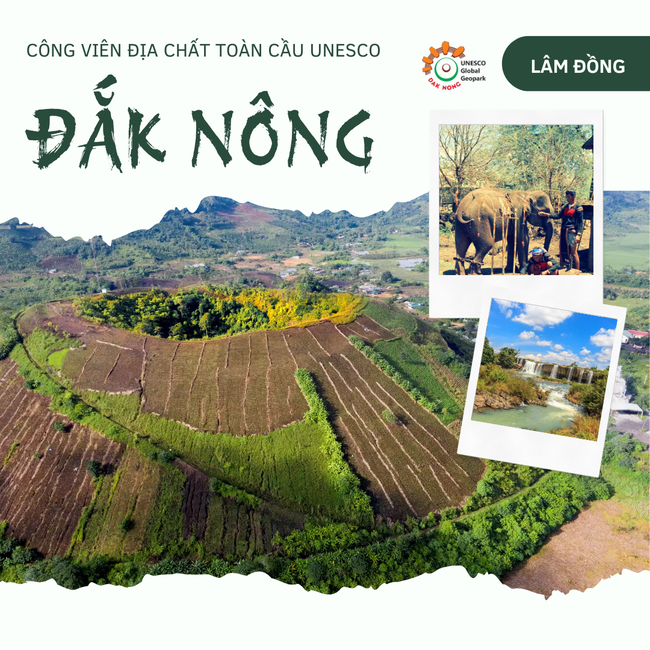
Notably, Lam Dong has expanded its tourism development orientation based on heritage, taking the theme “Dak Nong UNESCO Global Geopark - Land of Melodies” as its core brand. M'nong heritage is integrated into experiential tourism routes, where visitors can visit archaeological sites and explore M'nong culture. The establishment of 42 cultural and folk art clubs at heritage sites has created opportunities for visitors to directly experience Nau M'pring and gong performances. The effective exploitation of M'nong heritage values has contributed to improving the material and spiritual life of the people, while expanding Lam Dong's cultural brand to be on par with the common heritage values of humanity.
Nau M'pring folk songs and intangible cultural heritages of the M'nong people are the "golden key" for Lam Dong to exploit its tourism potential, affirming its position as one of the leading cultural and tourism centers of the Central Highlands and Vietnam./.
Source: https://bvhttdl.gov.vn/nau-mpring-va-ot-ndrong-dau-an-van-hoa-mnong-tren-ban-do-di-san-viet-nam-20251209125939722.htm

![[Photo] The captivating scenery of the fragrant maple forest in Quang Tri](/_next/image?url=https%3A%2F%2Fvphoto.vietnam.vn%2Fthumb%2F1200x675%2Fvietnam%2Fresource%2FIMAGE%2F2025%2F12%2F10%2F1765353233198_lan09046-jpg.webp&w=3840&q=75)
![[Photo] Explore the US Navy's USS Robert Smalls warship](/_next/image?url=https%3A%2F%2Fvphoto.vietnam.vn%2Fthumb%2F1200x675%2Fvietnam%2Fresource%2FIMAGE%2F2025%2F12%2F10%2F1765341533272_11212121-8303-jpg.webp&w=3840&q=75)














![[Video] The craft of making Dong Ho folk paintings has been inscribed by UNESCO on the List of Crafts in Need of Urgent Safeguarding.](https://vphoto.vietnam.vn/thumb/402x226/vietnam/resource/IMAGE/2025/12/10/1765350246533_tranh-dong-ho-734-jpg.webp)










































Comment (0)