

Acquiring Credit Suisse brought UBS nearly $35 billion in profit, gave it assets double Switzerland's GDP, and eliminated a competitor in the securities trading sector.
On June 12th, UBS announced the completion of its acquisition of rival Credit Suisse. This is the largest merger in the global banking industry since the 2008 financial crisis. The deal also creates a Swiss banking giant with $1.7 trillion in assets and 120,000 employees worldwide.
Following the merger, UBS Group will manage two separate companies: UBS and Credit Suisse. The integration process is expected to take 3-4 years. During this time, both banks will continue to have separate branches and work with their own clients and partners.
Swiss financial authorities (FINMA) commented that the completion of the takeover "has brought transparency and stability to both banks." This is a project of national importance to Switzerland, as the country's economy is heavily reliant on the financial sector.
In March, UBS agreed to take over Credit Suisse for more than $3 billion, through an emergency arrangement by the Swiss government . Credit Suisse was then in a crisis of confidence and experiencing a massive withdrawal of funds by customers. Swiss officials feared that Credit Suisse – one of the world's 30 most important banks – would collapse, triggering a global financial crisis.
"This marks the beginning of a new chapter, for both UBS and the global financial industry," UBS CEO Sergio Ermotti and UBS Chairman Colm Kelleher said in a letter to the press on June 12.
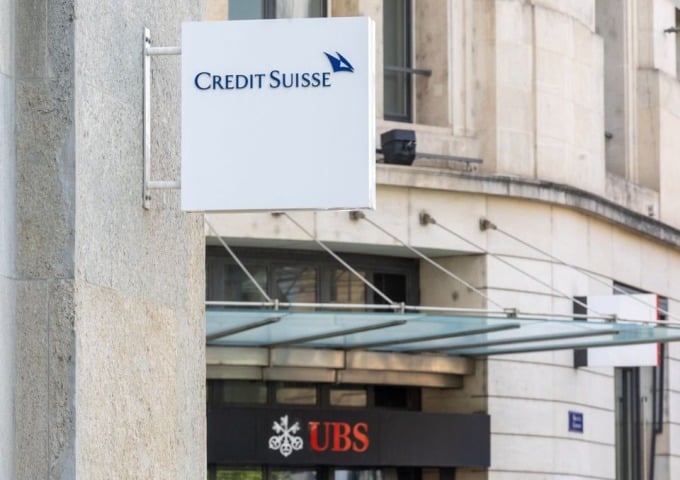
UBS and Credit Suisse logos displayed on buildings in Geneva. Photo: Reuters
Acquiring Credit Suisse will incur significant costs for UBS. Last month, UBS estimated it would lose $17 billion as a result. This includes $13 billion from readjusting Credit Suisse's asset values and $4 billion in legal and administrative expenses.
Nevertheless, analysts believe that the benefits UBS received were significant. Thanks to the acquisition of Credit Suisse, UBS's asset management segment grew to $5 trillion overnight. They will also become the world leader in asset management for the wealthy, an area UBS focused on developing after the 2008 financial crisis.
They are already the leading bank in this sector in China. Therefore, UBS's role in the rest of Asia will be further strengthened by the merger with Credit Suisse.
In Switzerland alone, the combined assets of these two banks are currently double the country's GDP. Deposits also amount to 45% of GDP. This is a huge figure, even for a country with sound public finances and low debt levels like Switzerland.
UBS will also acquire Credit Suisse's profitable domestic business. Analysts believe that the value of this segment alone is three times the price UBS paid for the entire Credit Suisse acquisition.
In addition, UBS will eliminate a competitor in the securities trading segment. Last year, UBS earned $7.1 billion from trading bonds, stocks, and currencies. This segment brought Credit Suisse $3.2 billion.
UBS also expects a profit of up to $34.8 billion from its acquisition of Credit Suisse at a price significantly below book value. This financial buffer will help offset potential losses and boost profits in the second quarter.
UBS also acknowledged it could save billions of dollars from consolidating the two banks' costs, primarily through staff reductions. The merger could result in tens of thousands of job losses, including in New York and London – where UBS plans to retain only a portion of Credit Suisse's investment banking business.
The bank also received significant support from authorities. Last weekend, the Swiss government agreed to absorb the 9 billion francs ($10 billion) loss incurred from the Credit Suisse bailout. This was the final major hurdle to completing the merger, helping UBS maintain market confidence during the transition. UBS will also have access to a large borrowing limit from the Swiss Central Bank.
UBS leaders still have a lot of work to do with this complex deal, especially deciding which areas and personnel to retain, replace, or eliminate. Nevertheless, they remain optimistic.
In April, Ermotti asserted on CNBC that the deal with Credit Suisse was not risky and would create many long-term benefits. Kelleher also stated at the UBS Annual Meeting in April: "While not the initiators, we believe this deal is financially attractive to UBS shareholders. I believe we have made the right decision."
Ha Thu (according to Bloomberg, Reuters)
Source link


![[Photo] Prime Minister Pham Minh Chinh holds a phone call with the CEO of Russia's Rosatom Corporation.](/_next/image?url=https%3A%2F%2Fvphoto.vietnam.vn%2Fthumb%2F1200x675%2Fvietnam%2Fresource%2FIMAGE%2F2025%2F12%2F11%2F1765464552365_dsc-5295-jpg.webp&w=3840&q=75)


![[Photo] Closing Ceremony of the 10th Session of the 15th National Assembly](/_next/image?url=https%3A%2F%2Fvphoto.vietnam.vn%2Fthumb%2F1200x675%2Fvietnam%2Fresource%2FIMAGE%2F2025%2F12%2F11%2F1765448959967_image-1437-jpg.webp&w=3840&q=75)












































![[OFFICIAL] MISA GROUP ANNOUNCES ITS PIONEERING BRAND POSITIONING IN BUILDING AGENTIC AI FOR BUSINESSES, HOUSEHOLDS, AND THE GOVERNMENT](https://vphoto.vietnam.vn/thumb/402x226/vietnam/resource/IMAGE/2025/12/11/1765444754256_agentic-ai_postfb-scaled.png)












































Comment (0)