

The unprecedented challenge facing Vietnam's fisheries sector began after the U.S. National Oceanic and Atmospheric Administration (NOAA) unexpectedly announced its refusal to recognize the equivalence of 12 Vietnamese fishing methods under the Marine Mammal Protection Act (MMPA).
According to a letter from NOAA to the Fisheries and Aquatic Services Administration ( Ministry of Agriculture and Environment ) dated August 26th, products from 12 rejected fishing methods will be banned from import into the United States starting January 1st, 2026. This ban targets fishing methods using gillnets and trawls, which are considered high-risk and harmful to marine mammals such as dolphins and whales.
Products from 12 rejected fishing grounds will be banned from import into the US, including flounder, swordfish, mullet, snapper, swordfish, grouper, tuna, mackerel, crab, lobster, squid, and lobster.
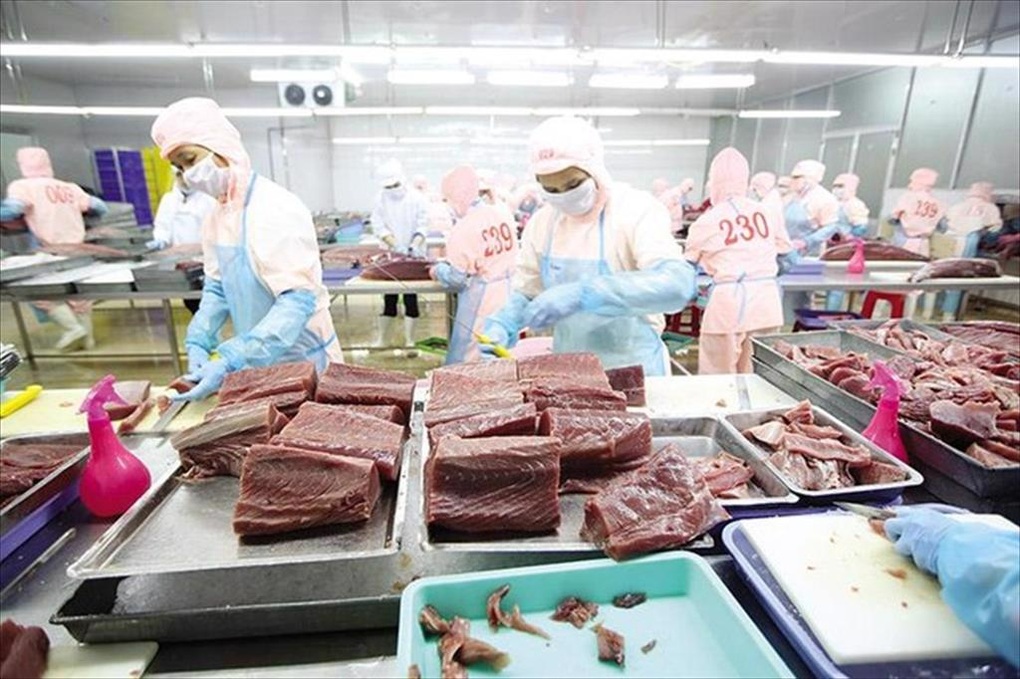
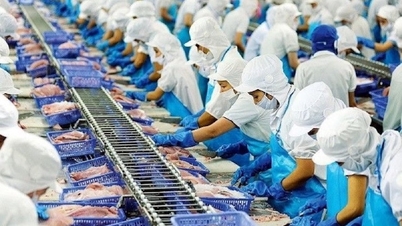
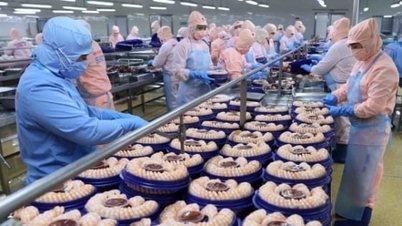
Processing tuna at a Vietnamese seafood factory. This industry has suffered the most severe losses due to the US decision (Photo: VASEP).
This decision, described as a "shock," directly threatens half a billion USD in export revenue, the livelihoods of hundreds of thousands of workers, and the position of Vietnamese seafood on the international stage.
According to export businesses, the immediate economic damage is enormous. The Vietnam Association of Seafood Processing and Export (VASEP) estimates that the seafood industry could lose approximately $500 million annually from the US market. This figure is equivalent to the total export value of affected goods to the US in 2024, which is $511.5 million.
Tuna, the largest export item, faces the risk of losing the entire US market, which accounts for $387 million out of nearly $1 billion in total exports in 2024.
Other important products such as crabs, squid, grouper, mackerel, and swordfish will also suffer the same fate. Not only will export businesses struggle, but this decision will also directly impact the livelihoods of hundreds of thousands of fishermen and workers in processing plants.
According to VASEP, it is noteworthy that the NOAA ruling puts Vietnam at a "double disadvantage" compared to its competitors. While direct competitors such as Thailand, India, and Japan are fully recognized as equivalent and have wide access to the US market, Vietnam faces the risk of losing market share to them. US importers will certainly prioritize stable supply sources without legal barriers, weakening the competitiveness of Vietnamese seafood.
More seriously, Vietnam depends on imported tuna for processing and exporting to the US, accounting for 75-80% of its needs. Many countries and territories that are both competitors and major suppliers of raw materials to Vietnam, such as Indonesia, China, the Philippines, and Taiwan (China), are also facing partial rejection. Now, this supply is also being restricted, making it difficult for Vietnamese businesses not only to sell their own catch but also to obtain legitimate raw materials for production.
According to VASEP, this "shocking" decision not only threatens $500 million in export revenue but also directly affects the livelihoods of hundreds of thousands of fishermen and workers, as well as the position of Vietnamese seafood in the international market.
Faced with this urgent situation, VASEP and the business community quickly stepped in. Immediately after the emergency meeting on September 8th, VASEP submitted a petition to the Government and relevant ministries, proposing both short-term and long-term solutions.
Key actions included proposing that the government hire American consultants to provide technical and lobbying support, establishing an inter-agency task force to develop a response plan, and working with NOAA to clarify the roadmap and request a transition mechanism.
From the business perspective, VASEP recommends that its members closely coordinate with the Association, proactively work with US importers, and develop scenarios for adjusting production and market conditions.
Source: https://dantri.com.vn/kinh-doanh/nganh-thuy-hai-san-viet-nam-choang-vang-truoc-quyet-dinh-cua-my-20250912093711759.htm
![[Photo] Closing Ceremony of the 10th Session of the 15th National Assembly](/_next/image?url=https%3A%2F%2Fvphoto.vietnam.vn%2Fthumb%2F1200x675%2Fvietnam%2Fresource%2FIMAGE%2F2025%2F12%2F11%2F1765448959967_image-1437-jpg.webp&w=3840&q=75)


![[Photo] Prime Minister Pham Minh Chinh holds a phone call with the CEO of Russia's Rosatom Corporation.](/_next/image?url=https%3A%2F%2Fvphoto.vietnam.vn%2Fthumb%2F1200x675%2Fvietnam%2Fresource%2FIMAGE%2F2025%2F12%2F11%2F1765464552365_dsc-5295-jpg.webp&w=3840&q=75)

























































Comment (0)