

Immediately after the Party led the people to achieve national independence, in order to promptly fulfill the political task and celebrate the great joy of the nation, Xuan Dieu wrote two epic poems, "The National Flag" and "The Conference of the Nation".
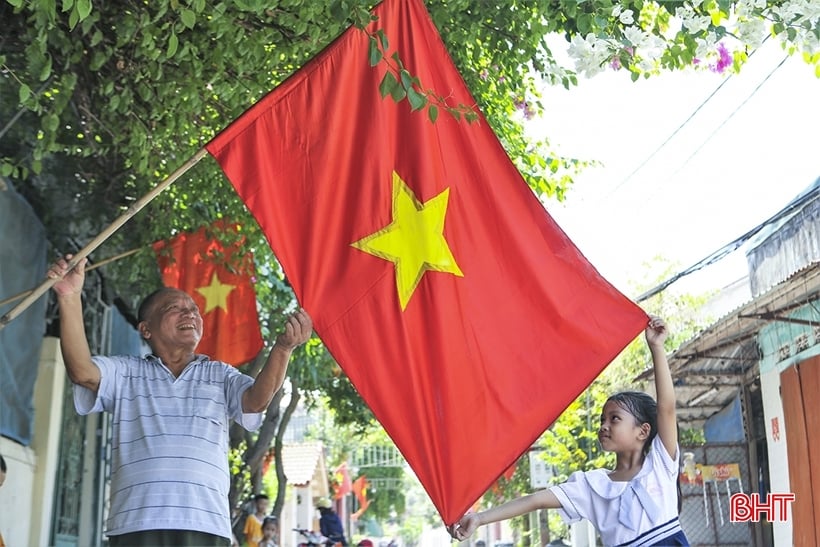
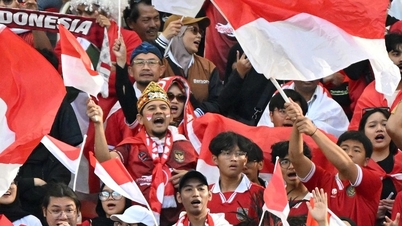
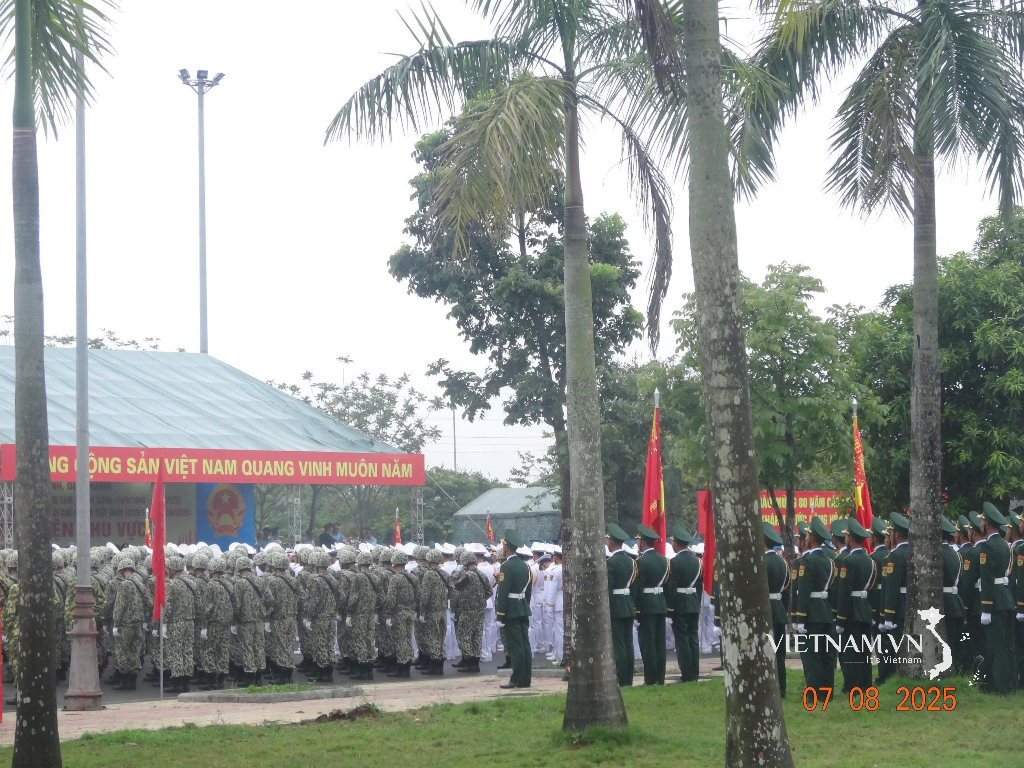
Displaying the national flag and the Party flag demonstrates patriotism and national pride; it is a conscious responsibility of every citizen.
The August Revolution exerted a powerful attraction, drawing Xuân Diệu's romantic self to the revolutionary winds sweeping across the newly reborn nation. "The National Flag," a heroic 300-line poem, begins with a refrain expressing the joyful exclamation in the poet's soul, a shared atmosphere of millions before the flag of independence: "The wind roars, the wind roars, the Vietnamese wind roars / Clouds fly, clouds fly, bright pink clouds / The wind sings on the mountains, the wind praises on the passes... The wind flies, and the music flies with it / Bringing new news throughout the Vietnamese sky... The wind has risen! The wind rises throughout the mountains and rivers! / The wind has risen! The wind blows the flag swiftly / Like all the surging tidal waves /... A wave of joy fills the chests of the youth / New spirits mix into the heart of the nation..."
The images of wind, clouds, mountains, rivers, flowers, and grass remain, but they no longer merely bask in the imagination and intoxicating spirit of the romantic self; they exist in a highly realistic and vibrant way, reflecting a new perspective and mindset. Each line of poetry in "The National Flag" overflows with excitement and exhilaration at the new image of the country and the new vitality of the nation, symbolized by the national flag, the red flag with a yellow star: "After many hardships and bitter experiences / One day the flag returned to Hanoi / To reign supreme on the shining platform / Amidst the people's cheers..."
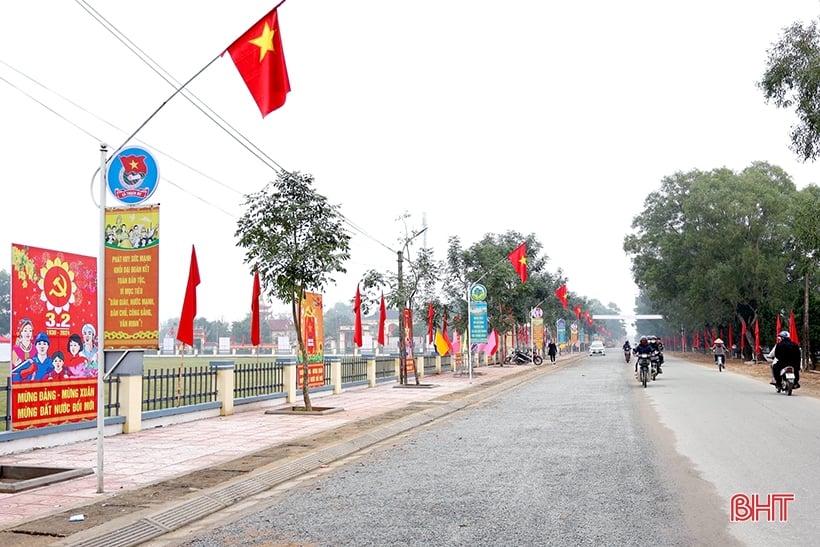
The national flag is proudly displayed along the roads in the rural areas of Ha Tinh province to celebrate the country's major holidays.
The image of the red flag with a yellow star symbolizes national independence, the strength of the Party, and the sacrifices and bloodshed of communist soldiers, militia, and guerrillas who overcame the darkest days of oppression to reclaim what was lost. Based on this imagery and theme, the poet develops a lyrical narrative with an epic tone, aiming to summarize the arduous journey to the glorious victory of the nation and explain the victorious power of the revolution.
The light of the Party's truth illuminated the path, creating immense righteous strength that united the entire nation to walk the revolutionary path of independence and self-reliance. Accordingly, with "The National Flag," for the first time, historical documents and images of real life, place names with historical and symbolic significance representing the Party's leadership and the people's struggles across the country—from Viet Bac to Rach Gia - Kien Giang, Saigon - Cholon, from Nhi Ha, Cuu Long to Ngu Binh, Tan Vien, Hong Linh...—entered his poetry naturally and intimately: "Who has ever heard of the guerrilla army?/ Mentioning it fills my heart with gratitude/ Oh, those soldiers, those heroes/ Those whose souls are as green as jade/ Following the call of the sacred land..."
On a surging stream of inspiration containing "unending joy," the poet's reflections on the country and the people are profoundly summarized and explained: "Oh history! Those August days / Throughout Vietnam, flags rise with the people's hearts /... Even dilapidated huts blossom / On old roots, a new shoot of life sprouts /... A hundred years of devastation like mist! / Vietnam! Vietnam! Red flag with a yellow star! / Chests holding their breath on the day of independence... Four thousand years, Mother's face does not age / We still have that youthful heart." This can be considered the first lengthy epic poem written about the August Revolution and the strength of the Party, the revolutionary soldiers, and the working people. These philosophical verses by Xuân Diệu about the Party, the country, and the people were inherited and further developed by young poets of the anti-American war generation in their epic poems about the resistance war against the US.
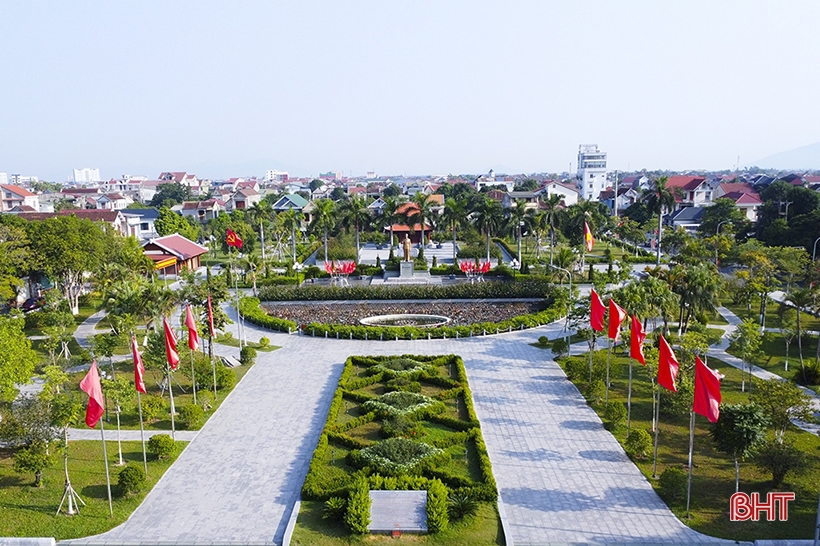
"The national flag is the lifeblood of the Vietnamese people within me, my first love with the early days of the revolutionary People's Government..."
Xuân Diệu further elaborated on the intoxicating and ecstatic state of mind in the revolutionary atmosphere when writing about the circumstances surrounding the creation of his epic poem "The National Flag": "In those first days, everything was fresh in people's hearts and across the country, as if concentrated and vividly displayed on the red flag with the yellow star. We were intoxicated by the national flag of independence and freedom, as if intoxicated by wine (...). The national flag is the life of the Vietnamese people within me, my first love with the early days of the revolutionary People's government..."
From the passionate embrace and infatuation of the romantic self to the excitement and enthusiasm for ideals and the new rebirth of the nation and its people, all are unified expressions of a sincere and utterly loyal heart to life and the fresh changes brought about by it. Therefore, Xuan Dieu, and no one else, welcomed the revolution with all his emotion and passion. For the first time in modern literature, the image of the nation and its people, as an aesthetic image, was depicted on a grand, profound scale and with the lengthy scope of an epic poem.
Nguyen Thi Nguyet
Source


![[Photo] Closing Ceremony of the 10th Session of the 15th National Assembly](/_next/image?url=https%3A%2F%2Fvphoto.vietnam.vn%2Fthumb%2F1200x675%2Fvietnam%2Fresource%2FIMAGE%2F2025%2F12%2F11%2F1765448959967_image-1437-jpg.webp&w=3840&q=75)

















![[OFFICIAL] MISA GROUP ANNOUNCES ITS PIONEERING BRAND POSITIONING IN BUILDING AGENTIC AI FOR BUSINESSES, HOUSEHOLDS, AND THE GOVERNMENT](https://vphoto.vietnam.vn/thumb/402x226/vietnam/resource/IMAGE/2025/12/11/1765444754256_agentic-ai_postfb-scaled.png)


















































Comment (0)