

 |
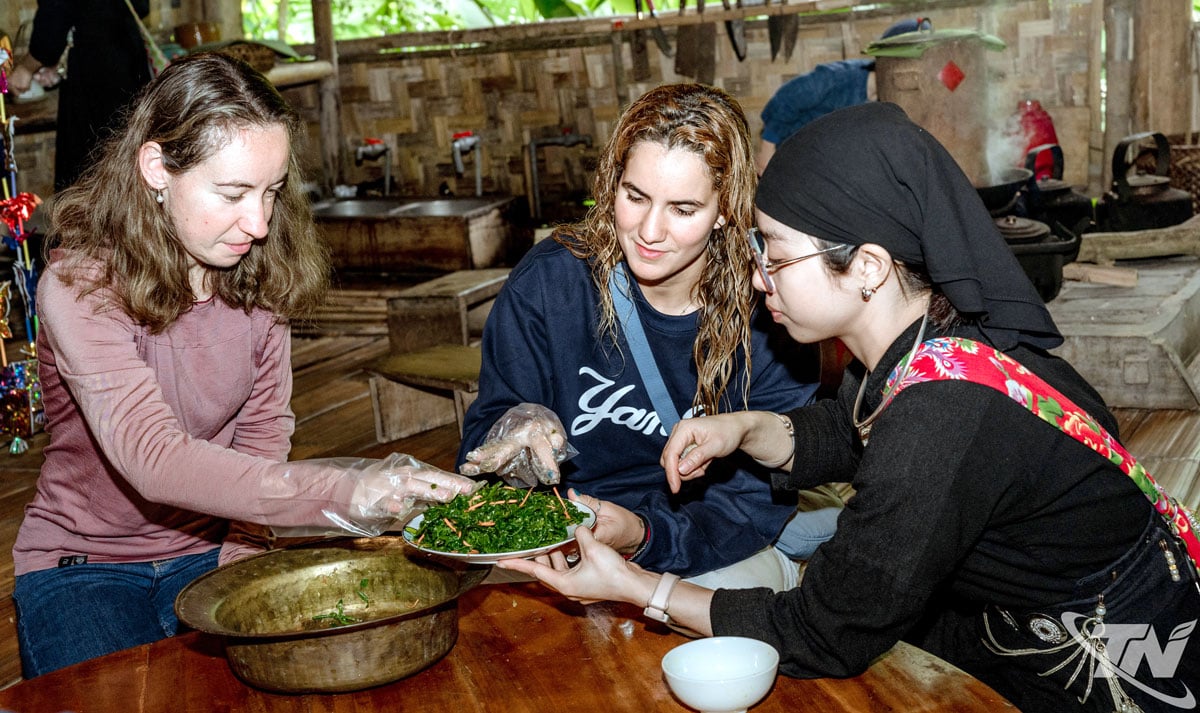
| Thúy An confidently introduces Tay culture to international friends. |
Thúy An's journey back to Thái Hải is special. Born elsewhere, after finishing junior high school, Thúy An moved with her parents to live permanently in the village. From her high school years, Thúy An grew up in a traditional stilt house, by the fireplace, surrounded by Tày folk songs and stories from the elders. "I consider the village my true home. Everything in my life and my personality have been nurtured here," Thúy An shared.
Her love for foreign languages was sparked by encounters with foreign tourists visiting her village, listening to their questions and curiosity about Tay culture. Thuy An decided to study Foreign Languages at Thai Nguyen University of Education. After graduating, despite having many career options, Thuy An made a surprising decision: returning to her village. “I think I understand my village better than anyone else, and when the villagers themselves introduce their culture in an international language, it will be more authentic and convincing,” Thuy An shared.
Now, Thuy An's days are filled with English and stories from her village. She works as a tour guide for international tourists and teaches English to nearly 40 children in the village. Thuy An's teaching methods are also very special: from outdoor games and folk tales to greeting visitors as soon as she meets them on the village road.
Thanks to that, children in Thai Hai village today are very bold. The words “Hello!”, “Nice to meet you!” resound naturally like greetings in Tay language. Many tourists are surprised when the children can have simple conversations in English, introducing the stilt house, customs or traditional meals.
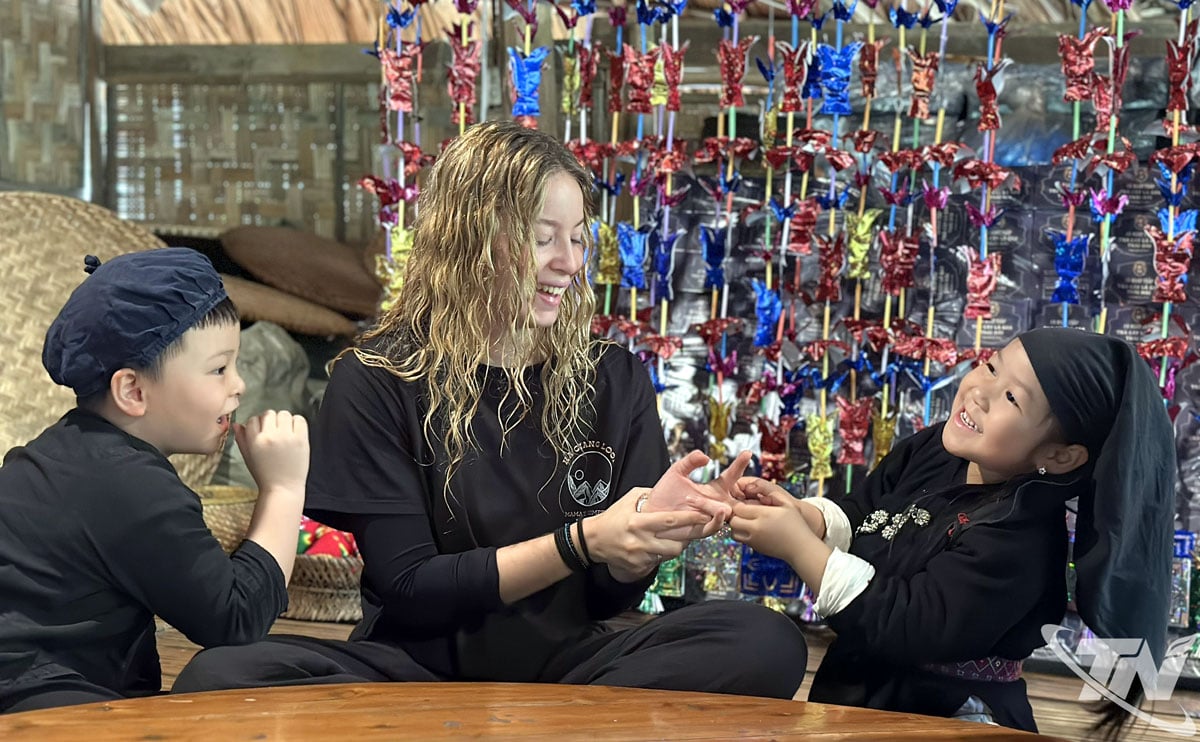 |
| Without any hesitation in front of international visitors, the children of Thai Hai speak English naturally and enthusiastically. |
Currently, there are 4-5 people in the village who speak English fluently and are capable of providing professional guidance. All of them grew up in the village or have long-standing ties to it, learning and improving their skills through interaction with tourists. Their maturity is creating a new generation – a generation that integrates into the community while still firmly preserving the Tay culture.
International tourists often have unforgettable impressions upon arriving in the village. Helena, from France, recounted that what moved and surprised her was not only the traditional food – flavorful, simply but beautifully presented – but also the way the young people spoke fluent English when introducing their culture. “I saw sincerity in every story. This is not just a place to visit, but a place that preserves a way of life,” Helena shared.
While many places pursue commercial tourism , Thai Hai chooses a sustainable path: relying on the community and placing culture at its core. Language is the bridge, and young people like Thuy An are the guides on that journey. Each time she takes tourists along the cobblestone path, Thuy An tells stories about each tree, each stilt house, each custom she heard about since childhood. Thuy An's storytelling transforms the narrative from mere information into emotion, from knowledge into living memory. Tourists thus experience Tay culture in a way that is intimate, continuous, and authentic.
Thai Hai remains a peaceful village today, but that peace is expanding. Children grow up speaking both Tay and English. The elderly are happy to see their culture cherished. Tourists come and return. And young people like Thuy An, with their love for their village and language skills, are bringing Thai Hai closer to the world .
Source: https://baothainguyen.vn/van-hoa/202512/nguoi-tre-thai-hai-mo-cua-ban-lang-ra-the-gioi-70169e4/

























![[Video] The craft of making Dong Ho folk paintings has been inscribed by UNESCO on the List of Crafts in Need of Urgent Safeguarding.](https://vphoto.vietnam.vn/thumb/402x226/vietnam/resource/IMAGE/2025/12/10/1765350246533_tranh-dong-ho-734-jpg.webp)





















































Comment (0)