

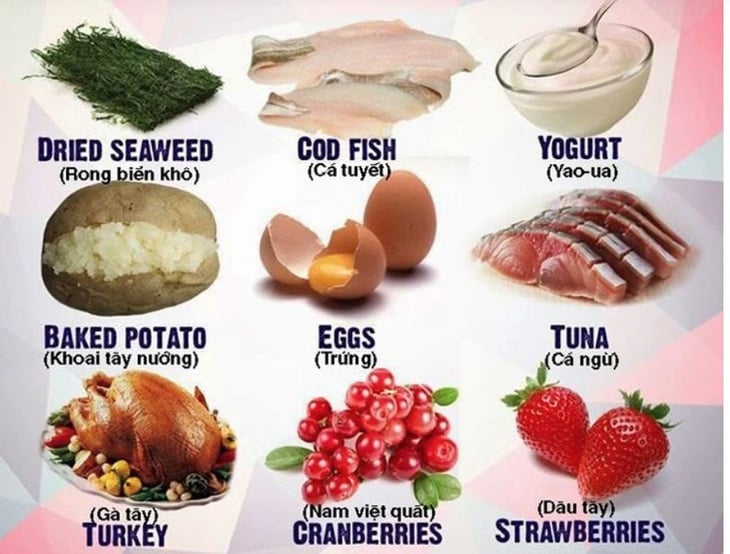
Foods rich in iodine - Photo: PINTEREST
How to supplement iodine carefully and avoid mistakes that could damage the thyroid gland?
Beware of hyperthyroidism due to excess iodine.
Ms. NTH, 35 years old, was frightened by the numerous thyroid diseases and thyroid tumors among her neighbors, and frequently supplemented her iodine intake with spirulina tablets and seaweed snacks. Recently, she experienced persistent fatigue and, after a doctor's examination, was diagnosed with hypothyroidism. The doctor advised her against arbitrarily supplementing iodine, as excess iodine can also cause illness.
Doctor Nguyen Xuan Tuan - lecturer at the University of Medicine and Pharmacy, Hanoi National University - said that when talking about the thyroid, many people immediately think "must supplement iodine".
"I've encountered many patients who self-medicated with iodine tablets, ate dried seaweed as a snack, or took multivitamin seaweed tablets containing iodine without knowing whether they were getting enough. They didn't know that iodine deficiency causes fatigue, but excess iodine can also cause illness, and even lead to serious thyroid hormone disorders," Dr. Tuan emphasized.
Dr. Tuan explained that the thyroid gland is the body's "endocrine conductor," producing the hormones T3 (triiodothyronine) and T4 (thyroxine) – which affect almost every metabolic process. Iodine is an essential raw material for the thyroid gland to produce T3 and T4 hormones – crucial hormones that regulate metabolism, energy, and many vital functions.
The body does not synthesize iodine, so we depend entirely on daily diet. However, "rich in iodine" is not always good. We need a scientific nutritional strategy, individualized to each body type.
Long-term iodine deficiency can lead to intellectual disability in children and increase the risk of goiter and hypothyroidism in adults. Some mountainous regions lacking iodized salt have very high rates of goiter. However, improper supplementation can cause hyperthyroidism in people who have never had thyroid disease due to iodine excess. Those with pre-existing nodular goiter or Graves' disease may experience a more severe trigger of the condition.
For some people who have undergone thyroid surgery, even taking iodine is ineffective because the thyroid gland is no longer able to "use" the iodine.
Furthermore, excess iodine can aggravate autoimmune thyroid diseases, such as Hashimoto's disease (chronic thyroiditis); Basedow's disease (Graves' disease). In particular, too much iodine stimulates the production of antibodies against the thyroid gland, causing inflammation, fibrosis or triggering thyroid storm.
Therefore, according to Dr. Tuan, do not arbitrarily supplement iodine or use seaweed regularly if you have thyroid dysfunction, a history of autoimmune disease, or are taking thyroid inhibitors (thionamides, levothyroxine...).
Be cautious with pills that claim to be "good for the thyroid."
According to Dr. Tuan, the body needs iodine like it needs water, but 2 liters a day is good, 10 liters a day is toxic. Iodine is the same, the right dose is medicine, overdose is trouble. Consult your doctor before using.
If we're already getting enough iodine from our daily diet, there's no need to take anything extra; that's a smart and scientific way to care for our bodies. If you're using iodized salt, eating commercially produced fish sauce, eggs, seafood, milk, etc., you're almost certainly not deficient in iodine. Be cautious with supplements that claim to be "good for the thyroid" but could actually put you closer to endocrine disorders.
Nutrition does not replace treatment but is the foundational pillar to help the thyroid function stably, prevent complications and improve quality of life. It is best to eat food groups that are beneficial for the thyroid such as:
Iodized salt (the most common and effective way to prevent iodine deficiency); seafood (sea fish, shellfish, oysters) are foods rich in iodine and highly bioavailable selenium; eggs and milk are natural sources of iodine and vitamin D; seaweed is very rich in iodine, however, it should only be consumed in moderation (because 1g of dried seaweed can contain up to 2,000 mcg of iodine - far exceeding the recommended daily intake of 150-300 mcg).
No food alone can heal the thyroid. But the right diet will create a favorable environment for the medication to take effect, the immune system to be regulated, and the thyroid recovery process to be sustainable.
It's important to eat enough – neither too much nor too little. Avoid excessive dietary restrictions that can lead to micronutrient deficiencies. When supplementing iodine, it needs to be individualized according to the disease and stage of treatment. For example, patients being treated for hypothyroidism need a combination of protein, iodine, and selenium. Patients with Graves' disease or hyperthyroidism should avoid excess iodine and stimulants (coffee, alcohol).
Some foods can easily lead to excess iodine if consumed incorrectly.
* Dried seaweed: can contain up to 1,000 mcg of iodine/g - should only be consumed in small amounts, a maximum of 1-2 times per week.
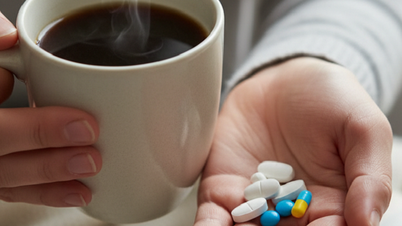
* Seaweed tablets: difficult to determine iodine content, easy to overdose.
* Multivitamin tablets: carefully read the iodine content.
Recommendations from the World Health Organization and endocrine organizations.
Adults need approximately 150 mcg of iodine per day.
* Pregnant women: increase to 220-250 mcg/day.
* Children: require less, depending on age.
Source: https://tuoitre.vn/nhieu-nguoi-gap-nguy-vi-tu-bo-sung-qua-nhieu-iod-co-hai-cho-tuyen-giap-2025090222074312.htm

![[Photo] Prime Minister Pham Minh Chinh holds a phone call with the CEO of Russia's Rosatom Corporation.](/_next/image?url=https%3A%2F%2Fvphoto.vietnam.vn%2Fthumb%2F1200x675%2Fvietnam%2Fresource%2FIMAGE%2F2025%2F12%2F11%2F1765464552365_dsc-5295-jpg.webp&w=3840&q=75)
![[Photo] Closing Ceremony of the 10th Session of the 15th National Assembly](/_next/image?url=https%3A%2F%2Fvphoto.vietnam.vn%2Fthumb%2F1200x675%2Fvietnam%2Fresource%2FIMAGE%2F2025%2F12%2F11%2F1765448959967_image-1437-jpg.webp&w=3840&q=75)










































![[OFFICIAL] MISA GROUP ANNOUNCES ITS PIONEERING BRAND POSITIONING IN BUILDING AGENTIC AI FOR BUSINESSES, HOUSEHOLDS, AND THE GOVERNMENT](https://vphoto.vietnam.vn/thumb/402x226/vietnam/resource/IMAGE/2025/12/11/1765444754256_agentic-ai_postfb-scaled.png)














































Comment (0)