

Accordingly, a British international market research and data analytics company was recently commissioned to conduct a survey on perceptions and access to healthcare services for cancer care and treatment in Southeast Asia.
The survey was conducted with over 6,000 people in 6 Southeast Asian countries (including over 1,000 Vietnamese participants). The results showed that the majority of survey participants were well aware of the importance of early cancer detection.
However, cancer screening rates remain low, access to treatment options is limited, and understanding of treatment and post-treatment care options is still inadequate.
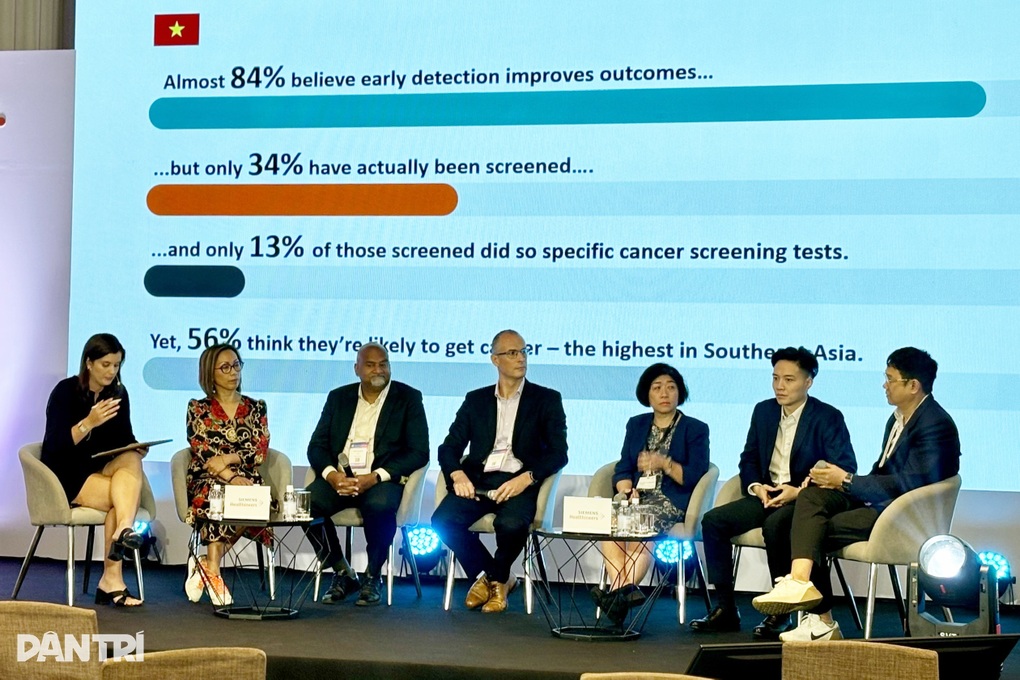
Experts analyze the level of awareness about cancer among the Vietnamese participants in the survey (Photo: Hoang Le).
Analyzing the group surveyed in Vietnam separately, the study noted that the majority (84%) believed that early cancer detection plays a crucial role in improving treatment outcomes, but only 34% of participants had ever been screened for cancer.
Of those, only 13% had undergone specific cancer screening tests.
Many reasons were given by Vietnamese participants in the study for not undergoing cancer screening, with the majority stating they "felt it was unnecessary." This is also a common sentiment in other countries in the region. Other reasons included the high cost of screening and fear of being diagnosed with cancer (both at 22%).
Although more than half of Vietnamese people surveyed said they believe they will get cancer at some point in their lives, this has not led to proactively taking preventive measures.
In addition, some people have limited knowledge about modern therapies and access to treatment. Furthermore, awareness of post-treatment care among survey participants is still low.
Speaking at a seminar announcing the survey, held in Ho Chi Minh City, Associate Professor Dr. Tran Thanh Huong, Deputy Director of the National Cancer Institute, said that affordability and accessibility are two key factors in cancer care and treatment.

A leukemia patient receives a stem cell transplant in Ho Chi Minh City (Photo: Hospital).
In this context, health insurance plays a crucial role in affordability. In Vietnam, 90% of the population has health insurance, but it does not cover targeted therapies. Furthermore, many cancer drugs are very expensive compared to people's incomes, making government assistance crucial.
Associate Professor Huong analyzed that many people have a habit of integrating this cancer screening into their annual health check-ups. However, there are now many options in cancer screening tests, so it is necessary to choose a method that suits both the cost and the individual's characteristics.
Regarding accessibility, Vietnam already has guidelines on treatment protocols, but it needs to continue updating them with new, modern methods so that people are aware of them.
Experts expect that the development of AI could help doctors make more accurate and targeted diagnoses, and that advanced interventions will help cancer patients no longer need chemotherapy in the future.
Source: https://dantri.com.vn/suc-khoe/nhieu-nguoi-viet-khong-tam-soat-ung-thu-vi-so-bi-chan-doan-mac-benh-20250911002550370.htm


![[Photo] Prime Minister Pham Minh Chinh attends the Conference summarizing and implementing tasks of the judicial sector.](/_next/image?url=https%3A%2F%2Fvphoto.vietnam.vn%2Fthumb%2F1200x675%2Fvietnam%2Fresource%2FIMAGE%2F2025%2F12%2F13%2F1765616082148_dsc-5565-jpg.webp&w=3840&q=75)


















































































Comment (0)