

At the end of the 2023-2024 crop year, Vietnam exported a total of 1.47 million tons of coffee, a decrease of 11.3% compared to the previous crop year. However, the export value in the past crop year still increased by 33%, reaching $5.42 billion - the highest in history, including $2 billion exported to the EU.
Coffee - the agricultural product with the sharpest price increase.
According to data from the General Department of Customs, in the third quarter, Vietnam's coffee exports reached 212,926 tons, worth $1.12 billion, a decrease of 12.9% in volume and an increase of 52.6% in value compared to the same period in 2023.
In the first nine months of 2024, exports of this commodity reached 1.1 million tons, equivalent to a value of over 4.3 billion USD, a decrease of 11.7% in volume but an increase of 38.7% in value compared to the same period last year. Despite the decrease in production, thanks to the sharp increase in price, coffee export revenue surpassed the 4.24 billion USD mark achieved in the whole of 2023, setting a new record.
At the end of the 2023-2024 crop year (from October of the previous year to September of this year), Vietnam exported a total of 1.47 million tons of coffee, a decrease of 11.3% compared to the previous crop year, but the export value for the crop year still increased by 33%, reaching 5.42 billion USD - the highest in history.
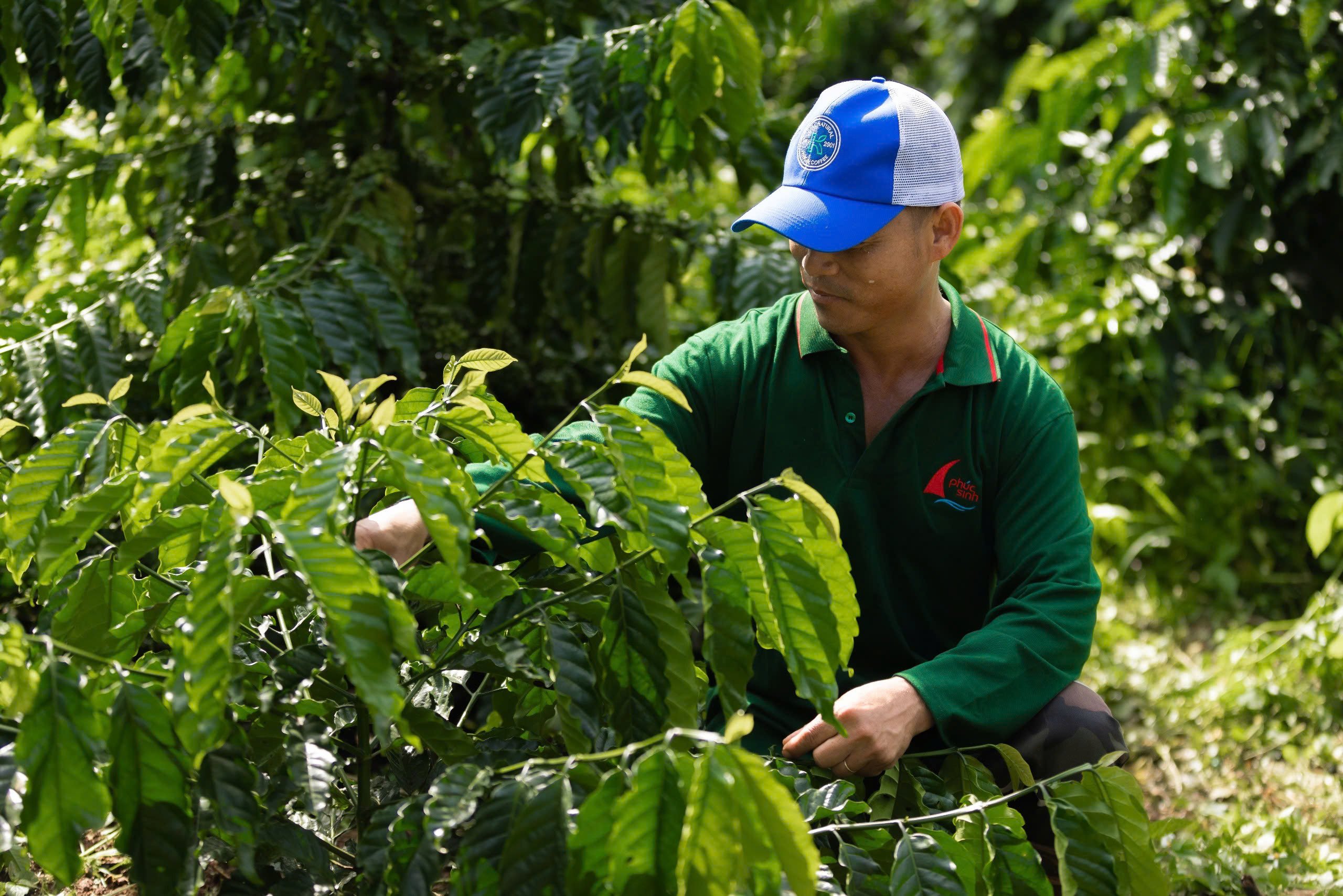
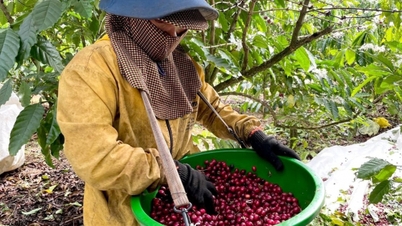
Farmers tend to their sustainably grown coffee plantations within the raw material area of Phuc Sinh Joint Stock Company in Nhan Dao commune, Dak R'Lap district, Dak Nong province. Photo: Hoai Yen.
This growth was driven by export coffee prices that were nearly 50% higher than the previous crop year, averaging $3,673 per ton. In the third quarter alone, the average export price of coffee reached $5,266 per ton, a 75.2% increase compared to the same period last year. In September, the average export price reached $5,469 per ton – the highest level ever recorded.
Coffee has become the agricultural product with the strongest price increase among Vietnam's key export items. Declining production, coupled with a sharp increase in global demand for robusta coffee, has driven prices up continuously and reached new highs in the 2023-2024 crop year. Vietnam, the world's largest producer and exporter of robusta coffee, is believed to have benefited from this trend.
According to independent analyst Nguyen Quang Binh, in recent months, many European importers have focused on buying Vietnamese coffee as the deadline for implementing the EUDR (Anti-Deforestation Regulation) approaches. This has contributed to pushing Vietnamese coffee prices to the highest levels in the world. Currently, coffee prices are fluctuating around 113,000 VND/kg in the Central Highlands market.
According to the Import-Export Department ( Ministry of Industry and Trade ), the European Union (EU) is Vietnam's largest coffee market, accounting for approximately 38% of the country's total annual coffee exports. Five EU countries are among the top 10 largest coffee importing markets for Vietnam.
Specifically, in the 2023-2024 crop year, with a volume of 562,601 tons and a value of 2 billion USD, compared to the previous crop year, there was an 8.6% decrease in volume but a 41.1% increase in value, accounting for 38.1% of the volume and 37% of the total value of Vietnam's coffee exports.
Germany, Italy, and Spain were the three largest export markets, with export values reaching $607.1 million, $416.6 million, and $412.6 million respectively, representing increases of 37.1%, 29.6%, and 74.6% compared to the previous crop year.
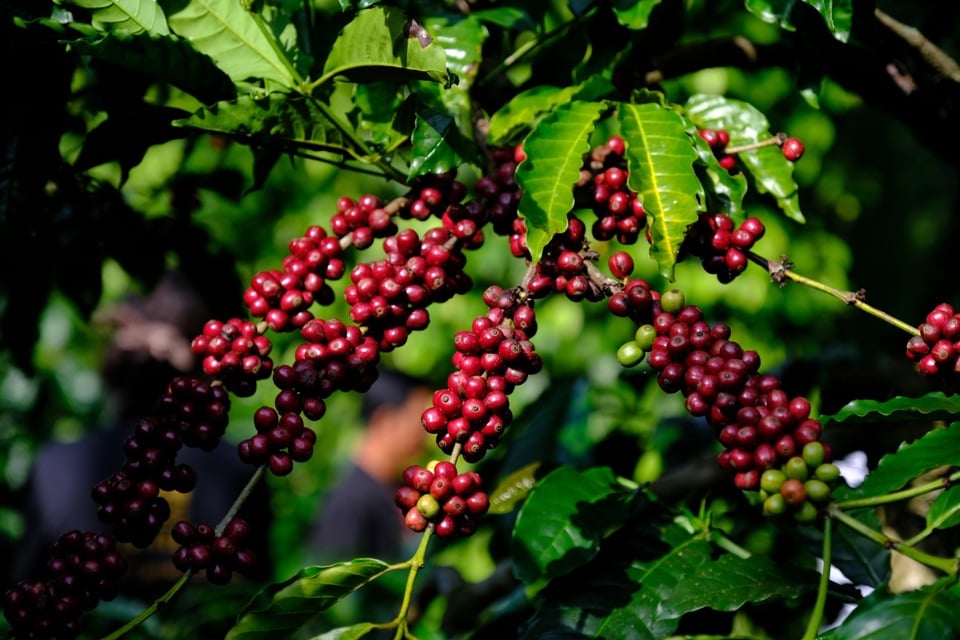
Vietnam is beginning to harvest its new coffee crop. Photo: IT
In addition, exports to the next largest market, Japan, increased by 38.4% in value despite a 0.3% decrease in volume; exports to Russia increased by 20% in value despite a 20.3% decrease in volume. Notably, coffee exports to many markets in the Asian region such as the Philippines, China, Indonesia, Malaysia, etc., increased very strongly in both volume and value compared to the previous crop year.
What are the forecasts for coffee prices when Vietnam harvests its new crop?
Vietnam's major coffee-growing regions have begun harvesting coffee in the fourth quarter. Forecasts indicate that the new crop will help alleviate the shortage of raw coffee in export markets, and coffee prices will gradually decrease. However, businesses believe that the 2024-2025 crop year will continue to see a decline in production, and shortages next year may arrive earlier.
Another factor indirectly supporting domestic coffee prices comes from positive developments in the global market. According to Hedgepoint Global Market brokerage firm, Brazilian farmers are delaying the sale of robusta coffee due to expectations of further price increases. Brazil has sold a record amount of robusta this year due to supply shortages from Vietnam.
Previously, Indonesia, the world's third-largest producer of robusta coffee, also reduced its coffee supply to the market in anticipation of higher prices. In addition, the Fed's interest rate cut will encourage speculative funds to buy coffee on exchanges, thereby pushing up both global and domestic coffee prices.
According to Mr. Trinh Duc Minh, Chairman of the Buon Ma Thuot Coffee Association, harsh climatic conditions and shrinking coffee growing areas have reduced the national harvest by approximately 10-15% in the 2023-2024 crop year.
“The drought has resulted in fewer and smaller beans. Furthermore, rain will hinder farmers from harvesting and drying the coffee, and transportation will also become more difficult,” Mr. Minh said. In fact, in recent years, farmers have shifted some of their coffee-growing areas to "hot" crops like durian and avocado... This has led to a decrease in the area planted with coffee compared to before.
According to a USDA report, declining groundwater levels and shade rates also pose long-term challenges as many Vietnamese farmers rely on wells for irrigation and forests to reduce evaporation. Vietnam's coffee-growing regions experienced wet weather in August, but heavy rains following Typhoon Yagi's landfall in the north in early September further flooded coffee plantations.
The Vietnam Coffee and Cocoa Association forecasts that the new coffee crop will yield approximately 1.47 million tons, a decrease compared to the previous crop due to unfavorable weather conditions, but exports could reach $5-6 billion thanks to high prices.
Source: https://danviet.vn/nhieu-nuoc-do-xo-mua-ca-phe-cua-viet-nam-rieng-mot-chau-luc-nay-da-bo-ra-2-ty-usd-20241118164647385.htm































































































Comment (0)