

The group of companies led by Japan Industrial Partners has acquired nearly 78% of Toshiba's shares, paving the way for a full acquisition and delisting.
On September 21, Japanese electronics giant Toshiba announced that its nearly $14 billion acquisition plan by a group of companies led by Japan Industrial Partners (JIP) had been successful. They began bidding for Toshiba shares in early August and now own 78.65% of the company's stock. This will pave the way for a full acquisition to gain control of Toshiba.
Toshiba also announced it will complete its delisting from the Tokyo Stock Exchange. The deal with JIP will bring control of Toshiba back into the hands of domestic investors, after years of struggling with foreign shareholders.
In March, Toshiba approved JIP's takeover bid of 2 trillion yen ($13.5 billion). Although some shareholders were unhappy with the price, Toshiba said it saw no prospect of receiving a higher offer.
"We would like to express our deepest gratitude to our shareholders for their understanding of the company's situation. With the new shareholders, Toshiba will take a major step towards a new future," said Toshiba CEO Taro Shimada.
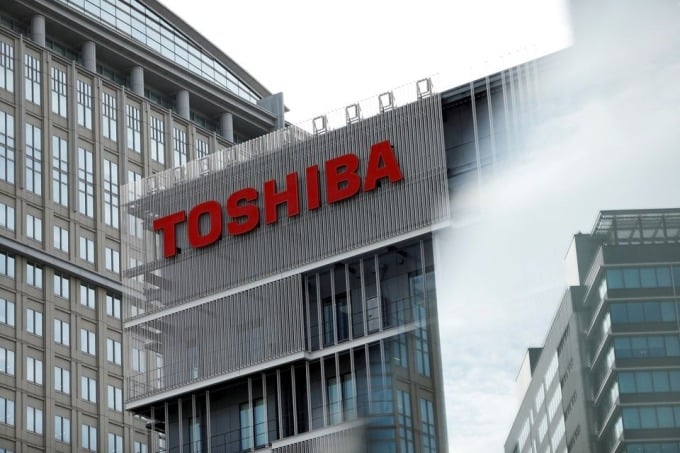
The exterior of Toshiba's building in Kawasaki, Japan. Photo: Reuters
JIP is a private equity firm. They are not well-known overseas. However, JIP has been involved in several spin-off deals of large Japanese corporations. They acquired Olympus's camera division and Sony's laptop division. JIP intends to retain CEO Shimada and his team.
The deal with JIP could end years of turmoil at Toshiba, marked by a series of scandals that led to the company's eventual sale. Toshiba's leadership, the Japanese government , and major foreign shareholders disagreed on the company's future. Investors sought to maximize profits, while the Japanese government prioritized keeping sensitive business segments and technologies out of foreign hands.
Toshiba has previously stated that it has a complex stakeholder structure and numerous shareholder groups with differing viewpoints. This somewhat impacts its business. Therefore, a stable shareholder structure would help the company pursue its long-term strategy.
Toshiba has faced a series of crises over the past eight years, beginning with the accounting scandal in 2015. This resulted in significant profit losses and necessitated a comprehensive restructuring of the company.
By early 2017, Toshiba had repeatedly missed deadlines for releasing its financial reports due to problems in its nuclear power business in the US. Projects in this sector were all over budget and behind schedule. The investment in nuclear energy in the US resulted in a loss of $6.3 billion for Toshiba, bringing it to the brink of delisting. The company was forced to sell its cash cow, the memory chip business, to foreign investors.
Early last year, shareholders rejected the management's proposal to split Toshiba. This forced Toshiba to explore other options, ultimately settling on a plan to sell it to JIP.
Ha Thu (according to Reuters, Kyodo News)
Source link
![[Photo] Prime Minister Pham Minh Chinh holds a phone call with the CEO of Russia's Rosatom Corporation.](/_next/image?url=https%3A%2F%2Fvphoto.vietnam.vn%2Fthumb%2F1200x675%2Fvietnam%2Fresource%2FIMAGE%2F2025%2F12%2F11%2F1765464552365_dsc-5295-jpg.webp&w=3840&q=75)

![[Photo] Closing Ceremony of the 10th Session of the 15th National Assembly](/_next/image?url=https%3A%2F%2Fvphoto.vietnam.vn%2Fthumb%2F1200x675%2Fvietnam%2Fresource%2FIMAGE%2F2025%2F12%2F11%2F1765448959967_image-1437-jpg.webp&w=3840&q=75)










































![[OFFICIAL] MISA GROUP ANNOUNCES ITS PIONEERING BRAND POSITIONING IN BUILDING AGENTIC AI FOR BUSINESSES, HOUSEHOLDS, AND THE GOVERNMENT](https://vphoto.vietnam.vn/thumb/402x226/vietnam/resource/IMAGE/2025/12/11/1765444754256_agentic-ai_postfb-scaled.png)





































Comment (0)