

Bombs containing the compound amatol, dating back decades, are becoming more dangerous because the substance is increasingly sensitive to external influences.
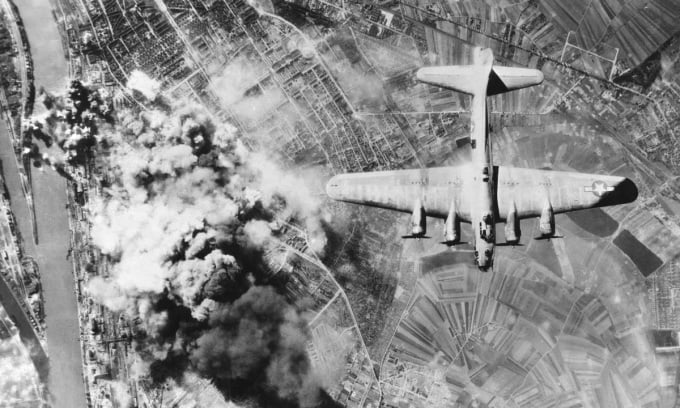
A US Boeing B-17 Flying Fortress aircraft drops bombs on the Ludwigshafen chemical and synthetic oil plant in Germany during World War II. Photo: Everett Collection
The Earth is littered with millions of tons of landmines, particularly from the two world wars of the 20th century. While a large amount remains buried and forgotten for decades, new research by a team of scientists from the University of Oslo and the University of Stavanger (Norway) shows that many bombs contain a chemical that makes them increasingly prone to detonation over time, IFL Science reported on March 27. The new research was published in the journal Royal Society Open Science.
This chemical is Amatol, a highly explosive material made from a mixture of TNT and ammonium nitrate, used in many types of bombs and mines manufactured for World War I and World War II, including aerial bombs, artillery shells, depth charges, and naval mines.
Other common explosives, such as pure trinitrotoluene (TNT) or pentaerythritol tetranitrate (PETN), remain relatively stable over time and do not become more dangerous than they were initially. However, over time, amatol appears to become more susceptible to adverse effects if stored under certain conditions.
In a new series of experiments, a Norwegian research team dropped weights on five samples of amatol explosives collected from the battlefield. The results showed that the bombs were more sensitive to impact than before and became increasingly unstable. This change in properties is most likely due to how amatol reacts with other chemicals in the natural environment.
"The study reveals that the presence of moisture, along with other factors, may contribute to increased sensitivity to the effects of amatol. Explosive mixtures containing ammonium nitrate can become sensitized when contaminated with small amounts of metal, or when in contact with metal. These contaminating metals can chemically react with ammonium nitrate, forming complex salts and making the mixture sensitized," the research team explained.
The discovery of unexploded bombs from World War II is not uncommon. Last month, a 500kg German bomb was found in the backyard of a house in Plymouth, England. More than 100 soldiers and bomb disposal experts were deployed to handle it, while 10,000 nearby residents were evacuated. Fortunately, the bomb was safely disposed of without any casualties. However, in 2008, 17 people at a construction site in the town of Hattingen, Germany, were injured when an excavator ran over a 250kg World War II bomb, causing it to detonate.
New research shows that incidents involving unexploded ordnance could become increasingly serious. The research team also emphasized that those responsible for handling unexploded ordnance need to be informed about the increasing sensitivity of Amatol over time.
Thu Thao (According to IFL Science )
Source link


![[Photo] Prime Minister Pham Minh Chinh holds a phone call with the CEO of Russia's Rosatom Corporation.](/_next/image?url=https%3A%2F%2Fvphoto.vietnam.vn%2Fthumb%2F1200x675%2Fvietnam%2Fresource%2FIMAGE%2F2025%2F12%2F11%2F1765464552365_dsc-5295-jpg.webp&w=3840&q=75)





















































































Comment (0)