

"Rice cultivation helps preserve land, while growing jicama helps escape poverty."
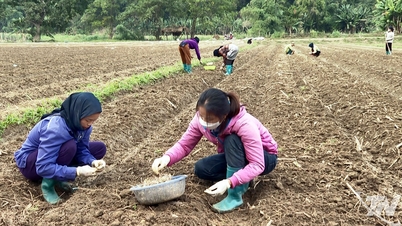
In the last days of November 2025, the atmosphere in Phi Gia and Ky Coi villages of Kim Thanh commune ( Hai Phong city) was busier than usual. A series of trucks and three-wheeled vehicles lined up to go in and out of the fields to load goods. This was the time when local farmers began harvesting the cassava tubers, which were planted early to meet the market demand at the end of the year.

Residents of Kim Thanh commune have begun harvesting over 70 hectares of early-season jicama. Photo: Dinh Muoi.
While quickly loading bundles of pure white jicama onto the cart, Ms. Doan Thi Doan (Phi Gia village) could not hide her excitement. “This year, jicama has a good harvest. Currently, traders are buying it at the field for about 12,000 VND/kg, and retail prices can reach 15,000 VND/kg. Every day, I sell 2 to 3 quintals, and on weekends, when demand is high, it can reach 5 quintals,” Ms. Doan said.
According to Ms. Doan, the cassava is planted about 3 months earlier than the main crop. Although the tubers are small and the sweetness has not reached its peak as in the main crop, in return, thanks to the scarcity of the market, the selling price is often 1.5 times higher. With the current price, farmers have recouped their investment costs and made a profit right from the beginning of the season.
Statistics from the People's Committee of Kim Thanh commune show that the whole commune currently has 75 hectares of cassava tubers being harvested, with an average yield of 2,000 - 2,500 kg/sao. This figure is a stepping stone before the locality enters the mass harvest of 226 hectares of cassava tubers in the main crop in January 2026.
In Ky Coi village (formerly Tam Ky commune), people's production thinking has completely changed. Ms. Nguyen Thi Quy, a household cultivating 2.7 sao of jicama, shared: "Here, people determine to grow rice every year only to improve the soil and get rice to eat. If they want to have money to spend and get rich, they have to rely on the winter crop, the main crop of which is jicama."

The lush green garden of 2 sao of jicama was newly planted after the harvest of the last Summer-Autumn rice crop of Mrs. Nguyen Thi Quy's family in Ky Coi village. Photo: Dinh Muoi.
According to Ms. Quy, jicama is planted in early July, and takes 4-5 months to grow. The plant requires careful care and higher investment capital than rice, but the economic efficiency is superior.
“If the price is good, each sao can bring in nearly 20 million VND, and even in bad years it can bring in over 10 million VND. In total, the family’s 2 sao of rice fields bring in nearly 50 million VND per crop, many times higher than growing rice or other crops,” Ms. Quy calculated.
Not only relying on experience, Kim Thanh farmers are increasingly focusing on intensive farming techniques. Mr. Nguyen Van Trang, a resident in the Tam Ky field area, is busy pruning the second crop of 3 sao of jicama, expected to be harvested at the end of 2025.
“Pinching the tops at the right time helps the plants focus their nutrients on the tubers instead of the leaves. Thanks to good care, my family’s rice field yields are always stable. After deducting all expenses, my family earns a net profit of 20-30 million VND/sao. Therefore, rice cultivation is mainly to preserve the soil and have rice to eat, while bean plants really help us escape poverty, even get rich,” Mr. Trang confided.
The economic pillar of suburban agricultural regions.
The rise of the jicama crop this year took place in a special context when Kim Thanh commune was newly established under Resolution No. 1669 dated June 16, 2025 of the National Assembly Standing Committee. The new commune was formed on the basis of merging the entire area and population of Dong Cam, Tam Ky, Dai Duc communes and part of Hoa Binh commune. With a natural area of 34.79 km2 and a population of nearly 43,000 people, Kim Thanh became a large-scale commune-level administrative unit, possessing the most concentrated and fertile agricultural land fund in Hai Phong city.
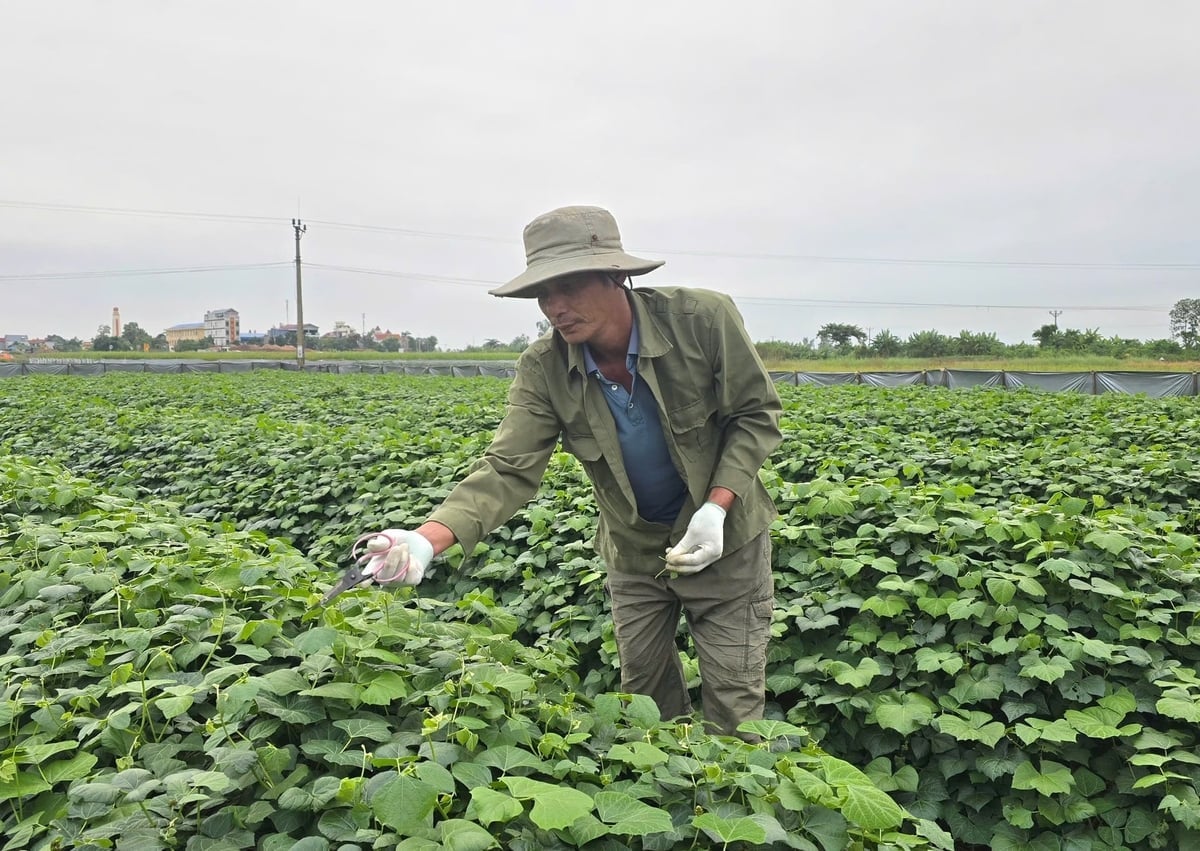
Mr. Nguyen Van Trang is pruning the tops of his family's 3 sao (approximately 3,000 square meters) of jicama plants in the Tam Ky field for the second time. Photo: Dinh Muoi.
Speaking to reporters, Mr. Nguyen Van Nghiep, Chairman of the People's Committee of Kim Thanh commune, said that the merger not only expands development space but also creates conditions for re-planning specialized production areas.
The biggest advantage of the new commune is the synchronous investment in infrastructure system. Intra-field and inter-village roads in 31 residential villages have been expanded, helping traders bring heavy trucks to the fields to buy, reducing intermediate transportation costs for people.
The locality is in a period of strong transformation. On the one hand, the commune is clearing the land for the Kim Thanh 2 industrial park with a scale of 437.24 hectares for industrial development. On the other hand, commodity agriculture, especially jicama, is still identified as an important economic pillar.
“Promoting the tradition of dynamism and creativity, we are aiming to build a clean agricultural product brand, bringing Kim Thanh radish into large supply chains, ensuring sustainable output for people,” Mr. Nguyen Van Nghiep emphasized.
The economic efficiency of jicama has been proven through actual data, for example, in the winter crop of 2023-2024, the production value of jicama in the entire old Kim Thanh district (now the jicama production area is mainly concentrated in Kim Thanh commune) reached about 240 billion VND, farmers earned more than 100 billion VND. Many households with large areas recorded a profit of 150-200 million VND/crop.
Source: https://nongnghiepmoitruong.vn/nong-dan-xa-kim-thanh-thoat-ngheo-nho-cay-cu-dau-d787502.html













![Green tea pork: [Part 2] A new specialty brand from Thai Nguyen](https://vphoto.vietnam.vn/thumb/402x226/vietnam/resource/IMAGE/2025/12/10/1765338249553_2114-img_6953-nongnghiep-112106.jpeg)




![[Video] The craft of making Dong Ho folk paintings has been inscribed by UNESCO on the List of Crafts in Need of Urgent Safeguarding.](https://vphoto.vietnam.vn/thumb/402x226/vietnam/resource/IMAGE/2025/12/10/1765350246533_tranh-dong-ho-734-jpg.webp)


















































Comment (0)