

From smart farming...
Since 2012, localities in the east of Gia Lai province have piloted the SRI (System of Rice Intensification) improved rice cultivation method on several dozen hectares. To date, this area has expanded to more than 6,100 hectares.
According to Mr. Kieu Van Cang, Deputy Head of the Department of Crop Production and Plant Protection of Gia Lai province, applying the improved SRI rice cultivation method, rice yield reaches 8-8.2 tons/ha, an increase of 4-6 quintals/ha compared to the old cultivation method, while the amount of seeds, fertilizers and irrigation water are all significantly reduced.
According to Mr. Cang, the SRI improved rice cultivation method is considered a breakthrough in rice production, fundamentally changing farming practices. Rice is planted sparsely, water management according to the principle of alternating wet and dry helps the root system develop strongly, the plants are strong, have fewer pests and diseases, and the rice grains have better quality.
Mr. Ho Ngoc Dung, Director of Phuoc Son Agricultural Cooperative (Tuy Phuoc Dong commune), said: “Since the summer-autumn crop of 2012, the Cooperative has piloted the improved SRI rice cultivation method on 37 hectares; the yield has reached 8-8.2 tons, much higher than before, which was only 7.6-7.8 tons. Farmers saw that applying this method made the rice plants much healthier and the yield was high, so the next crop expanded to 100 hectares and has remained stable until now.”
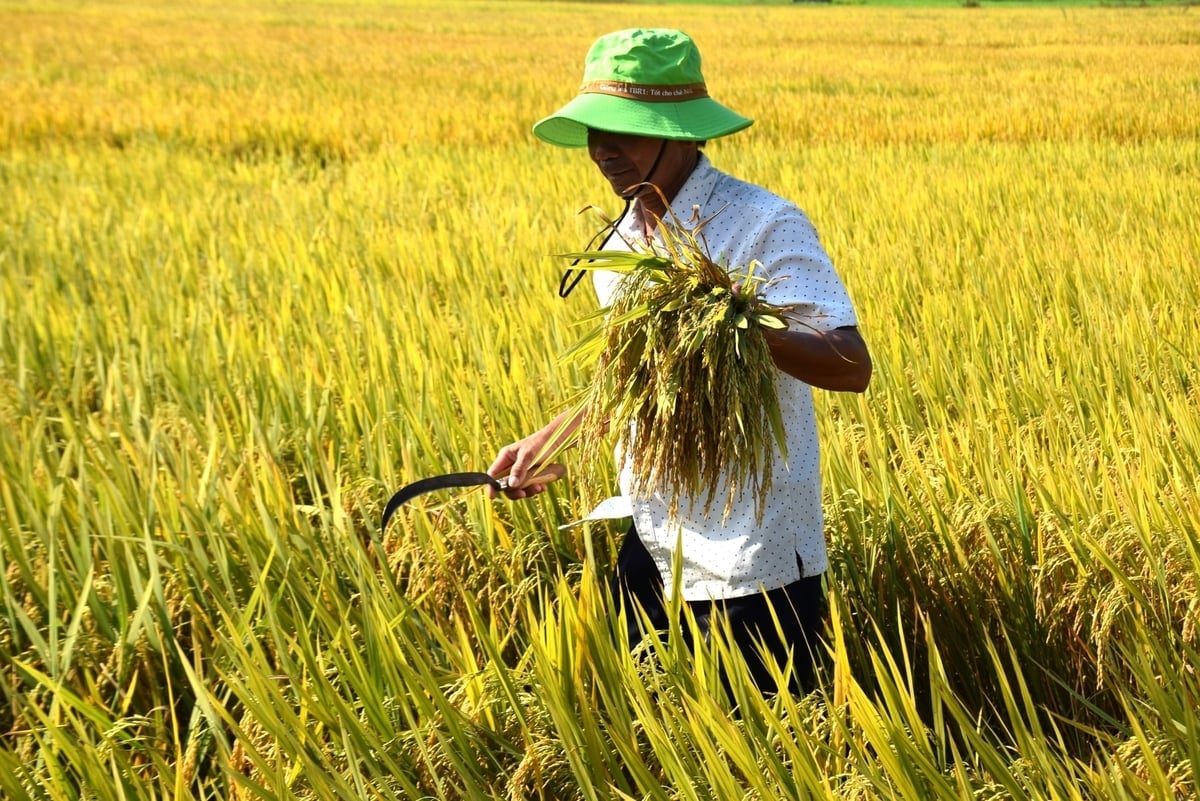
Water management according to the principle of alternating wet and dry helps rice plants have strong root systems, strong plants, few pests and diseases, and high yields. Photo: V.D.T.
According to Mr. Dung, rice grown using the SRI improved farming method has deep roots, strong stems, is less likely to fall over, saves water, fertilizer and reduces pests and diseases. In particular, it also limits greenhouse gas emissions.
However, Mr. Dung said that if the irrigation system is built synchronously, the canals are clear, and the water flows in and out smoothly, then expanding the area applying the improved SRI rice cultivation method will be more favorable.
“The cooperative has 1,184 hectares of rice production area, but only about 100 hectares apply the SRI method. To expand, it is necessary to invest in upgrading the irrigation system, clearing the flow and proactively providing water for each field. At the same time, it is necessary to train the irrigation team and farmers to master the techniques and practice the correct procedures so that the model can be sustainable and effective,” added Ho Ngoc Dung, Director of Phuoc Son Agricultural Cooperative.
According to Mr. Kieu Van Cang, the biggest limitation for the current alternating wet and dry irrigation method is the irrigation infrastructure and water management. It is necessary to have a complete canal system, regularly maintained and repaired to be able to actively regulate water between fields.
“In the coming time, the unit will coordinate with localities to strengthen training and effectively promote the SRI model; at the same time, recommend the province to invest in internal irrigation infrastructure, apply water-saving irrigation technology and digitize water level monitoring for more accurate regulation,” said Mr. Cang.
According to Mr. Cang, in the coming time, Gia Lai's agricultural sector will continue to transfer improved rice cultivation techniques through large-field programs, agricultural extension models, low-carbon production projects and water-saving management, expanding the area of SRI application in areas with proactive irrigation conditions.
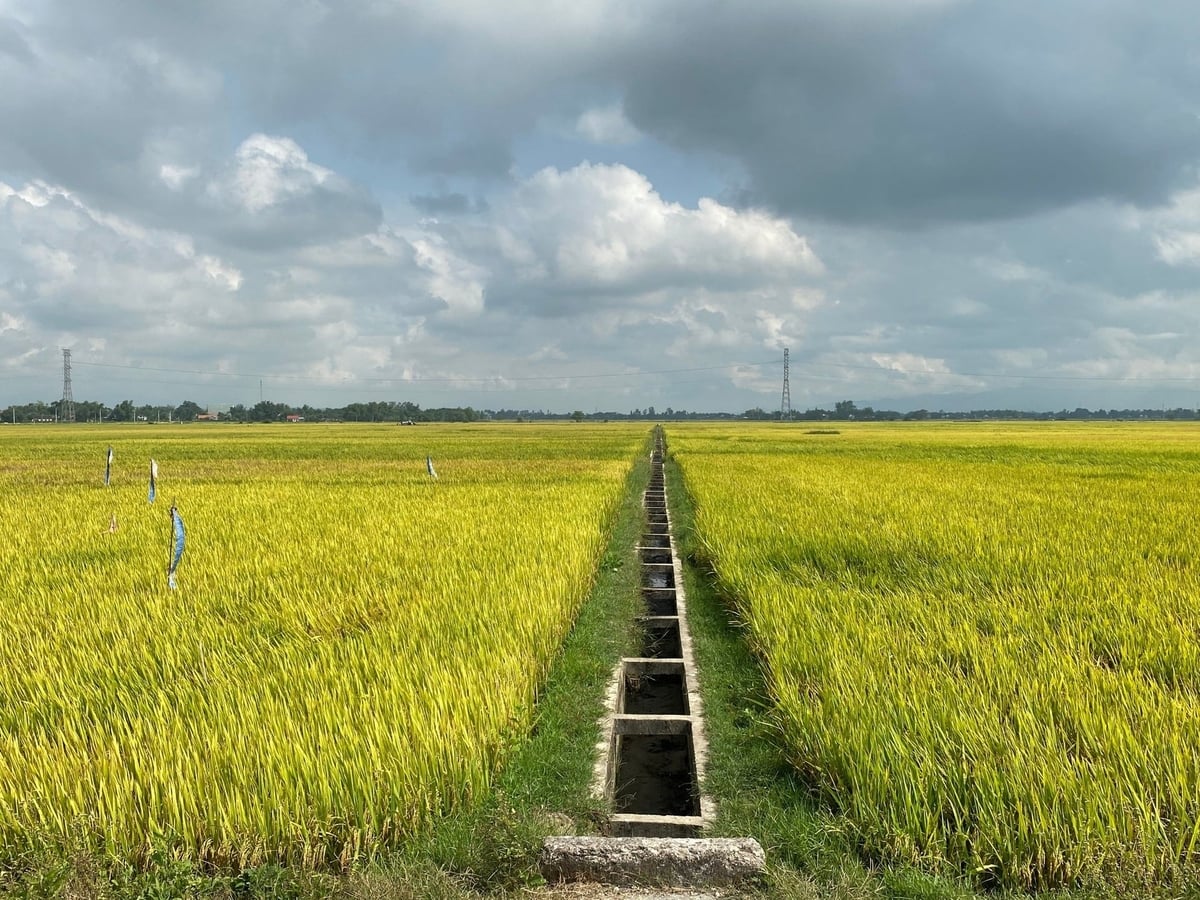
To apply the alternating wet-dry irrigation method, a complete canal system is required to actively regulate water between fields. Photo: V.D.T.
...to low-emission farming
Recently, the South Central Coast Agricultural Science and Technology Institute in collaboration with the Department of Agriculture and Environment of Gia Lai province has implemented the project "Alternate wetting and drying - A solution to reduce greenhouse gas emissions in sustainable rice cultivation" funded by the Japan International Cooperation Agency (JICA) through Green Carbon Japan Vietnam Co., Ltd. The model was piloted on an area of 10.4 hectares in Quy Nhon Dong ward, initially bringing positive results.
According to Dr. Pham Vu Bao, Deputy Director of the South Central Coast Agricultural Science and Technology Institute, this technique helps save up to 4,400 m³ of water per crop, reduces the number of watering times, and maintains good growing conditions for rice plants.
In particular, this model has helped reduce greenhouse gas emissions, with total CO₂ equivalent emissions (CO₂e) of only 1.95 tons/ha/crop, a reduction of about 70% compared to traditional farming methods (6.47 tons/ha/crop).
“If we want to replicate the model of “Alternate wetting and drying - A solution to reduce greenhouse gas emissions in sustainable rice cultivation”, we need to invest in a greenhouse gas emission monitoring and surveillance system, build a carbon credit profile that meets international standards, and mobilize climate financial resources. In addition, close coordination between all parties, from agricultural management agencies, local authorities, scientists, businesses, international organizations to farmers, is a key factor to ensure the success and spread of the model”, Dr. Pham Vu Bao shared.
Source: https://nongnghiepmoitruong.vn/trong-lua-giam-phat-thai-nong-dan-va-moi-truong-deu-huong-loi-d788067.html
![[Photo] The captivating scenery of the fragrant maple forest in Quang Tri](/_next/image?url=https%3A%2F%2Fvphoto.vietnam.vn%2Fthumb%2F1200x675%2Fvietnam%2Fresource%2FIMAGE%2F2025%2F12%2F10%2F1765353233198_lan09046-jpg.webp&w=3840&q=75)


![[Photo] Explore the US Navy's USS Robert Smalls warship](/_next/image?url=https%3A%2F%2Fvphoto.vietnam.vn%2Fthumb%2F1200x675%2Fvietnam%2Fresource%2FIMAGE%2F2025%2F12%2F10%2F1765341533272_11212121-8303-jpg.webp&w=3840&q=75)






![Passion fruit capital faces the challenge of sustainability: [Part 1] Regaining stability](https://vphoto.vietnam.vn/thumb/402x226/vietnam/resource/IMAGE/2025/12/10/1765333731519_1322-z7304406080505_7f5b16cdbceddbe34392d83300f8dfba-120956_263.jpeg)


![Green tea pork: [Part 2] A new specialty brand from Thai Nguyen](https://vphoto.vietnam.vn/thumb/402x226/vietnam/resource/IMAGE/2025/12/10/1765338249553_2114-img_6953-nongnghiep-112106.jpeg)








![[Video] The craft of making Dong Ho folk paintings has been inscribed by UNESCO on the List of Crafts in Need of Urgent Safeguarding.](https://vphoto.vietnam.vn/thumb/402x226/vietnam/resource/IMAGE/2025/12/10/1765350246533_tranh-dong-ho-734-jpg.webp)





















































Comment (0)