

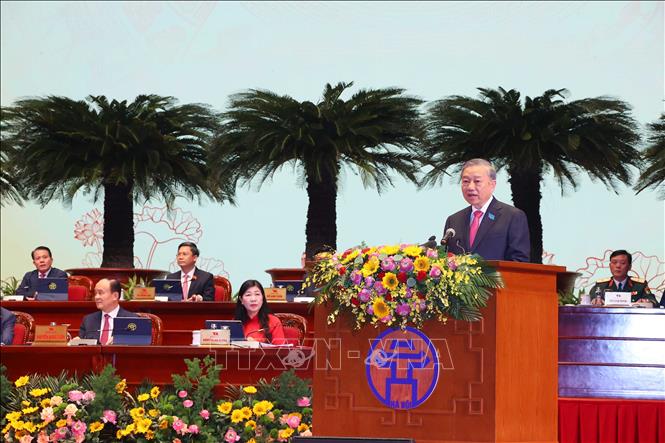
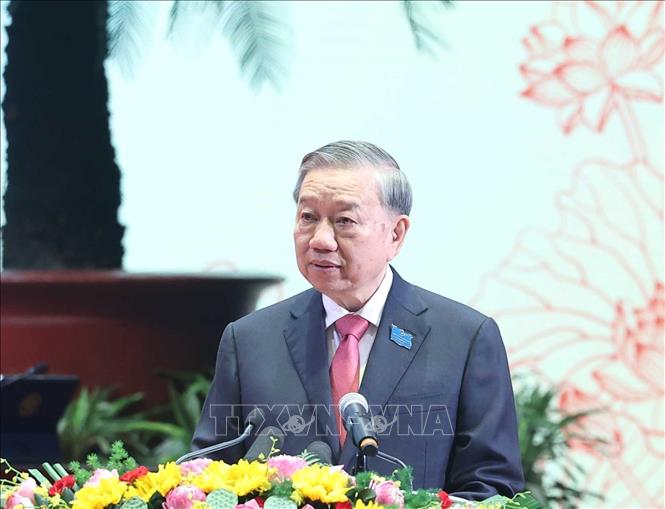
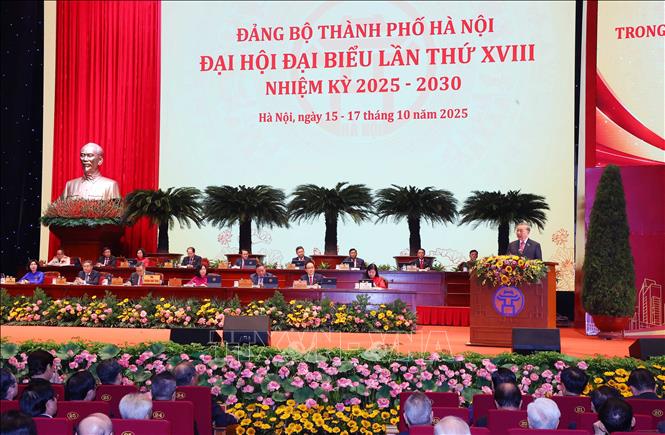
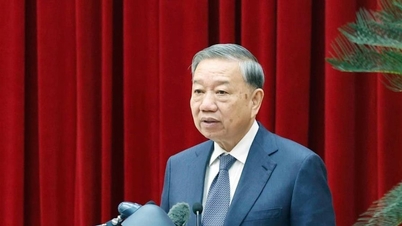
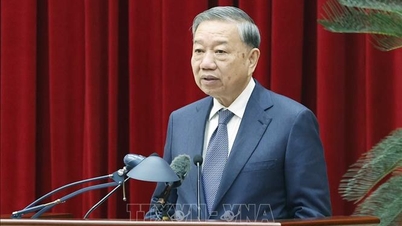
General Secretary To Lam attended and delivered a keynote address at the Congress. The Vietnam News Agency (VNA) respectfully presents the General Secretary's speech:
Distinguished leaders and former leaders of the Party, State, Vietnam Fatherland Front , and leaders of Hanoi City.
Distinguished members of the Presidium of the Congress,
Distinguished delegates, esteemed guests, and attendees of the Congress, and invited guests,
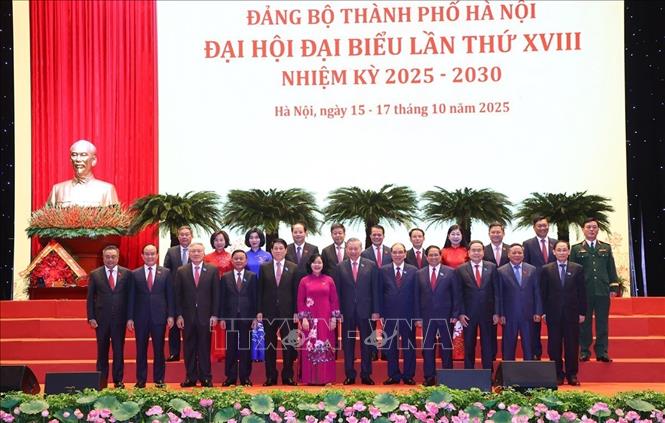
Today, I, along with my comrades from the Politburo and the Secretariat, am very pleased to attend the 18th Congress of the Hanoi City Party Committee - a political event of special significance for the capital and the entire country.
On behalf of the Central Committee of the Party, the Politburo , and the Secretariat, I warmly welcome and wish good health to the veteran revolutionaries, Vietnamese Heroic Mothers, Heroes of the Armed Forces, Labor Heroes, distinguished guests, and the 550 delegates attending the congress, outstanding Party members representing nearly half a million Party members of the Hanoi City Party Committee. Through you, I would like to send my warmest greetings and best wishes to all cadres, Party members, compatriots, soldiers, and people of all walks of life in the Capital City.
Comrades,
Beloved President Ho Chi Minh once instructed: “The whole country looks to our capital. The world looks to our capital. All of us must strive to maintain order and security, making our capital a peaceful, beautiful, and healthy capital, both materially and spiritually”; “The Hanoi Party Committee must set an example for other Party Committees.” These instructions are both an honor and a great responsibility for Hanoi. This Congress is an opportunity for comrades to reflect on themselves, set the right goals, create a new momentum, new determination, and new driving force for the development of the capital in the new era of the nation, and fulfill Uncle Ho's aspirations for Hanoi.
With that spirit in mind, I propose that the Congress discuss two strategic questions to define the vision and course of action for the entire term.
Firstly, how will Hanoi define its identity and development model to both preserve the spirit of Thang Long and transform itself into a creative, green, smart, globally connected metropolis, commensurate with the image of a capital city of a high-income developed country with a socialist orientation by 2045?
Secondly, how will the Hanoi City Party Committee enhance its leadership capacity and fighting strength to transform goals and policies into results, so that the people of the capital city can participate in and benefit from the fruits of development?
From those two key questions, we look back on the journey so far to determine the right starting point for our next step forward.
During the past term, despite facing countless difficulties and challenges, including many new and unprecedented issues, the Party Committee, government, and people of Hanoi have always strived to maintain stability and development, making positive contributions to the overall achievements of the country.
Through the review and evaluation by the comrades, it was found that the targets set at the 17th City Party Congress were basically achieved and exceeded, with 4 targets completed 1 to 2 years ahead of schedule. Among these, 14 outstanding results were highlighted in the Political Report and substantiated with specific data. We are pleased to see that the appearance of the Capital City has continuously developed towards a modern, smart, green, and sustainable direction, with many key projects completed and put into use. The capital's economy has continuously developed with a growth rate higher than the national average, its size increasing 1.4 times compared to the beginning of the term; budget revenue is 1.8 times higher than the previous term; science, technology, innovation, and digital transformation have been strongly promoted. The cultural values and people of the capital are preserved and promoted, especially through the 80th anniversary of the August Revolution and National Day on September 2nd, contributing to spreading the image of Hanoi as an elegant and civilized city, a "City for Peace" in the world. The quality of life of the people of the capital is increasingly improved, with the highest Human Development Index (HDI) in the country. National defense, security, and social order and safety are maintained. Party building and rectification have seen many changes; the organization and apparatus of the capital's political system have been streamlined, operating effectively and efficiently; the leadership methods of Party committees at all levels have been gradually reformed. The two-tiered local government model operates smoothly, effectively, and efficiently, serving citizens and businesses even better…
On behalf of the Central Committee, the Politburo, and the Secretariat, I warmly congratulate, highly appreciate, and commend the achievements that the Party Committee, the Government, and the people of Hanoi have made during the past term.
I agree with your assessment of the six limitations and weaknesses mentioned in the political report. We must frankly acknowledge that there are still many long-standing "bottlenecks" that need to be addressed, such as: the quality of growth and labor productivity are not commensurate with the potential, strengths, and specific policies of the Central Government for Hanoi; science, technology, and innovation are still limited; infrastructure has not kept pace with development; planning, land, construction, and urban management still have many shortcomings; traffic congestion, flooding, air pollution, and pollution of rivers and lakes persist; the development of a cultured, elegant, and civilized lifestyle has not met expectations… A segment of officials are still afraid of making mistakes, afraid of responsibility, working in a "mediocrity" style, "thinking in the old ways," not daring to boldly innovate and make breakthroughs; and there are even still manifestations of corruption, waste, and negativity that hinder the development of the Capital. Facing the truth is essential for change; it's a prerequisite if we want to achieve breakthroughs. I propose that the Congress continue to conduct a thorough analysis of the causes of existing shortcomings and limitations in order to develop policies and solutions to definitively address them in the next term.
Comrades,
Our country and our capital city are entering a new era of national development, with opportunities, advantages, difficulties, and challenges intertwined. The two centenary goals of the nation place very high demands and pose enormous challenges, requiring a renewal of awareness and a strong breakthrough in action from the central government to the localities. The Party Committee, government, and people of Hanoi need to deeply understand the particularly important position and role of the capital city in the country; fully recognize the attention and support provided by the central government to the capital city; and clearly see Hanoi's immense responsibility in fulfilling the hopes and expectations of the people of the whole country and the people of Hanoi.
For Hanoi to enter a new phase of development, it requires a comprehensive and systematic vision where ideology, institutions, space, economy, and people are intertwined into a sustainable development whole. In this, ideology guides institutions; institutions create space; space opens the way for the economy; the economy nurtures people; and people, in turn, create and refine ideology. Therefore, I would like to suggest the following seven requirements and tasks to you:
Firstly, we must build a clean, strong, exemplary, and responsible Party organization and political system. This is the first breakthrough axis, determining all success. The Hanoi Party organization must be truly exemplary, a shining example of political acumen, revolutionary ethics, leadership capacity, and fighting spirit. Every cadre and Party member must dare to think, dare to act, and dare to take responsibility for the common good; their words must match their actions; and they must serve the people.
Continue to seriously implement the Central Resolutions 4 of the 12th and 13th Party Congresses, in conjunction with Directive 05-CT/TW on studying and following the ideology, ethics, and style of Ho Chi Minh.
Resolutely prevent and combat corruption, negative practices, and waste; uphold the spirit of self-criticism, solidarity, and unity throughout the Party organization; and strengthen the close relationship between the Party and the people.
Focus on improving the effectiveness and efficiency of the two-tiered government system, shifting strongly from a management mindset to a constructive, service-oriented mindset, implementing clear decentralization and delegation of power, accompanied by accountability and control.
We must radically change our mindset with a new spirit: "Hanoi says it and does it—doing it quickly, doing it correctly, doing it effectively, and doing it to the end."
Secondly, we need to place "Culture - Identity - Creativity" at the center of all development orientations for the Capital, considering it a powerful endogenous resource, the foundation for shaping Hanoi's character, intellect, and upward momentum, and the basis for the Capital to affirm its leading role, position, and influence on the nation in the new era.
Hanoi, the capital city, embodies the soul, character, and wisdom of the nation. Its strength lies not only in its population size or GDP, but in the depth of its culture, nurtured throughout history, from the ancient relics of Thang Long citadel to the modern rhythm of life as a leading political, cultural, and economic center of the country.
Hanoi must be built as a "City of Culture, Identity, and Creativity," aiming for a "Civilized, Modern, and Sustainable Capital" with contemporary wisdom and global stature: where culture is the root, the crystallization of national wisdom, nurturing faith, aspirations, and resilience, creating a unique appeal that no other city can replicate; identity is the foundation, the core competitive advantage, helping Hanoi not only preserve its historical soul but also create an attraction to lead creativity, develop a knowledge-based economy, and attract talent; creativity is the driving force for development, transforming heritage into living values, simultaneously preserving, developing, and expanding the city's stature, from planning, architecture, and art to education, science, and governance.
To achieve this, the development strategy must seamlessly integrate culture, space, economy, and people. Every policy, project, and investment must ensure the preservation of traditional values while shaping cultural spaces for future generations and fostering innovation. We must develop "creative arteries" linking the entire capital city, ensuring a flow of creative energy from heritage and knowledge to technology, connecting cultural, academic, and innovation centers.
Based on this, three "creative poles" will be formed: Heritage - the historical inner city center and the Red River waterfront area - Co Loa Citadel; Knowledge - the National University and training and research centers; and Technology - Hoa Lac High-Tech Park and other innovation zones. These will be the driving forces behind the creativity of the entire capital, maximizing the value of history, knowledge, and technology, transforming Hanoi into a city that embodies the past, present, and future.
When Hanoi places Culture, Identity, and Creativity at the center of all its development orientations, the capital city not only affirms its leading position, guiding and spreading national strength, but also becomes a model city with character, intelligence, vitality, and sustainability, where the past, present, and future converge into a comprehensive force, forming the foundation for the country's development in the new era.
Thirdly, Hanoi must create a completely new governance model, capable of coordinating, leading, and thoroughly resolving urgent issues, while simultaneously opening up a long-term, sustainable development vision.
Hanoi, the thousand-year-old capital of Vietnam, with a population of around ten million and its central political position, is facing urban challenges accumulated over its history: old apartment buildings, persistent traffic congestion, chronic air pollution, flooding during heavy rains, and overloaded inner-city infrastructure. These challenges are not merely infrastructure problems but also a test of national governance capacity, a test of the stature and resilience of the capital city.
I also propose that the delegates attending the Congress discuss and agree to include in the Action Program for the 18th term the four long-standing problems of the Capital that the people are eagerly awaiting: traffic congestion; urban order, cleanliness, civility, and hygiene; environmental pollution, water pollution, and air pollution; and finally, flooding in urban and suburban areas.
To overcome this, Hanoi cannot simply adjust to the old ways but must create a completely new governance model: from management to creation; from overlapping and fragmented to synchronized and integrated; from short-term to sustainable, with the stature of a modern capital city, capable of thoroughly solving urgent problems while opening up new avenues for development; not only maintaining order but also creating the capacity for breakthroughs; not only managing the present but also proactively shaping the future. We must bravely do things no one has done before, be cautious in our methods but decisive in our actions to lead the thinking, standards, and development model of the entire country.
It must be an advanced, unique, integrated, and comprehensive governance model, where all policies, projects, and resources operate in a linked manner, like the functions of a city body, under a central coordination system and an interdisciplinary data platform, eliminating fragmentation, overlap, and conflict. All decisions must be based on science and evidence, tested, simulated, and refined before implementation, not on sentiment or vested interests.
Fourth, perfect the multi-polar, multi-center urban model, transforming each development pole into a true dynamic center, closely connected by backbone infrastructure, strategic axes, and integrated connecting corridors.
Developing Hanoi in the new phase requires a fundamental shift from a "monopolar, concentrated" model to a "multipolar, multi-centered" structure. It is no longer feasible to continue compressing all administrative, economic, educational, medical, and cultural functions into the already overloaded historical inner city. Instead, urban space must be reorganized into dispersed poles, while still ensuring synchronized connectivity.
Each urban area holds a specific mission within the unified whole of the Capital: the central core, linked to the Hoan Kiem-Ba Dinh area, plays a political, cultural, and heritage preservation role; the far northwest, home to the Hoa Lac High-Tech Park, becomes a center for high technology, education, and research; the south, with its modern industrial zones, handles logistics, supporting industries, mechanics, and processing; and the east, with its gateway ports, is a center for trade and services. Each area becomes a dynamic satellite, both functionally independent and closely connected to the entire Capital and surrounding areas, helping Hanoi become a city that radiates influence, connects, and leads the region and the nation.
Multipolar development is a design that helps Hanoi expand the scale of its center, so that each pole becomes a "dynamic satellite" - both functionally independent and organically connected to the overall capital and surrounding areas.
The core of this model is the "infrastructure-driven planning" mindset replacing the "plan to build" mindset – meaning that all residential, industrial, commercial, or housing strategies must be designed around actual infrastructure capacity, especially transportation, energy, clean water, drainage, waste treatment, and digital infrastructure, treating the entire system as a unified whole across the city.
Infrastructure must be one step ahead, synchronized and smart: expressways, subway systems, elevated railways, river ports, airports, and electricity-water-communication networks must be linked according to the "axis-ring-station" concept.
Planning is no longer a static blueprint, but a dynamic infrastructure strategy, continuously updated with digital data, monitored with simulation models, ensuring that all projects are implemented in a well-founded, transparent, and effective manner.
This is the method of transforming planning from geometry to strategy, from maps to operational capabilities.
Fifth, develop Hanoi into a center for science, technology, and innovation, a central driving force for regional and national development based on a knowledge-based economy. Hanoi's GRDP in 2024 is estimated at approximately US$58.6 billion, ranking second nationwide in terms of size. Hanoi's GRDP growth in the first nine months of 2025 is projected at 7.92%, ranking 17th out of 34 localities in terms of growth rate. Compared to 2024, the increase from 6.65% to 7.92% is positive, but in terms of growth rate compared to the national average, Hanoi has not yet shown any significant improvement compared to other localities, despite its GRDP still ranking second nationwide.
Developing science, technology, and innovation is a decisive factor in accelerating growth in the coming period and is a key driving force for Hanoi to enter a new phase of development – from an administrative and political capital to a leading national center of knowledge, technology, and innovation, playing a leading role in the Red River Delta region and spreading its influence throughout the country. This is not only a requirement for socio-economic development, but also a strategic choice of national significance, reflecting a shift in growth model thinking based on science, technology, talent, and innovation.
Hanoi must become a place for creating new policies, testing new technologies, training new talents, and generating new ideas for the nation. The capital city possesses all the most favorable conditions, along with Ho Chi Minh City, to assume the role of the country's innovation and technology center: it is a hub for high-quality intellectual human resources, with leading universities and research institutes such as Hanoi National University, Hanoi University of Science and Technology, the Posts and Telecommunications Institute, and the Vietnam Academy of Science and Technology; it is a national hub for technology and data infrastructure, with key high-tech zones like Hoa Lac, data centers, research centers, and a synchronized digital infrastructure network; it has a thriving business and innovation ecosystem, with companies like Viettel, VNPT, FPT, MobiFone… and thousands of technology startups; and it houses research centers of global technology corporations such as Samsung and Qualcomm. It is also a hub for abundant capital from major financial institutions such as Vietcombank, Techcombank, VPBank, Agribank, BIDV, VietinBank, etc.
When all components are connected, operating synchronously and uniformly within a dynamic, transparent, strategically oriented governance mechanism, and led and developed by the state, Hanoi will realize its superior synergistic strength. This strength will not only drive breakthroughs in technology application and innovation, but also help the capital city gradually conduct scientific research to master core and strategic technologies, and take the lead in the development of emerging industries.
Sixth, placing people at the center and as the measure of all development, building a humane, happy, just, and civilized capital city, becoming a model of culture and knowledge leading the nation. In every development strategy, people must be both the starting point and the destination. For Hanoi—the center of national excellence, the place where Vietnamese history, culture, and intellect are crystallized—the role of people becomes even more crucial, not only as the subject of development, but also as the yardstick for evaluating the success of all policies, projects, and future designs of the capital city.
Putting people at the center is not only a humanistic perspective, but also the operating principle of a modern, smart, and sustainably developed city. All policies, plans, technologies, and infrastructure must serve the capacity and quality of life of the people. The capital city must become a place where all citizens have the opportunity to learn, create, start businesses, and contribute; while simultaneously having a comprehensive welfare network that ensures healthcare, education, social security, housing, employment, and cultural and artistic spaces for all social classes. Only when people are fully developed can society truly be just, creative, and happy.
Human development is the core of Hanoi's development. This includes not only improving capabilities, dignity, and quality of life, but also developing a culture of conduct and civic ethics. Hanoi needs to uphold the spirit of "elegance, compassion, and responsibility" in modern life, while simultaneously building a standard, clean, and people-oriented public service environment where all actions of officials and state agencies reflect responsibility and commitment to the people.
Seventh, maintain national defense and security; expand foreign relations, regional and international cooperation.
Hanoi must always be a strong fortress in terms of politics, security, and social order. It must proactively monitor the situation early and from afar; effectively prevent and combat crime, especially high-tech and organized crime; and enhance its capacity for disaster prevention, rescue, and adaptation to climate change. The sense of safety and peace of mind of its residents and tourists should be the measure of the capital's peace. At the same time, it must strengthen foreign relations, integration, and cooperation for regional and international development, expand its network of cooperation with major cities worldwide, and actively participate in the network of "Green, Smart, and Creative Cities." Through these efforts, Hanoi's position as a leading political, cultural, educational, and economic center of Vietnam must be enhanced on the international stage.
Comrades,
The Central Committee of the Party, as well as I personally, deeply believe that, with a spirit of breakthrough, innovation, creativity, democracy, discipline, unity, and responsibility, the Party Committee, government, and people of Hanoi will certainly overcome all difficulties and challenges, strive to achieve even greater achievements, worthy of the stature and position of "the capital of a thousand years of culture," "the heroic capital," "the city for peace," and "the creative city"; confidently and steadily leading the way with the whole country into the new era, making a worthy contribution to the development of the country into a prosperous, happy, and powerful nation, standing shoulder to shoulder with the great powers of the world.
Wishing you all good health, happiness, and success. Wishing the 18th Congress of the Hanoi City Party Committee great success.
Thank you very much, comrades!
Source: https://baotintuc.vn/thoi-su/phat-bieu-cua-tong-bi-thu-to-lam-tai-dai-hoi-dai-bieu-dang-bo-thanh-pho-ha-noi-lan-thu-xviii-nhiem-ky-2025-2030-20251016131237888.htm


![[Image] Close-up of the newly discovered "sacred road" at My Son Sanctuary](/_next/image?url=https%3A%2F%2Fvphoto.vietnam.vn%2Fthumb%2F1200x675%2Fvietnam%2Fresource%2FIMAGE%2F2025%2F12%2F13%2F1765587881240_ndo_br_ms5-jpg.webp&w=3840&q=75)
































































Comment (0)