

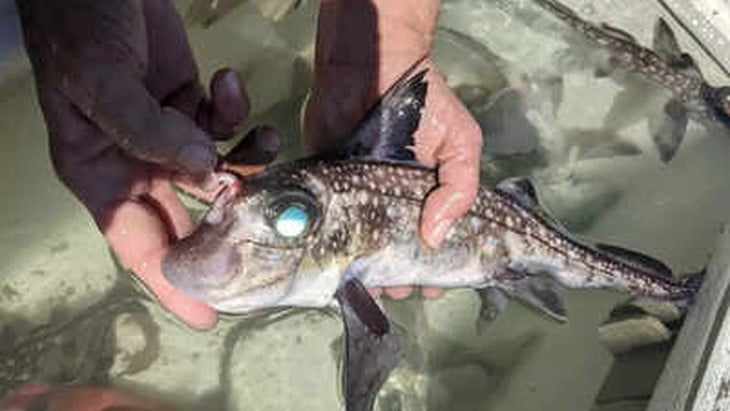
Ghost sharks are not actually sharks, but belong to the chimera group, distant relatives of sharks and rays - Photo: University of Florida
In a study recently published in the Proceedings of the National Academy of Sciences (PNAS) , researchers from the University of Washington and the University of Florida (USA) studied ghost sharks living off the coast of Washington state, particularly in the waters around San Juan Island in Puget Sound.
This is a cartilaginous fish with glowing green eyes, averaging about 60 cm in length, often called the "ocean ghost" because of its shimmering body in the dark.
The team discovered that the males of this species possess a unique structure called a tenaculum located in the middle of their forehead. On this appendage, the tiny spikes previously thought to be horn-like spines are actually… real teeth.
Through histological experiments and molecular analysis, the research team demonstrated that the teeth in the tenaculum share the same genes and developmental patterns as the teeth in the mouths of fish. Furthermore, the supporting tissue for the teeth, called the dental lamina, previously only found in the jaw, is now also present in the frontal lobe.
"This is the first clear evidence that vertebrates can grow teeth outside their mouths. This discovery overturns centuries-old assumptions in evolutionary biology," said researcher Karly Cohen of the University of Washington.
Through underwater footage, scientists observed that male ghost sharks use their frontal teeth to firmly grip the pectoral fins of females during mating. When not in use, the tenaculum folds up and is stored neatly in a small groove on its forehead.
Dr. Gareth Fraser, an evolutionary biologist at the University of Florida, describes it as follows: "The teeth in the tenaculum are arranged in multiple rows, operating like a conveyor belt similar to a shark's jaws. This is truly a spectacular mechanism that we haven't seen in any other species in the animal kingdom."
This discovery not only sheds light on the long-standing mystery of the ghost shark's peculiar structure but also opens up new avenues of research into the evolution of teeth in vertebrates.
For a long time, scientists believed that teeth only formed in the oral cavity. But now, evidence from ghost sharks suggests that teeth can develop in locations outside the jaw, provided there is suitable underlying tissue.
Although the evolutionary mechanisms behind this extraordinary phenomenon cannot yet be fully explained, scientists assert that the discovery has fundamentally changed our understanding of dental biology, while also highlighting the remarkable diversity of life in the deep ocean.
Source: https://tuoitre.vn/phat-hien-ca-map-moc-rang-tren-tran-khoa-hoc-sung-so-20250911102726748.htm
























































































Comment (0)