

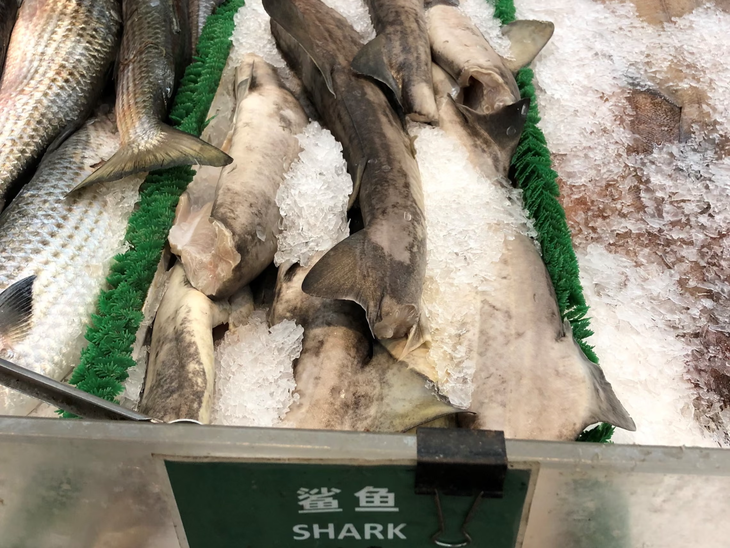
A stall in the US simply labels its products with the generic word "shark" - Photo: GUARDIAN
According to The Guardian on September 12, much of the shark meat sold in the US is mislabeled, with many products originating from endangered species.
The study, conducted by the University of North Carolina at Chapel Hill, tested products from supermarkets, seafood markets, and online retailers.
The results showed that 93% of the samples were mislabeled or ambiguously labeled to the point that buyers had no idea which shark species they were consuming. Only one product was correctly labeled with the specific species.
"The aim of this study is to clearly identify the shark meat products sold in the United States," said marine ecologist Savannah Ryburn, the lead researcher.
More specifically, the team purchased and analyzed the DNA of 29 shark meat products from supermarkets, seafood markets, and online stores in the US to accurately identify the species.
DNA analysis revealed the meat came from 11 different shark species, including the great hammerhead shark and the shell hammerhead shark, both of which are critically endangered according to the International Union for Conservation of Nature (IUCN).
Nevertheless, these species are still available on the US market at prices as low as $2.99 per pound (approximately $6.59 per kilogram).
The study, published in the journal Frontiers in Marine Science , found that 27 of the 29 samples tested were sold under the label "shark" or "mako shark." Two of the remaining products had the species name listed, but one was misidentified.
"Mislabeling or ambiguity leaves consumers unable to make informed choices about what they put into their bodies," Ryburn warned.
"In our research, shellfish hammerhead and great hammerhead sharks were generically labeled as 'sharks,' even though these two species are advised against consumption due to their very high levels of contaminants. Without accurate labeling, consumers are unlikely to avoid purchasing these products," she added.
Health risks of eating shark meat
In addition to conservation concerns, the study also warns of health risks, as shark meat contains high levels of mercury, which is particularly dangerous for children and pregnant women.
"Shark meat contains high levels of mercury, highlighting the serious impact of mislabeling in the seafood industry on human health," said Ryburn. "The appearance of shark meat in American supermarkets is surprising, given the critical decline in shark populations globally."
The number of sharks in the ocean has decreased by more than 70% since 1970, mainly due to the increasing demand for their meat.
In addition, the widespread use of shark products in daily life—from animal feed to cosmetics—also contributes to the species' overfishing globally.
Source: https://tuoitre.vn/93-thit-ca-map-ban-tai-my-bi-dan-nhan-sai-sieu-thi-ban-ca-loai-nguy-cap-20250913102324161.htm


![[Image] Vietnam's colorful journey of innovation](/_next/image?url=https%3A%2F%2Fvphoto.vietnam.vn%2Fthumb%2F1200x675%2Fvietnam%2Fresource%2FIMAGE%2F2025%2F12%2F14%2F1765703036409_image-1.jpeg&w=3840&q=75)

























































![[Image] Vietnam's colorful journey of innovation](https://vphoto.vietnam.vn/thumb/402x226/vietnam/resource/IMAGE/2025/12/14/1765703036409_image-1.jpeg)































Comment (0)