

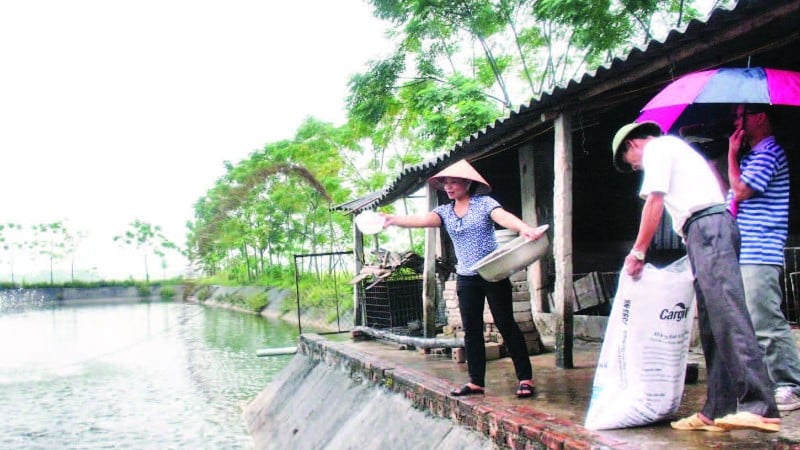
Aquaculture is positioned as one of Vietnam's key economic sectors. Decision No. 339/QD-TTg dated March 11, 2021, of the Prime Minister approving the Strategy for the Development of Vietnam's Fisheries Sector until 2030, with a vision to 2045, has set several goals, such as: maintaining a growth rate of 3-4% per year in the value of aquaculture production; achieving a total aquaculture output of 7 million tons; and creating jobs for approximately 3.5 million workers. By 2045, aquaculture will be a modern, sustainable, and commercially advanced economic and trade sector; Vietnam will become one of the world's top three producers and exporters of aquatic products.
According to statistics from the Vietnam Association of Seafood Processing and Export (VASEP), from 2018 to the present, Vietnam's aquaculture production has grown steadily from 4.1 million tons to 5.7 million tons (2024), reaching a turnover of 10.07 billion USD. This year, with 1.3 million hectares of inland aquaculture and 9.7 million m² of sea cage farming, aquaculture production is projected to see a slight increase compared to 2024.
To develop aquaculture into a key economic sector, it is essential to apply advanced science and technology to production. In this regard, water quality monitoring equipment is an indispensable component to replace existing traditional methods. Several countries with developed aquaculture industries place great importance on water quality monitoring. However, each country has different regulations.
For example, Thailand assigns the Fisheries Department to oversee the entire aquaculture area; Oceania countries issue water quality control procedures and implement strict controls; some European countries delegate control to aquaculture owners, considering it as part of environmental reporting and management…
In Vietnam, several aquaculture businesses have adopted high-tech equipment in production, monitoring, and water quality control, such as the E-Sensor Aqua device from Eplusi Technology Company; TC Check from TC Group; and e-Aqua from the Saigon Center for Technology and Equipment Development (Cenintec). Many large aquaculture areas also contract with monitoring companies to track the water quality of their ponds…
However, most notably, the aquaculture water quality monitoring system, researched and developed by the Institute of Information Technology (Vietnam Academy of Science and Technology), boasts a full range of outstanding and comprehensive features.
According to Dr. Pham Ngoc Minh from the Institute of Information Technology, the development of the water quality control system is the result of many years of serious work by the research team. This system utilizes an IoT application platform combined with modern technical equipment, ensuring superiority and effectiveness for the aquaculture industry in Vietnam. The product has been tested and certified by the Center for Analysis and Environment (CAE) with calibration certificate number CAE25HC12711, dated October 27, 2025.
The IoT water quality monitoring system consists of five main parts: a power supply unit, providing input (220VAC/50Hz) and output (24VDC/12VDC) power to the system; a processing unit with a central data processing module integrating digital input and output ports; a display screen; a 4G module; and a wireless communication module.
In terms of operation, after installation, the server connects to data collection stations and automatically analyzes water samples, thereby detecting abnormalities and warning farmers of potential risks. In addition, the system integrates, stores, compiles, and manages data over long periods to help users monitor water quality trends over time.
In terms of user interface, the system displays monitoring data in intuitive numerical, graphical, and tabular formats that are very easy to use. It can also simultaneously monitor multiple aquaculture ponds, allowing for large-scale production. In addition to the data displayed on the main screen, the system can send parameters and warning data to registered user phone numbers via wireless modules.
Test results show that IoT water quality monitoring systems are very useful, especially for aquaculture areas with many potential safety risks due to pollution or the easy spread of diseases.
Test results show that IoT water quality monitoring systems are very useful, especially for aquaculture areas with many potential safety risks due to pollution or the easy spread of diseases.
Dr. Ngo Duy Tan (Vietnam Space Center), a member of the research team, affirmed that the IoT system helps automate the process of monitoring water quality, minimize risks, increase production efficiency, reduce costs, and optimize aquaculture operations. This system has the potential to be an important tool in Vietnam's sustainable aquaculture activities.
Although aquaculture water quality monitoring systems have proven superior through experiments and trials, further testing is needed to assess their durability and adaptability to various water bodies, types, and aquaculture models. This requires significant funding as well as support from policies, media, and especially the business community, organizations, and individuals in the aquaculture industry.
Source: https://nhandan.vn/ung-dung-cong-nghe-iot-giam-sat-chat-luong-nuoc-nuoi-trong-thuy-san-post930118.html











































































Comment (0)