

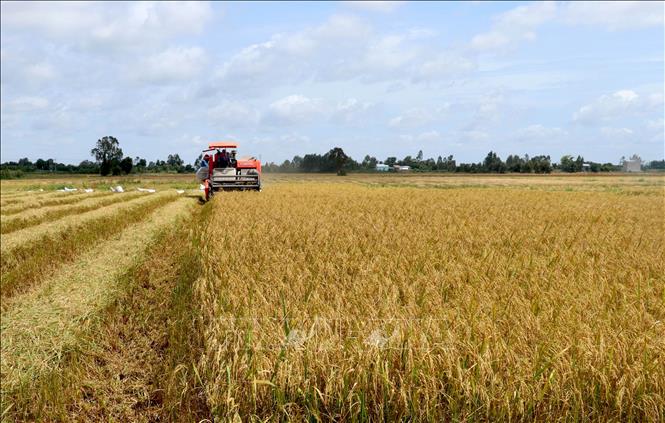
Decision 4296/QD-BNNMT, issued for the first time, affirms the view that agricultural extension plays a crucial role in technology transfer, information, communication, knowledge dissemination, training, and intellectualizing farmers. At the same time, it contributes to promoting innovation in agriculture, developing the agricultural economy towards green growth, reducing emissions, building modern and civilized new rural areas, protecting the ecological environment, adapting to climate change, and improving and enhancing the material and spiritual lives of farmers.
Along with that, there is a need for comprehensive reform of agricultural extension work based on an agricultural economic mindset, placing farmers as the main subjects and center of the development process, enhancing the capacity of farmers and other actors in the agricultural value chain; expanding the scope of activities from primarily transferring scientific and technical knowledge to serving production to providing information, guiding skills, organizing production, and linking along the value chain, based on science and technology, innovation, and digital transformation to create breakthroughs in productivity, quality, and efficiency.
In addition, develop agricultural extension in a professional direction, in which state agricultural extension plays a central role, orienting activities, mobilizing resources and connecting participants; promote socialization and public-private cooperation, increase the participation of research and training agencies, businesses and related organizations and individuals participating in the agricultural extension ecosystem.
Based on that, the Agricultural Extension Development Strategy to 2030, with a vision to 2050, sets out several key objectives. Specifically, by 2030, 100% of state agricultural extension officers will have standardized professional titles and receive training in economics, markets, and digital transformation; 100% of officers from cooperatives, enterprises, and socio-political organizations participating in community agricultural extension groups will receive training in agricultural extension methods, new technical advancements, and knowledge of economics, markets, and digital transformation to serve agricultural extension activities and community agricultural extension.
Professional farmer training with 100% of farmers participating in the chain in raw material areas trained in processes, techniques, standards, quality regulations, production organization and market linkage.
Regarding technology transfer, agricultural extension models and projects focus on the synchronized transfer of advanced solutions and technologies, organizing production and linking along the value chain, ensuring 100% of products meet quality and food safety standards, and protecting the environment; increasing economic efficiency by over 15%, reducing input costs by over 10%, and being replicated in the value chains of key agricultural sectors.
Poverty reduction agricultural extension has over 70% of communes in difficult and extremely difficult areas built poverty reduction agricultural extension models to create stable and sustainable livelihoods for poor farmers.
Digital transformation of agricultural extension activities: 100% of agricultural extension models using state budget funds are managed on the digital agricultural extension system; over 50% of agricultural extension training courses are implemented on the digital agricultural extension platform; 100% of agricultural extension technical documents are digitized and disseminated on the digital agricultural extension system; 100% of products from agricultural extension models and projects are introduced and promoted on e-commerce platforms or digital environments.
100% of agricultural extension materials are compiled with the participation of research institutes, universities, experts, and businesses; over 50% of agricultural extension models and projects mobilize investment resources from businesses and international organizations for agricultural extension activities through public-private partnership programs, technical assistance, and linkage projects.
Vision to 2050: Building a professional, modern, intelligent agricultural extension system with the capacity to connect, lead, and spread knowledge and values in the agricultural ecosystem. Farmers have effective access to agricultural extension services through an integrated digital platform and a team of professional, highly qualified agricultural extension officers.
Developing a dynamic public-private partnership agricultural extension ecosystem, closely linked with science and technology, innovation, markets, and financial resources, contributes to enhancing competitiveness and promoting green, low-emission, environmentally friendly, and climate-change-adaptive agricultural development.
To achieve the above goals, the Agricultural Extension Development Strategy sets out 7 key solutions, including: Perfecting the agricultural extension development policy mechanism; Developing agricultural extension human resources; Training professional farmers; Transferring and applying advanced science and technology, improving productivity, quality, efficiency and sustainable development; Agricultural extension for poverty reduction, natural disaster prevention, climate change adaptation; Digital transformation in agricultural extension activities; International cooperation, public-private partnership, and socialization of agricultural extension.
In the 2025 - 2030 period, the strategy prioritizes projects: strengthening the capacity of the agricultural extension system; training professional farmers; transferring technology, promoting value chain linkages in key industries in raw material areas; agricultural extension to reduce poverty in disadvantaged areas; developing digital agricultural extension platforms and digital technology infrastructure; and socializing agricultural extension activities.
In addition, it is necessary to develop agricultural extension models to transfer farming techniques that adapt to climate change, conserve resources, reduce emissions, prevent and mitigate natural disasters and diseases, and protect the environment.
Source: https://baotintuc.vn/kinh-te/phe-duyet-chien-luoc-phat-trien-khuyen-nong-tam-nhin-den-nam-2050-20251017185743415.htm











![[Infographic] Cross-exchange rates for determining taxable value from December 11-17](https://vphoto.vietnam.vn/thumb/402x226/vietnam/resource/IMAGE/2025/12/11/1765413245543_infographic-ty-gia-tinh-cheo-de-xac-dinh-tri-gia-tinh-thue-tu-11-1712-20251211021920.jpeg)









![[Video] The craft of making Dong Ho folk paintings has been inscribed by UNESCO on the List of Crafts in Need of Urgent Safeguarding.](https://vphoto.vietnam.vn/thumb/402x226/vietnam/resource/IMAGE/2025/12/10/1765350246533_tranh-dong-ho-734-jpg.webp)
















































Comment (0)