

Hanoi pho is still delicious today, but it has changed somewhat in both its cooking and serving methods due to various social changes, according to pho expert Trinh Quang Dung.
Mr. Trinh Quang Dung, a 71-year-old scientist working at the Vietnam Academy of Science and Technology, launched his book "One Hundred Years of Vietnamese Pho" (Vietnam Women's Publishing House) in 2022 after decades of collecting and researching valuable documents about pho from the past to the present.
During his research, Mr. Dung found two opposing viewpoints regarding the origin of pho: Hanoi or Nam Dinh . In the early 20th century, the "pho vendors" of Nam Dinh style traveled to Hanoi to ply their trade. Around the same time, the pho style originating from Di Trach, Ha Dong province (now Hanoi), also emerged.
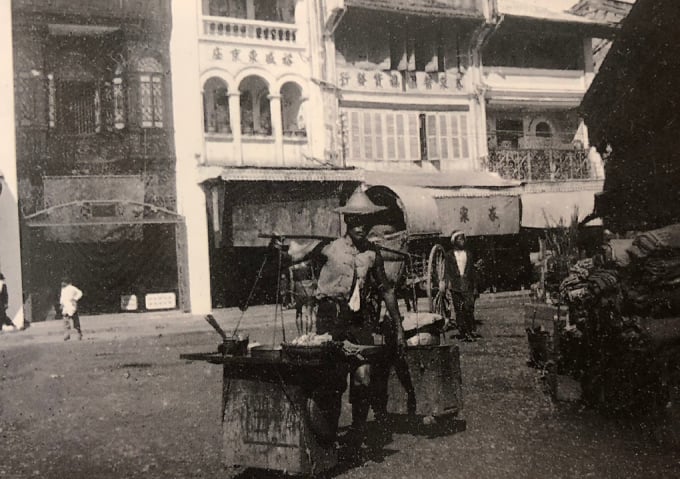
A photograph of a street vendor selling pho in Hanoi was displayed at the "Street Vendors" event – an art exhibition organized by the French Institute in Vietnam and the French School of Far Eastern Studies (EFEO) in late 2022 in Ho Chi Minh City. The photograph was taken before 1950. Photo: EFEO
However, the researcher argues that Hanoi is the cradle of pho's development because its market is more abundant than that of Nam Dinh. Despite a large customer base from the Nam Dinh textile factory, pho remains a luxury in rural Vietnam, where street food consumption is not common. These are the conclusions the researcher reached after a research trip to Nam Dinh and a conversation with an elderly person in Van Cu village.
"In Van Cu village, the Co family has the largest number of people selling pho, estimated at around 75% of the population who left farming to sell pho. Gradually, other families also started selling pho, and Hanoi is the most prosperous place for this profession," Mr. Dung told VnExpress.
Researchers suggest that there are characteristics of traditional pho that are difficult for the current generation to appreciate. Throughout the war, Hanoians were repeatedly evacuated to rural areas. Upon their return, they had become somewhat "ruralized," their eating habits more unrefined, and they no longer retained the refined elegance of old Hanoians. Social changes over different periods have also directly affected traditional pho.
Mr. Dung stated that the most noticeable sign of the decline of traditional pho is the simple, narrow-bottomed bowl from Bat Trang pottery village or many other traditional pottery workshops. This type of bowl has a flared rim and a narrow base. The gradually decreasing surface area helps keep the broth hot until the last spoonful. The bowl's capacity is small, not as large as modern pho bowls, because people in Hanoi in the past considered pho as a light snack, not a filling meal.
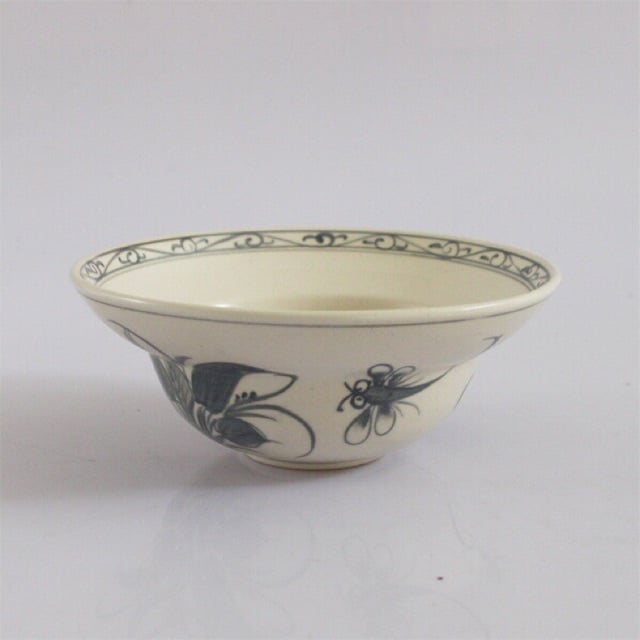
An antique-style porcelain bowl. Photo: Huonggombattrang
"Pho, as a substitute for rice, appeared later when life gradually became more informal and social changes disrupted many of the quintessential aspects of Hanoi's culture," Mr. Dung said.
According to researchers, people in Hanoi in the past had very sophisticated tastes when enjoying pho. Many would bring lime from home to pho restaurants, believing it would make the dish tastier than the lime served elsewhere. In the book "One Hundred Years of Vietnamese Pho," author Trinh Quang Dung writes that the most discerning pho connoisseurs in Hanoi must try the restaurant's signature broth. This broth isn't cow's blood, but rather the concentrated stock of simmered beef bones and marrow, which is "very sweet and rich."
Mr. Dung said that in the past, pho noodles had to be wide, almost the size of a man's little finger. The wide noodles could absorb more broth, so just by tasting the noodles, one could clearly feel the sweetness of the broth. When eating, people would pick up the noodles, a thin slice of meat, and add a little broth to the spoon. They would then eat each small, delicate bite with ease and grace.
Mr. Dung said that delicious pho must be eaten hot. Therefore, the temperature of the air conditioner has diminished the taste of the pho. When researching old documents, the scholar noted that the late writer Nguyen Tuan had repeatedly affirmed this.
"The hotter the pho, the better it tastes because it's not tainted by the greasy taste of beef fat," Mr. Dung said.
One of the "quintessence" of traditional Hanoi pho that has now disappeared is the mobile pho carts. These carts never prepared two bowls at a time; they only started preparing the noodles and slicing the meat when a customer ordered, unlike now where the meat is pre-sliced "very industrially." The pho was always piping hot, incredibly refreshing to eat, he said.
What Mr. Dung dislikes are the versions of pho that are touted as "high-end," using imported beef and a host of luxurious ingredients, making each bowl cost millions of dong. According to him, that can't be called pho; it's more like "selling meat" or "selling mushrooms." In his book, Mr. Trinh Quang Dung also mentions the ambiance for enjoying pho. According to the author, pho should be eaten in a casual setting, rather than a "fancy, 5-star, or 6-star" restaurant.
"For pho to be delicious, you need the right context. You have to eat pho right at the restaurant, and a dirty restaurant at that, is even better," the author quotes journalist Pham Chu in an article in Chinh Luan (a Saigon newspaper before 1975). However, Mr. Dung also adds that this is probably only true in the old days. Nowadays, if an author wrote like that, they would be heavily criticized.
However, Mr. Dung said that in reality, pho lovers in Hanoi don't pay much attention to the appearance or decor of the restaurant, but are more concerned with the quality of the pho. Old-fashioned restaurants like Thin Bo Ho and Tu Lun, despite not having "big buildings and gleaming tables and chairs," still attract customers. In particular, pho restaurants originating from Nam Dinh in Hanoi and other places often have a rustic, sometimes messy, style. Mr. Dung confirmed this when he spoke with Mr. Co Nhu Hung, former chairman of the association of pho restaurant owners from Thanh Nam. Meanwhile, the trend of "air-conditioned pho," imported from Ho Chi Minh City, is not well-received in Hanoi.
Mr. Dung also believes that one of the factors causing traditional pho to no longer be the same as before is the use of MSG and sugar to create sweetness. This was characteristic of pho during the subsidy period when the economy was difficult and people had to tighten their belts.
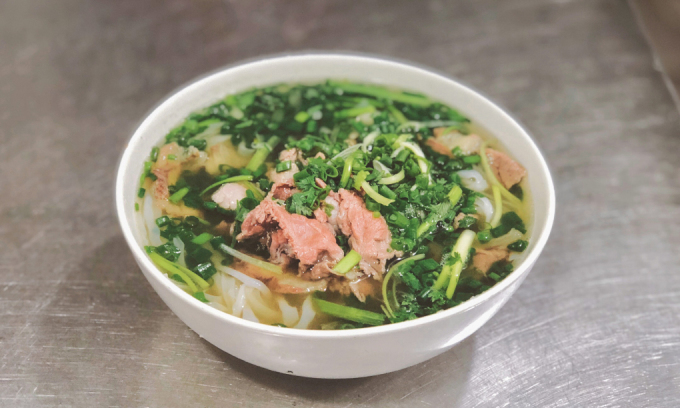
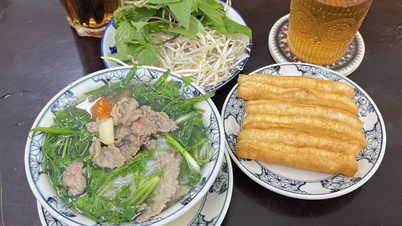
This photo of a bowl of pho was taken in August 2023 at a restaurant in Dong Da district, Hanoi – where customers still queue up like in the old days. Photo: Quynh Mai
"There's a shortage of meat and bones; where would we get them from? Therefore, when cooking pho, the only option is to rely on the savior, MSG," wrote Trinh Quang Dung in his book about pho.
However, back then, MSG was also very precious and not readily available. In 1979, a regular bowl of pho cost a few hundred dong, but a special bowl with added MSG cost up to 1,000 dong. This is understandable because during the subsidy period, Hanoi once had a type of "meatless pho," meaning pho without meat, consisting only of boiling water and MSG, served with rice noodles.
The subsidy period significantly influenced the way people in Hanoi used to eat pho. According to scholars, besides MSG, this period of scarcity created variations such as leftover rice served with pho, and pho with bread – which Mr. Dung calls "mixed pho." This type of pho was popular because people were always hungry. Therefore, it remained a "delicacy" compared to the "fist-shaped" or "pitcher lid" cakes – cakes made from wheat flour, shaped like fists or flattened like pitcher lids. This style of eating has gradually disappeared, but one version that is still "preserved and promoted" is pho with fried dough sticks.
"Those who appreciate pho would never approve of a chaotic eating style that detracts from the noble flavor of the dish they have always revered as a royal deity," commented Trinh Quang Dung in his book "One Hundred Years of Vietnamese Pho."
According to Mr. Dung, state-run pho restaurants during the subsidy period were a sign of the "ruralization" of old Hanoi residents after their evacuation to the countryside to escape American bombing. When eating state-run pho, customers had to serve themselves and queue for bowls. The staff didn't pay much attention to customers. At that time, state-run pho restaurants didn't have napkins – considered a luxury item for the "petty bourgeoisie." Many customers would finish their meal by simply wiping their mouths with their chopsticks, like they would at a feast in the countryside.

Mr. Trinh Quang Dung, photo taken in May 2023. Photo: Provided by the interviewee.
Mr. Dung said he would not eat at traditional restaurants that require customers to queue and serve themselves, no matter how delicious the pho is. He believes that people in Hanoi traditionally had refined eating habits and didn't bother queuing to eat. However, he also emphasized that this is a matter of personal preference and therefore he wouldn't judge.
Society has changed, and the old generation of Hanoians like Mr. Dung are gradually disappearing. The traditional bowl of pho, the refined way of eating from a bygone era, is "a beautiful past that young people, even if they hear stories about it, will find hard to understand," he said.
Tu Nguyen
Source link





















































































Comment (0)