

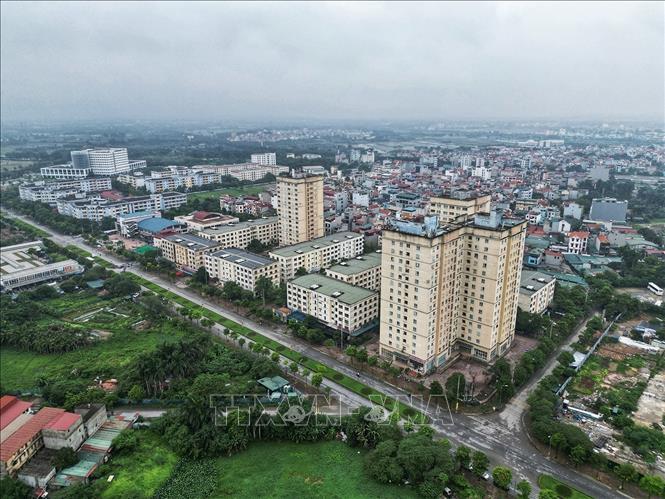
In the context of housing prices increasing much faster than income, especially in large cities, the establishment of the fund is expected to open new doors to help millions of people get closer to their dream of owning a home.
Housing prices in Hanoi and Ho Chi Minh City have increased 2-3 times in a decade, while the income of the majority of people has not increased proportionally. Many young workers said that their savings after many years of working are still not enough to put down a deposit to buy a 50-60 square meter apartment.
Ms. Minh Phuong, a civil servant in Hanoi, commented that the “thirst” for housing is not only a story of low-income people. Even people with average incomes now have difficulty accessing commercial housing because the prices are beyond their reach. Without public financial intervention, the market will continue to be deeply divided.
Not only home buyers are under pressure, the rental market in big cities is also heating up as workers flock to find jobs. Prices for rented rooms and mini apartments have increased sharply since the COVID-19 pandemic, directly affecting the lives of workers - the core force maintaining urban service production activities.
In that context, the birth of Decree 302 attracted great attention, creating a legal framework for a national-scale housing fund. Mr. Ha Quang Hung - Deputy Director of the Department of Housing and Real Estate Market Management ( Ministry of Construction ) said that the National Housing Fund has the function of mobilizing, managing and investing long-term in the development of social housing, housing for officials, civil servants, public employees and workers, to ensure stable and sustainable financial resources for social security goals.
The National Housing Fund will supplement the supply of rental housing with the aim of saving land resources, many people can use this housing fund in rotation. Thereby, ensuring to solve the need for stable, long-term housing for those who cannot afford to buy social housing.
At the same time, this Fund will promote the development of social housing, while balancing supply and demand, adjusting the structure of real estate goods, thereby reducing the cost of the commercial housing segment, helping the real estate market develop more stably and healthily - Mr. Hung analyzed.
Lawyer Thu Ha (Hanoi Bar Association) commented that the social housing rental model is considered an effective solution thanks to reasonable costs while still ensuring quality of life. The establishment of the National Housing Fund at this time has strategic significance, both reducing pressure on the real estate market and expanding housing opportunities for people, while supporting the goal of building at least 1 million social housing units.
The establishment of the National Housing Fund not only helps increase housing supply but also represents an important shift in the way the State performs its role. Instead of just stopping at issuing policies, the State has begun to directly participate in the process of creating supply.
According to experts, for many years, housing has been mainly considered a market commodity, but Decree 302 brings housing closer to the concept of social welfare, similar to education and health care. This is an orientation suitable for countries with rapid urbanization.
Many previous social housing programs, although having the right goals, lacked sustainable resources. The biggest problem was capital. Commercial banks were not interested in low-interest loans, and the state budget was not enough to maintain them continuously. Now, the National Housing Fund hopes to be able to "fill" this gap.
When the Fund operates with large charter capital and a clear disbursement mechanism, businesses will be motivated to participate in affordable housing projects instead of focusing only on the high-end segment - many experts commented in common.
Some businesses said they would consider expanding their social housing portfolio if they could access long-term preferential capital from the National Housing Fund. Only when financial costs are reduced can businesses lower their selling prices while still ensuring efficiency.
From the perspective of the people, Ms. Hoang Ha - an office worker in Hanoi said, if there is a 25-year loan package with a stable interest rate of 5-6%, the family will consider buying a small apartment within the next few years.
Experts say Decree 302 is not a “magic wand” but is the foundation for Vietnam to build a more sustainable housing model. As urbanization continues to increase and the young workforce remains the key force of the economy, ensuring housing opportunities for all people is a key factor for stable development.
The key lies in implementation. If operated transparently, on target and coordinated synchronously between the Central - local - enterprises, the National Housing Fund can completely become a fundamental tool to solve the "thirst" for housing that has lasted for many years.
According to Decree 302 of the Government, the National Housing Fund will invest in building social housing and infrastructure for rent. The Fund receives and converts the function of public-owned housing; is allowed to buy, order or receive housing transfers from 100% state-owned enterprises.
In addition, the Fund can also receive resettlement and temporary housing and voluntary contributions, or purchase commercial housing for rent to civil servants, public employees and workers.
Source: https://baotintuc.vn/bat-dong-san/quy-nha-o-quoc-gia-giai-phap-can-co-cho-con-khatan-cu-20251204184331166.htm


![[Photo] Cat Ba - Green island paradise](/_next/image?url=https%3A%2F%2Fvphoto.vietnam.vn%2Fthumb%2F1200x675%2Fvietnam%2Fresource%2FIMAGE%2F2025%2F12%2F04%2F1764821844074_ndo_br_1-dcbthienduongxanh638-jpg.webp&w=3840&q=75)





















































![[VIMC 40 days of lightning speed] Da Nang Port: Unity - Lightning speed - Breakthrough to the finish line](https://vphoto.vietnam.vn/thumb/402x226/vietnam/resource/IMAGE/2025/12/04/1764833540882_cdn_4-12-25.jpeg)
















































Comment (0)