"Sincerity and trust" are the most important assets of the Vietnam-Japan relationship. This is what Prime Minister Pham Minh Chinh emphasized throughout his four-day working visit to Japan.
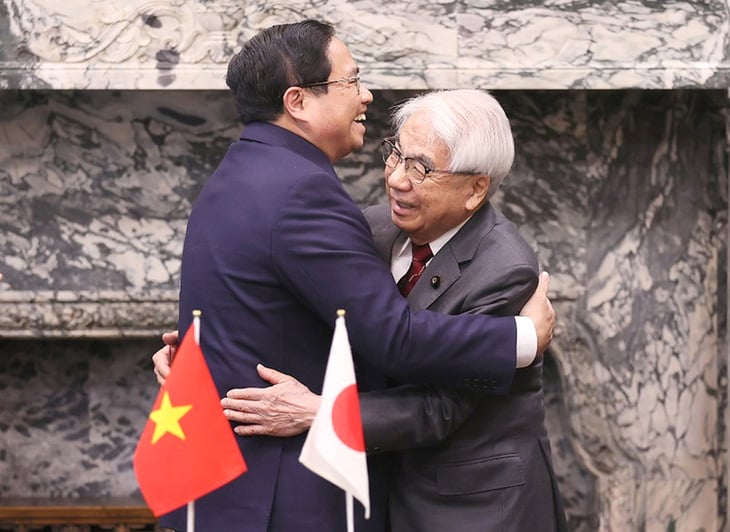
Prime Minister Pham Minh Chinh and President of the Japanese Senate Otsuji Hidehisa embraced upon meeting - Photo: VNA
Perhaps that is why, in addition to activities at the Summit to celebrate the 50th anniversary of ASEAN - Japan relations, talks with Prime Minister Kishida Fumio, meetings with the king and politicians, he spent a lot of time meeting organizations, individuals and old friends.
I've met many former Japanese prime ministers.
Before heading to Hanoi on the afternoon of December 18th, Prime Minister Pham Minh Chinh visited the family of the late Prime Minister Abe Shinzo and met with Mrs. Abe Akie. During his lifetime, Mr. Abe paid special attention to fostering friendly relations between Vietnam and Japan. In January 2017, Mr. Abe stated in Hanoi: "The majestic Red River flows through Hanoi towards the East Sea and then connects to Tokyo Bay. Japan and Vietnam are two countries bound together by a free sea." Earlier, meeting with former Prime Minister Suga Yoshihide, the head of the Vietnamese government recalled the assistance that Mr. Suga personally and the Japanese government had given to Vietnam, helping Vietnamese people living and working in Japan during the period when the world was isolated by the COVID-19 pandemic, and providing 7.4 million doses of vaccine as non-refundable aid. During his meeting with former Prime Minister Yasuo Fukuda, Prime Minister Pham Minh Chinh expressed his admiration for the "heart-to-heart" doctrine put forth by Prime Minister Fukuda Takeo (father of former Prime Minister Fukuda) in 1977, which laid the foundation for the strong development of relations between Japan and ASEAN, including Vietnam-Japan relations. Vietnam's Japanese friends were delighted and hopeful for the immense potential for future cooperation, especially after the two countries announced the upgrading of their relationship to a Comprehensive Strategic Partnership last November. Thanking the valuable sentiments of his good friends towards Vietnam, Prime Minister Pham Minh Chinh summarized the 50-year journey of Vietnam-Japan relations with the word "more": deeper affection; more clearly felt sincerity; higher trust; more effective and substantive cooperation; increasingly broader scope and scale of cooperation; and a greater understanding and appreciation of each other.
When receiving the Chairman of the Japan-Vietnam Parliamentary Friendship Alliance, Nikai Toshihiro, and key members of the alliance's leadership, the Prime Minister emphasized that sincerity, trust, and affection are the most important assets in the relationship between the two countries.
We request Japan to provide a new generation of ODA.
Sincerity and trust are essential to bring us closer together, with the ultimate goal of bringing more material and spiritual benefits to the people of both countries, so that both nations can develop and prosper. With that in mind, during working sessions with Japanese politicians, investors, and donors, Prime Minister Pham Minh Chinh frankly requested that the Japanese provide ODA to Vietnam with "more favorable terms, simpler procedures, and faster implementation."
Without shying away from mentioning some specific cooperation projects that still have outstanding issues between the two countries, the Prime Minister affirmed that he would direct relevant agencies to actively coordinate with partners to resolve them definitively, such as the restructuring of the Nghi Son Refinery and Petrochemical Plant project to reduce losses, and the determination to implement the O Mon gas project in Block B... Regarding the request from the President of the Japan International Cooperation Agency (JICA), Tanaka Akihiko, to expedite the disbursement of the fourth loan for the Ho Chi Minh City urban railway project, Ben Thanh - Suoi Tien section (the Japanese Government provided the fourth loan of approximately 7,000 billion VND), the Prime Minister agreed and promised to direct it immediately. "For the old projects, I will ask the leaders of ministries and agencies to coordinate with JICA to resolve the remaining issues. We will learn from experience to implement new generation ODA projects more quickly and effectively," he emphasized. Regarding prospects for economic cooperation, in meetings with leaders of Japanese corporations and partners, the Prime Minister urged Japanese investors to invest more strongly in Vietnam in new technologies, semiconductor industry, chip manufacturing, digital transformation, green transformation, environmental technology, hydrogen, etc., especially in technology transfer to Vietnam. "I look forward to your actions," he urged the investors.
The pattern of geese flying gradually changed.
Speaking to Tuoi Tre newspaper, researchers Yessi Vadila and Lili Yan Ing (ASEAN and East Asia Economic Research Institute) noted that at the ASEAN-Japan Summit, both sides reaffirmed their commitment to a multilateral trading system, avoiding divisive unilateral actions and strengthening regional trade and investment for shared prosperity. "The relationship between ASEAN and Japan has moved beyond the 'flying geese' model, highlighting mutual influence and shared development, emphasizing a future of interconnectedness and progress," the researchers stated. The 'flying geese' model was often used in the past to describe Japan's leading role. But now it is gradually changing, as evidenced by Prime Minister Kishida Fumio's emphasis on the phrase "co-creation" between Japan and ASEAN, highlighting equality in the relationship. On the sidelines of the first Asian Zero Emission Community (AZEC) Summit, Japanese and ASEAN companies also agreed on a series of deals focused on decarbonization, highlighting the need to mobilize private resources to achieve net-zero emissions in Asia. This process, according to Prime Minister Kishida Fumio, requires at least $28 trillion.





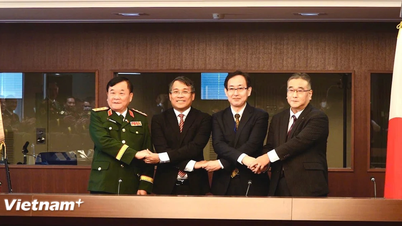

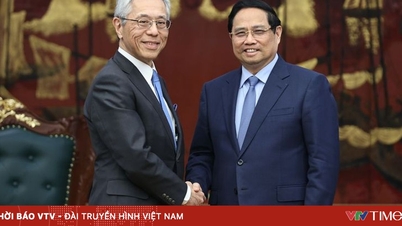

![[Photo] Prime Minister Pham Minh Chinh receives Governor of Gunma Prefecture (Japan) and Special Advisor to the Japan-Vietnam Friendship Parliamentary Alliance](https://vphoto.vietnam.vn/thumb/402x226/vietnam/resource/IMAGE/2025/11/25/1764066321008_dsc-1312-jpg.webp)

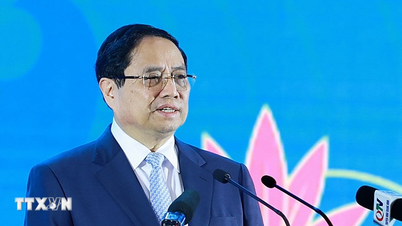
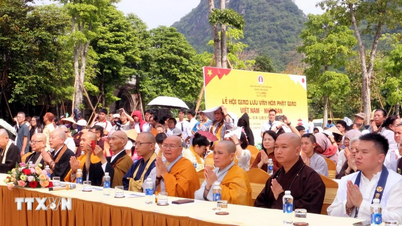
![[Photo] Prime Minister Pham Minh Chinh receives the Chairman of the Japan-Vietnam Friendship Association in the Kansai region](https://vphoto.vietnam.vn/thumb/402x226/vietnam/resource/IMAGE/2025/11/03/1762176259003_ndo_br_dsc-9224-jpg.webp)



























































Comment (0)