

Around Hudson Bay in Canada, scientists have discovered that everything is lighter than anywhere else.
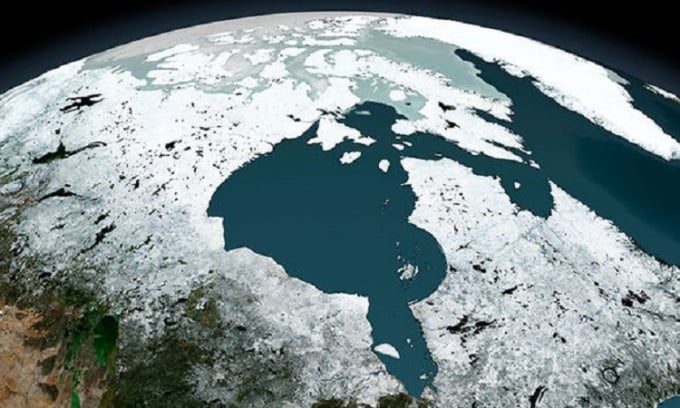
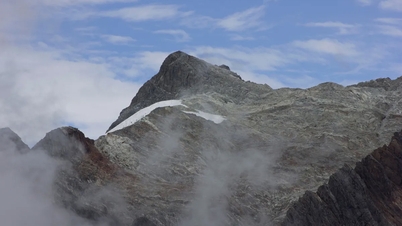
Hudson Bay in Canada. Photo: Express
In the nearly 1.3 million square kilometer bay area, you lose about 1/25,000 of your body weight. Researchers first discovered this anomaly in the 1960s when mapping discrepancies in Earth's gravitational field. But it took them decades to figure out the cause, according to the Mail.
Normally, you weigh 68.0389 kg. Near Hudson Bay, your weight would be around 68.0361 kg. The answer to this mystery begins with the fact that the gravitational force any object exerts on another object is proportional to its mass. Researchers used NASA's Gravity Recovery and Climate Experiment (GRACE) satellites to map two gravity anomalies around Canada's Great Bay in 2007 and examine how they changed over time. The Canadian gravity anomaly has been known for a long time and is the result of deformation of the Earth's crust during the last Ice Age, according to physicist Dan Britt, director of the Center for Lunar and Asteroid Surface Science at the University of Central Florida.
Approximately 20,000 years ago, Canada and much of North America lay beneath the Laurentide ice sheet, a vast glacier about 3.2 kilometers thick in the area near Hudson Bay. This ice sheet was heavy enough to compress the Earth's crust. A similar process occurred in many other places with thick ice sheets. The details of this process relate to the viscosity of the mantle.
Under the weight of the Laurentide ice sheet, the Earth's crust around Hudson Bay began to compress and sink. In the process, it pushed away some of the hot magma in the semi-liquid mantle beneath. The compression was strongest on both sides of Hudson Bay, where two giant domes formed on the ice sheet. The gradual shrinking of Laurentide over the next 10,000 years created many of the landscapes in North America, including the Great Lakes region. Some theories predict that the displacement of the molten magma reduced Earth's gravitational pull around Hudson Bay, but NASA's GRACE satellite indicates that this is only part of the reason. The Laurentide ice sheet theory and GRACE data only explain about 25-45% of the gravitational difference. Scientists estimate that the remaining 55-75% is related to the convection theory.
Beneath the Earth's surface, a band of molten rock called magma creates convection currents due to the natural rising and sinking of the bubbling material. This process pulls Earth's tectonic plates inward, causing a decrease in mass and the gravitational pull of the Hudson Bay region. Researchers predict that gravity will gradually increase again in Canada. Geophysicist Mark Tamisiea at the Harvard-Smithsonian Center for Astrophysics in Cambridge, Massachusetts, predicts it will take about 300,000 years for the region's gravity to equal the global average.
An Khang (According to Mail)
Source link










































































Comment (0)